Executive Summary
The processing of gold and silver ores requires careful characterization of both gold and silver mineral deportment, respectively. Gold is mostly present as native gold or as electrum (a gold-silver alloy). Gold can be associated with either value or gangue minerals and be present in a wide range of grain sizes from nuggets down to colloidal species and thus requires systematic diagnostic testing in order to design a proper strategy for its recovery. What further complicates the processing of gold ores is the presence of carbonaceous matter and/or of certain sulfides which can negatively impact cyanidation. One nowadays has access to both traditional and more modern diagnostic and analytical tools to properly characterize these ore types.
In like manner, silver can be present in many forms and contained in- or associated with both value and gangue minerals. By contrast to gold, however, what complicates recovery of silver is the fact that it is present in many more minerals in a given ore deposit and thus understanding what is recoverable is key. Furthermore, the chemistry of silver itself often leads to dissolution and reprecipitation processes which impacts flotation recovery and contributes to the complex nature of silver ore characterization. The following is a discussion of the nature of these ore types, their characterization, as well as processing approaches and the products Syensqo recommends for their recovery by flotation.
General Comments / Major Considerations
Gold Ores
Gold in gold-containing ores is found in many forms, the most important of which are native (or metallic) gold and intermetallic gold-silver alloys such as electrum. To a lesser extent, it can also be found in the form of gold tellurides and gold-silver tellurides as in calaverite (AuTe2), krennerite ((Au,Ag)Te2), sylvanite (AgAuTe4) and petzite (Ag3AuTe2), although, in particular ores, these can account for a significant amount of the gold present4. Gold particles can span a range of sizes: from large nuggets, to small grains (down to 0.1 𝛍m) intimately associated with base metal sulfides such as copper sulfides, iron sulfides, arsenic sulfides (arsenopyrite, enargite) and arsenic-containing sulfides (e.g. arsenian pyrite); down to so-called “invisible gold” sizes: like colloidal particles of 10 nm to 0.1 𝛍m in size surface-bound, within minerals, or in solid solution within sulfide crystal lattices. Finally, gold can also be hosted in non-sulfide minerals such as quartz, carbonates, silicates and carbonaceous matter typically as “invisible gold”. All minerals in the ore that are associated with gold are commonly referred to as gold carrier minerals3. Table 1 summarizes the occurrence of Au based on size as described.
Table 1. Form of Au found in Au-containing ores based on size.
| Form | Microscopic Au | Submicroscopic Au | Surface-bound Au* |
| Nature | Visible under microscope | Invisible under microscope | Invisible under microscope |
| Carrier Minerals | All Au minerals:
| Occurring with/within:
| Occurs on:
|
*surface-bound Au not often encountered in ores processed by flotation.
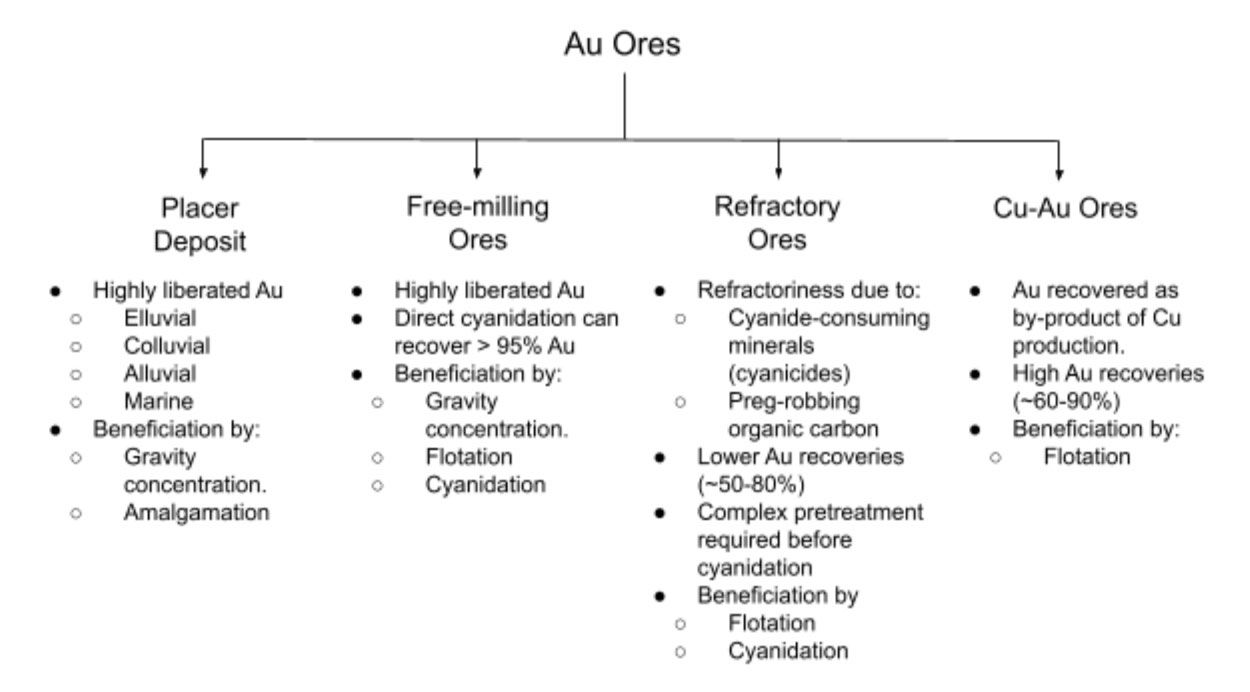
Treatment methods for the recovery of gold from gold-bearing ores depend on various factors, such as the mode of occurrence of the gold and associated minerals, and the grade of gold in the ore. For example, there is gold in what are called “placer deposits” in which gold has naturally separated from rock minerals during geological sedimentation processes and has collected along the path of rivers. This natural process leads to the separation of gold by gravity from other minerals. Gold particles can exist in a wide range of sizes from tens of microns to millimeters in size and are almost entirely liberated. Placer gold is thus separated by gravity concentration (gravity concentrators, tables, jigs) or amalgamation. Ores in which gold is associated with mostly non-sulfide gangue minerals and is readily recoverable by gravity methods, flotation or cyanidation, are generally referred to as “free-milling” ores, gold recovery in these ores is often upwards of 95%. The choice of treatment method for such ores depends upon a) the grade of the gold in the ore, b) the recoveries obtained by each method, c) possible environmental constraints, and d) overall process economics. If flotation is carried out for upgrading, a strong sulfide collector is normally used, sometimes in conjunction with a secondary collector. Ores in which little of the gold is associated with sulfide minerals can often be treated by direct cyanidation of the whole ore. In many cases, however, results are unsatisfactory, due to the adverse effect of the sulfide minerals on both cyanide consumption and gold recovery (as discussed later for refractory ores). In this case, the gold is separated from the sulfide minerals by flotation, in which the sulfide minerals are depressed at pH > 11 with lime and any free gold is floated off in the concentrate. The concentrate is then treated by cyanidation.
It is interesting to note that pure metallic gold does not readily adsorb any known sulfide collector as we have reported previously10, 11. However, if gold is alloyed with just a small percentage of silver, adsorption is enhanced. Fortunately, almost all naturally-occurring gold does contain silver, usually in the range of 5 to 10% which is sufficient for good collector adsorption and flotation (unless the gold surface is heavily tarnished).
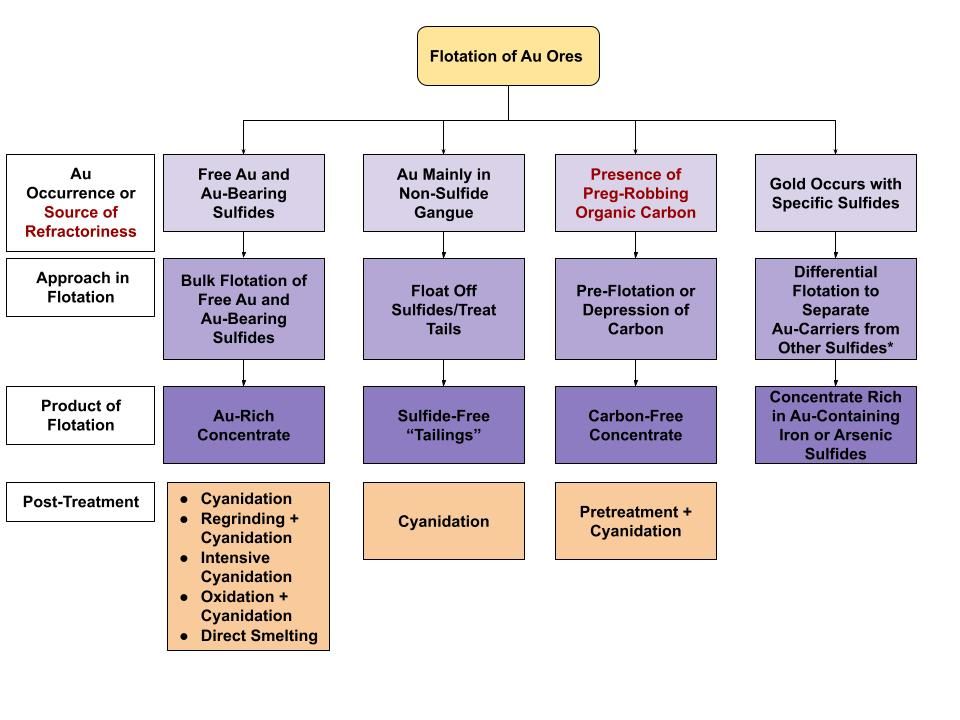
Gold can also be found in deposits which contain significant amounts of sulfide minerals, particularly the iron sulfides pyrite-marcasite, pyrrhotite and arsenopyrite. These are termed “refractory” gold ores. The treatment method for these ores depends on whether or not significant amounts of the gold are associated by intimate physical locking with-, or in solid-solution within the iron sulfide and/or arsenic sulfide minerals. When there is a significant amount of the gold intimately locked with the iron sulfides or in solid solution within the same, the sulfides must be floated together with any free gold (free gold is used interchangeably with liberated gold), prior to further treatment of the flotation concentrate. The flotation concentrate is then generally subjected to oxidation (e.g. by roasting, bio-oxidation or autoclaving) prior to cyanidation to recover the gold. Roasting is favored whenever there is a great amount of carbonaceous matter in the ore for which the other processes are not effective. Carbonaceous matter can interfere with gold extraction by cyanidation through a process termed preg-robbing, i.e. adsorption of gold cyanide from pregnant cyanidized solutions (ores refractory to cyanidation due to sulfides and carbonaceous matter are often called “double refractory” ores). As mentioned previously, presence of pyrrhotite, marcasite and even secondary copper minerals like chalcocite, bornite, etc. can also render an ore refractory to cyanidation; these minerals are often referred to as cyanicides given that they consume cyanide therefore interfering with efficient extraction of gold. Lastly, gold telluride and related minerals do not dissolve in cyanide below pH 12 and thus their presence and quantity should be properly determined in advance. In some cases the flotation tailings contain sufficient gold for them to also be treated by cyanidation. Figure 1 shows a flowchart of how refractory gold ores are processed by flotation and subsequent cyanidation (where applicable) depending on the occurrence of gold; it is clear that mineralogy and metallurgical objectives of the plant will dictate flotation.

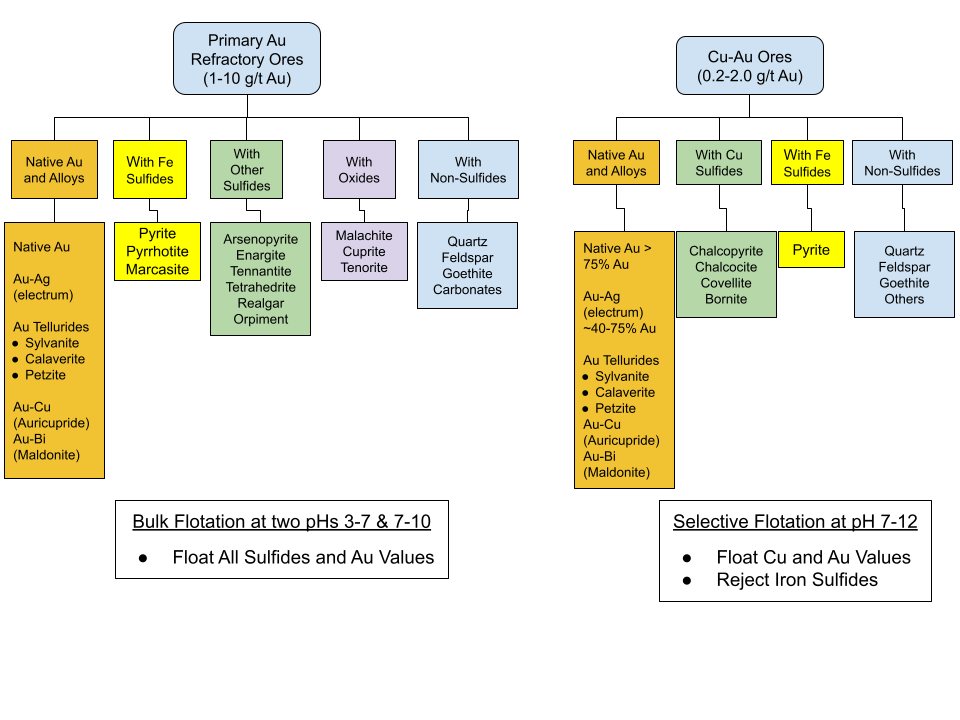
To conclude, Figure 3 summarizes the nature of all Au ore deposits discussed above and their characteristics.
Technical Note. Characterization of Gold and Copper-Gold Ores
(Based on methodology put forth in Chryssoulis and Cabri, 1990)
Effective processing of gold and copper-gold ores requires proper and systematic characterization of the ore(s) to be treated. This is especially true in the case of refractory (or double-refractory) gold ores in which the objective is to:
- Identify the gold-carrier minerals
- Determine what amount of gold from the bulk assay is contained within each of the minerals
- Rank said minerals based on their amenability to processing options; and
- Determine the nature of minerals that are detrimental to the process such as cyanicides, preg-robbing carbonaceous matter, etc. to decide on how they are managed.
A first step is to obtain a bulk gold chemical assay, which can be ordered from a commercial or industrial metallurgical lab and is carried out through a fire assay method in which collection and cupellation processes are performed to isolate the gold (and other precious metals) followed by detection through atomic absorption (AA), inductive coupled plasma - atomic emission spectrometry (ICP-AES), or inductive coupled plasma - mass spectrometry (ICP-MS). In addition to gold, assays for Ag, As, S, Te, Bi, Sb and for organic and graphitic carbon (TOC-total organic carbon) should also be obtained. Te, Bi, and Sb assays when combined with mineralogy information of major ore minerals can affirm the presence of gold telluride, gold-bismuth and gold-antimony minerals, respectively. As and S assays are used to determine the concentration of minerals that are known to carry gold in the submicroscopic size ranges, namely, arsenopyrite and pyrite.
A mineralogical study should also be done to characterize both the “visible” and “invisible” size classes of gold. The total amount of “visible” gold can be determined in stages as follows8: First, a sample is ground and a separation of gravity-separable gold is done by use of Mozley-type tables, centrifugal gravity concentrator or hand-panning, the concentrate of which is fire-assayed for gold, this is considered non-refractory gold; the tailings are subjected to cyanidation and a portion of the leach residue assayed for gold. The remaining residue of the first step is then reacted with hydrochloric acid to dissolve labile sulfides such as pyrrhotite and liberate any associated gold, the residue is then subjected to cyanidation and a portion is assayed for gold. The remaining residue from the previous step is then reacted with hot sulfuric acid to dissolve acid-soluble minerals such as sphalerite, reactive pyrite and labile Cu sulfides, thus liberating locked gold associated with these. Again, a sample of the residue is subjected to cyanidation and assayed for gold. The remaining residue is then contacted with hot nitric acid to dissolve any other, more resistant sulfides, followed by cyanidation of part of the residue. Finally, given the potential of preg-robbing carbon being present (as suggested by TOC or otherwise), the remaining residue is roasted, subjected to cyanide leaching and part of the residue assayed for gold. Any remaining gold at this stage is most probably locked in silicates and/or in fine sulfides occluded by silicates. If no cyanicides or preg-robbing carbon are present, but tellurides are suggested, visible gold can be estimated by direct cyanidation of pulverized samples (weight of sample = 500 g, K80 of -10 𝛍m), first at pH 10.5-11 for native gold and electrum and then at pH >12 for dissolution of tellurides; the increase in assay upon increase in pH is a good estimate of the gold telluride content. This yields the amount of cyanidable gold.
Mineral associations and gold size distribution in the visible class (i.e. down to 1.5 𝛍m) can be determined by reflected-light microscopy (of 800X magnification) or better yet by SEM-EDX with automated image analysis. In microanalytical techniques such as, for example, SEM or QEMSCAN, care should be taken to analyze the right number of polished mounts based on grain size and gold assay for good statistical representation (see Butcher et al. on how to deal with the so-called “nugget effect” in sampling). Another similar technique currently available for detailed mineralogical analysis is the Tescan Integrated Mineral Analyzer (TIMA-X) offered by some commercial laboratories. The invisible gold fraction has to be determined by ion probe, more specifically, by secondary ion mass spectrometry (SIMS), which is offered by some commercial labs and which can detect sizes down to the tens of nanometers, appropriate for colloidal gold detection. For insulating minerals such as quartz, however, SIMS is less appropriate and techniques such as proton-induced X-ray emission (PIXE) can be used instead. Both of these techniques have detection limits in the tenths of ppm level. By contrast, electron microscopy has a detection limit of around 200 ppm for gold in pyrite with sizes only down to about 0.1 𝛍m and thus hidden submicroscopic gold inclusions of 20 nm - 0.1 𝛍m are not observable. In this manner, the systematic determination of gold deportment and its balance within a given ore allows for a rational approach to processing of said ore for optimum recovery and grade of gold concentrates.
For an example of the use of traditional chemical gold assays together with quantitative X-ray diffraction (QXRD) and/or QEMSCAN in a Cu-Au application see Agorhom et al., 2012 and Goodall, 2008. For use of SIMS in gold characterization of a Cu porphyry ore as well as an informative definition of gold-rich Cu porphyry ores see Kesler et al., 2002.
Silver Ores
Most of the silver recovered commercially is associated with the base metal sulfide ores of copper, lead, lead-zinc and copper-lead-zinc ores. Silver occurrence ranges from a minor to a major constituent in these ore types. In general, the silver tends to concentrate with the copper and lead sulfides in these types of ores. Silver also occurs in association with sphalerite, arsenopyrite, and even with pyrite. In the latter case, depending on the silver content of the pyrite, a pyrite concentrate may be produced from the base metal circuit tailings, which can be treated by roasting and cyanidation for silver recovery. Silver sulfides and silver-antimony-arsenic sulfides such as argentite, polybasite, proustite, pyrargyrite, stephanite, and tetrahedrite respond best to flotation in a natural circuit. Regulating agents, such as sodium sulfide, lime, caustic soda, and starch tend to depress the silver minerals.
When the silver ore contains only minor amounts of base metal sulfides, bulk flotation of all sulfides is usually the best practice for maximum silver recovery. If silver-bearing zinc sulfides, arsenopyrite, pyrrhotite and pyrite are present, copper sulfate will usually be required to activate these minerals, prior to collector addition. If, on the other hand, these sulfide minerals do not contain silver then careful use of lime may be required to depress the same sulfides and consequently to prevent concentrate dilution.
With partially oxidized silver-bearing ores, cyanidation of flotation tailings for silver and gold recovery may be economically justified. In addition, sulfidization prior to flotation is commonly practiced, when the silver values are associated with oxide minerals such as cerrusite, malachite cuprite and cerargyrite.
It is worth noting that silver mineralogy is more complex than that of gold and, in addition, silver-bearing minerals tend to be more numerous than that of gold, where in a given deposit, gold may be present in one to two minerals whereas silver may be present in at least five5. Silver minerals are also in general more unstable than those of gold as well, mainly due to the chemistry of silver. For example, due to changing environment conditions, some silver minerals may undergo dissolution and reprecipitation onto gangue minerals, which can lead to unsuccessful flotation or overestimated recovery results 9, 5. Dissolution of silver minerals can also lead to the formation of impermeable coatings that preclude deliberate silver dissolution in processing the mineral or negatively impact the floatability of the minerals.
Challenges Faced
Gold Ores
The following are some of the challenges faced by plants in flotation of coarse gold particles:
- Changing mineralogy between ore types/zones and concomitant change in deportment of gold among the present minerals.
- Lack of an effective strategy/flowsheet based on mineralogy to maximize gold recoveries and/or grades. For example, processing ores containing free gold as if gold were associated with a massive sulfide or complex sulfide matrix leading to poor selectivity and thus poor upgrading of concentrates4.
- Presence of cyanicides such as pyrrhotite, marcasite and secondary copper minerals which consume cyanide and thus interfere with the cyanidation step.
- Presence of carbonaceous matter that absorbs auriferous cyanide from pregnant leach solutions.
- Variability of the nature and morphology of carbonaceous matter as well as challenges in its proper characterization.
- Presence of carbonate minerals, clays and altered silicates which lead to slime coating of values, high pulp viscosities and large consumption of reagents, thus impacting concentrate recovery and grade.
- Very fine grain sized gold that does not become exposed or liberated at the normal grind sizes.
- Presence of “invisible” gold in solid solution with gangue leading to its poor recovery during cyanidation when not properly diagnosed.
Silver Ores
- The deportment of silver in a larger number of minerals as compared to gold makes its recovery in general more challenging.
- The instability of silver minerals often leads to dissolution-reprecipitation onto gangue minerals making part of its recovery impossible or leading to its (recovery) overestimation.
- The lower market value of silver as compared to gold limits the lower grade of ores that can be exploited as well as what expensive techniques can be used towards recovery of silver as occluded fines in gangue, for example.
Traditional Strategies / Syensqo Recommendations
Gold Ores
In free-milling ores, when flotation is used for upgrading prior to cyanidation, the common collector choice is a strong xanthate such as potassium amyl xanthate. The use of a secondary collector such as AERO® 7152, AERO® 5100, AERO® 7310, AEROFLOAT® 31, AEROFLOAT® 25, AEROPHINE® 3418A or AEROPHINE® blends such as, AEROPHINE® 3407, AEROPHINE® 3409 and AEROPHINE® 3416 have been used to improve recoveries. In 2008, Syensqo introduced a new, novel product line for gold, namely, the AERO® MAXGOLD® 900 series as well as formulations like AERO® MX-950. MAXGOLD® and FM-100TM formulations target free milling gold and gold in iron sulfides to improve recovery. If the gold is tarnished and slow-floating, in the past, a Syensqo AERO® 400 series collector such as AERO® 407 or AERO® 412 was used to improve recovery. However, when AERO® 400 collectors are used in conjunction with AERO® MAXGOLD® 900, gold recovery can be improved. By carefully-designed flotation work, using the FM-100TM process, Syensqo has the ability to design custom collector formulations utilizing MAXGOLD® and well-known collector chemistries, to meet demands of specific ores and process conditions. In the cases in which little gold is associated with sulfide minerals, sulfides are often prevented from floating by operating at pH > 11 with lime to separate them from the free gold. The collectors mentioned previously are effective in these cases. An alternative method for these ore types is the use of AERO® 6205, AERO® 6697, AERO® 5688, or AERO® MX-955 (a MAXGOLD® formulation) at pH 8 to 9, again, to selectively float off the free gold away from the sulfides. All these products are excellent collectors for gold over a wide pH range. The consumption of lime is reduced and gold recovery is often enhanced, since lime has a tendency to depress free gold.
For refractory ores with gold locked in sulfides, the flotation of the sulfides is usually conducted at natural pH with a combination of a strong sulfide collector such as sodium isobutyl or potassium amyl xanthate, however, with the advent of the introduction of Syensqo's MAXGOLD® product line, total xanthate replacement is possible. AERO® MAXGOLD® 900 can be also used as a secondary collector, along with a primary collector such as AERO® MX-6205. In many cases, the use of a secondary collector (AERO® MAXGOLD® 900) is beneficial for the recovery of free gold. Other chemistries that may also provide benefit as a secondary collector include AERO® 7152, AEROFLOAT® 208, AERO® 407, AERO® 5688 and AERO® 6697. For tarnished ores and for ores containing significant quantities of arsenopyrite, the use of copper sulfate (50 to 500 g/t) to activate the sulfides should be investigated. AERO® 5100, AERO® 3739, AERO® MX-3754, AERO® 400 series, AERO® MX-500 series, AERO® MX-910 and AERO® MX-950 are excellent products to be used in this application. The choice of frother is very important in flotation of gold ores, especially due to the need for accommodating the flotation of a range of particle sizes. In order of increasing strength and persistence, Syensqo offers OREPREP® OTX-140, OREPREP® F-597 and OREPREP® F-549 for gold ore flotation, however, we sometimes work with customers to formulate custom frothers specific to their operations through our FMTM-100 process.
Syensqo offers a number of modifiers to aid in sharpening value and gangue mineral separations. For example, AERO® 736 is offered as an effective carbon pre-flotation collector that leads to minimal losses in gold. We also offer CYQUEST® 3223, a dispersant designed to be used as a grinding aid, slurry viscosity reducer, and in scrubbing to remove slimes. CYFLOC® 591 can also help in reducing the negative impact of high clay ores in the flotation of gold ores.
Silver Ores
In ores where silver follows copper and lead sulfides, Syensqo recommends AEROFLOAT® 242, AERO® 7310, AEROFLOAT® 31, AEROPHINE® 3418A and AEROPHINE® blends such as AEROPHINE® 3407, AEROPHINE® 3409, AEROPHINE® 3416, AERO® 7583 as the preferred collectors. AERO® 6931, AERO® MX-950 and AERO® MX-6205 have also demonstrated good recovery of silver associated with copper sulfides. AERO® 6931 and AEROPHINE® 3418A are the products of choice specifically for flotation of argentiferous galena. In cases where silver is not associated with sphalerite, arsenopyrite, pyrrhotite or pyrite, the use of dithiophosphates, AEROFLOAT® 242 and AERO® 3477 with small amounts of a lower xanthate, such as isopropyl xanthate (usually 20-50 g/t of total collector) is recommended. Another good option in these cases is the use of AEROPHINE® 3418A, either alone or in combination with xanthate. When silver minerals occur as attachments to the gangue, AERO® MX-950 and AERO® XD-5002 are particularly useful. Finally, when silver is associated with oxide minerals and sulfidization is practiced, the use of AERO® 407 or AERO® 7151 is recommended.
References
- Agorhom, E.A., Swierczek, Z., Skinner, W., Zanin, M. Combined QXRD-QEMSCAN mineralogical analysis of a porphyry copper-gold ore for optimization of the flotation strategy. XXVI International Mineral Processing Congress (IMPC), New Delhi, India, 2012. Paper No. 335.
- Butcher, A. R., Helms, T. A., Gottlieb, P., Bateman, R., Ellis, S., & Johnson, N. W. Advances in the quantification of gold deportment by QEMSCAN. In Seventh Mill Operators Conference, Kalgoorlie, WA, AusIMM October, 2000 pp. 267-271.
- Chryssoulis, S. L., and L. J. Cabri. Significance of gold mineralogical balances in mineral processing. Transactions of the Institution of Mining and Metallurgy 1990, 99: C1-C10.
- Dunne, R. Flotation of gold and gold-bearing ores. Chapter 14 in Developments in Minerals Processing Vol. 15: 309-344. Elsevier B.V. 2005. Editor: Mike D. Adams.
- Gasparrini C. Differences between gold and silver and their effects on recoveries. Chapter 8 In: Gold and Other Precious Metals. Springer, Berlin, Heidelberg 1993. https://doi.org/10.1007/978-3-642-77184-2_9.
- Goodall, W.R. Characterization of mineralogy and gold deportment for complex tailings deposits using QEMSCAN®. Minerals Engineering, 2008, 21:528-523.
- Kesler, S.E., Chryssoulis, S.L., Simon, G. Gold in porphyry copper deposits: its abundance and fate. Ore Geology Reviews 2002, 21(1-2):103-124.
- Olin, E. Diagnostic leaching for refractory gold ores. SRK Consulting’s International Newsletter Issue No. 53 (2016).
- Woodcock, J.T.; Sparrow, G.J.; Bruckard, W.J. Flotation of precious metals and their minerals. In: Froth flotation: a century of innovation. Fuerstenau, M.C.; Jameson, G.J.; Yoon, R.-H. Editors, editors. Littleton, Colorado, USA: Society for Mining, Metallurgy and Exploration, Inc. (SME) 2007.
- Nagaraj, D.R. et al. The chemistry and structure-activity relationships for new sulfide collectors. In: Processing of Complex Ores, Pergamon Press, Toronto, 1989, pg.157.
- Nagaraj, D.R., Brinen, J.S., Farinato, R.S., and Lee, J.S. Electrochemical and spectroscopic studies of the interactions between monothiophosphates and noble metals. Langmuir 1992, 8(8):1943-1949.