Executive Summary
Processing of tarnished or heavily oxidized Cu ores with the use of conventional chemistries often results in poor Cu and Au recoveries and losses in the form of unsaleable concentrates due to poor value metal grades. Syensqo has a new line of collectors, namely, the AERO® MX-3710 series, which have been specifically designed to improve both recovery and grade of Cu and Au in these difficult-to-process ores. These collectors are effective for both primary and secondary copper minerals, work well in a wide range of conditions, are selective against both pyrite and non-sulfide gangue (e.g. aluminosilicates) and are applied as primary collectors used alone or in conjunction with more traditional chemistries such as dithiophosphates or xanthates. The potential for recovery and/or grade improvement is a function of the degree of oxidation or tarnishing of the Cu minerals.
General Comments / Major Considerations
The new AERO® MX-3710 collector series (AERO® MX-3714, AERO® MX-3715, AERO® MX-3716 and AERO® MX-3718) was developed with the objective of improving metallurgical performance in difficult-to-process Cu/Au ores containing tarnished or heavily oxidized Cu sulfide minerals. Cu in these ores occurs as primary and secondary Cu sulfide minerals with an acid soluble Cu content in the range of 10-40% of the total Cu head assay. Gangue minerals are predominantly silicates with high content of aluminosilicates with head assays ranging from 15-30% in the feed. Typically, Cu and Au recoveries and/or grades achieved when treating these ores are poor.
Challenges Faced
Tarnished or heavily oxidized Cu refers to sulfide minerals whose surfaces present high amounts of products of oxidation, originating from the surface itself or from extraneous species like iron oxides/hydroxides. These tarnishing processes, in turn, tend to render these minerals more hydrophilic and consequently more difficult to float when using traditional strategies. In this context, the main challenges lie in achieving satisfactory Cu recoveries and saleable Cu concentrate.
A key challenge associated with the presence of tarnished Cu minerals in ores is diagnosing the problem. The only definite way to identify tarnishing is by electron microprobe analysis or other surface techniques, which are time-consuming and require specialized equipment (unlike oxide Cu, for which a simple AS Cu assay may be sufficient). Invariably, the diagnosis of tarnishing is by elimination of all other possible reasons for low recoveries (liberation issues, acid soluble Cu, and problematic non-sulfide gangue). In addition, these ores come with complicating factors like selectivity for Cu against pyrite (driven either by fine interlocking of Cu in pyrite and/or the activation of pyrite from Cu ions), high content of aluminosilicates, and high content of acid soluble Cu (i.e. well-defined oxide Cu minerals).
Traditional Strategies / Syensqo Recommendations
The usual approach in processing the kind of tarnished Cu ores mentioned above is by using xanthate collectors alone or in combination with dithiophosphate and/or mercaptobenzothiazole, these can in turn be applied with or without the use of sodium sulfide (Na2S) or sodium hydrosulfide (NaHS) both of which are used to activate tarnished minerals by sulfidization. These solutions, however, still fall short of optimal performance for all the reasons mentioned above.
In response, Syensqo has recently developed the AERO® MX-3710 series of collectors which offer the potential to significantly improve Cu and Au recoveries when processing heavily tarnished Cu ores, where they can be used as primary collectors together with xanthates as secondary collectors. Note that AERO® MX-3710 collectors are not designed for oxide Cu minerals for which we have specifically developed AERO® OX-100, however, tarnished minerals often occur with oxide Cu, combinations of both AERO® MX-3710 and AERO® OX-100 should be explored in these instances. Based on the performance shown to date, we can state that AERO® MX-3710 collectors:
- Are effective on primary and secondary Cu sulfide minerals.
- Show excellent performance on heavily tarnished Cu sulfide minerals.
- Have good performance in a wide pH range from 7 to 12.
- Have better selectivity against pyrite when compared to xanthates.
- Are froth supportive potentially leading to less frother usage.
- Are selective against non-sulfide gangue minerals.
Generally, the more challenging a tarnished copper ore is, the more room for improvement there is when applying our AERO® MX-3710 collectors. All in all, AERO® MX-3710 collectors have been proven at both the lab and plant level with ongoing trials as of the writing of this report. Below are case studies showcasing the benefits of using these collectors.
Case Studies
Case Study 1
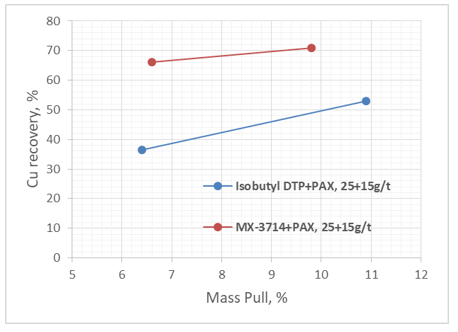
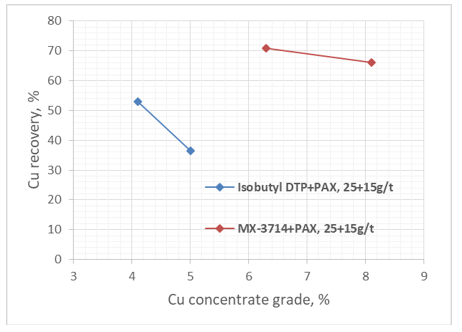
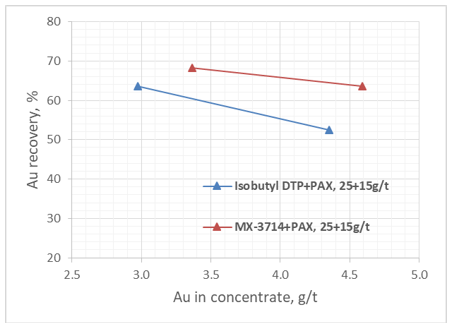
AERO® MX-3714 was successfully evaluated at a Cu/Au plant as primary collector with amyl xanthate as secondary collector. This reagent combination outperformed the incumbent reagent scheme of isobutyl dithiophosphate/amyl xanthate. The ore head grades were as follows:
| Total Cu, % | Au, g/t | S, % | Fe, % | Al2O3, % |
| 0.72 | 0.39 | 3.85 | 8.28 | 17.25 |
| Total Cu, % | AS Cu, % | Primary Cu Sulfides, % | Secondary Cu Sulfides, % |
| 0.72 | 0.19 | 0.22 | 0.31 |
The following graphs show the results obtained in the lab that were later confirmed in the plant, where there was a significant improvement in Cu and Au metallurgy at less mass pull.
 |  |
Case study 2
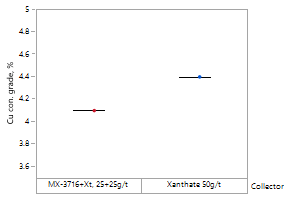
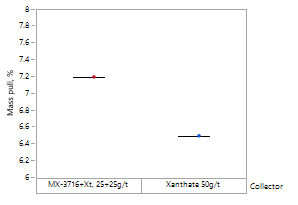
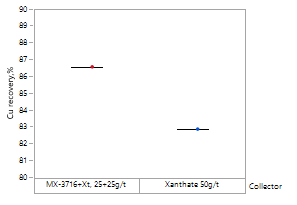
AERO® MX-3716 in conjunction with xanthate as secondary collector was evaluated in the lab against the incumbent collector, xanthate alone, at an equal total collector dosage of 50 g/t. The head assays of the ore tested are shown in the following table.
| Total Cu, % | AS Cu, % | S, % | Fe, % | Al2O3, % |
| 0.38 | 0.04 | 2.30 | 5.43 | 19.42 |
The results of lab flotation tests on mass pulls and Cu performance are shown in the variability charts below.
 |  |