
Executive Summary
Carbonaceous gangue (Corg) or simply “carbon” is most common in precious metal ores (Au/Ag) and polymetallic ores (Cu/Pb/Zn), but it is being encountered more and more in Cu ores. Carbonaceous gangue can vary widely in composition, morphology and association. It can prove problematic both in the flotation step and downstream. The impact of carbonaceous gangue on sulfide flotation is complex and multifaceted and leads to detrimental effects in processing such as requirement of higher reagent dosages, overflowing of cells, low concentrate grades, slow flotation kinetics and lower recovery of values, preg-robbing in the cyanidation stage, smelter penalties, and plant performance variability and disruption. In some cases, mines with no satisfactory mitigation measures stockpile high carbon ores or batch-process high carbon ores. This in turn can lead to challenges in mine planning and lost revenues. The best carbon management strategy, however, is one that holistically considers the Corg surface chemistry, composition, mineralogy, reagent scheme, and processing method. Bulk flotation is a viable approach when ores contain sufficiently low carbon or if other downstream mitigation measures are in place. However, when present in sufficiently high abundance, the presence of Corg requires deliberate intervention in order to mitigate processing challenges and improve metallurgical outcomes. The majority of mines deal with high carbonaceous gangue via two methods: carbon depression or carbon preflotation.
In Syensqo's experience for many decades as a provider of tailored solutions for mineral processing, carbonaceous ores are some of the most challenging and carbon management reagents can’t be treated as point solutions. Syensqo therefore offers robust solutions for processing high-carbon-containing ores for both carbon depression and preflotation processes. Our team of experts can help customers in applying our reagents in a holistic manner by taking into account the many variables involved including the plant’s carbon management strategy, plant flowsheet, ore type, ore mineralogy, flotation behavior and overall reagent scheme.
General Comments / Major Considerations
Carbonaceous gangue (also referred to herein as Corg, or simply, “carbon”) consists of organic, non-carbonate material. In the literature, it is also described by terms like organic carbon, graphitic carbon, total organic carbon (TOC), non-carbonate carbon, kerogen, bitumen, pyrobitumen, carbonaceous material and graphite. This material originates from plant matter that has been altered over time under the high pressure and temperature conditions of geochemical processes, a process that is termed coalification. Depending on the degree of alteration of this matter, Corg will vary in composition and fall anywhere between plant matter and purely graphitic material as illustrated in Figure 1. At one extreme, material of low alteration may have 50 mol% aromatic carbon atoms and 25 mol% oxygen atoms and, at the other extreme, may contain > 95 mol% aromatic carbon atoms and very few oxygen-containing functional groups. High carbon Corg materials have increasing resemblance to graphite, a form of pure carbon comprising stacks of aromatic sheets with pure crystalline order. However, pure graphite is rarely reported in sulfide ores. Nitrogen and sulfur are also routinely present in Corg, but the quantities are lower and these atoms exert negligible impact on the material’s surface chemistry and overall properties. Therefore, in the context of sulfide ores, Corg has more in common with bituminous and anthracitic coal. Chemical differences may in turn manifest physically as differences in hydrophobicity, however, Corg can also vary in physical properties unrelated to surface chemistry such as degree of porosity where the surface area per particle may be several tens of times greater than that expected from geometric area alone. For more information, the reader is referred to an excellent review on the profound chemical and structural variability of these materials5.
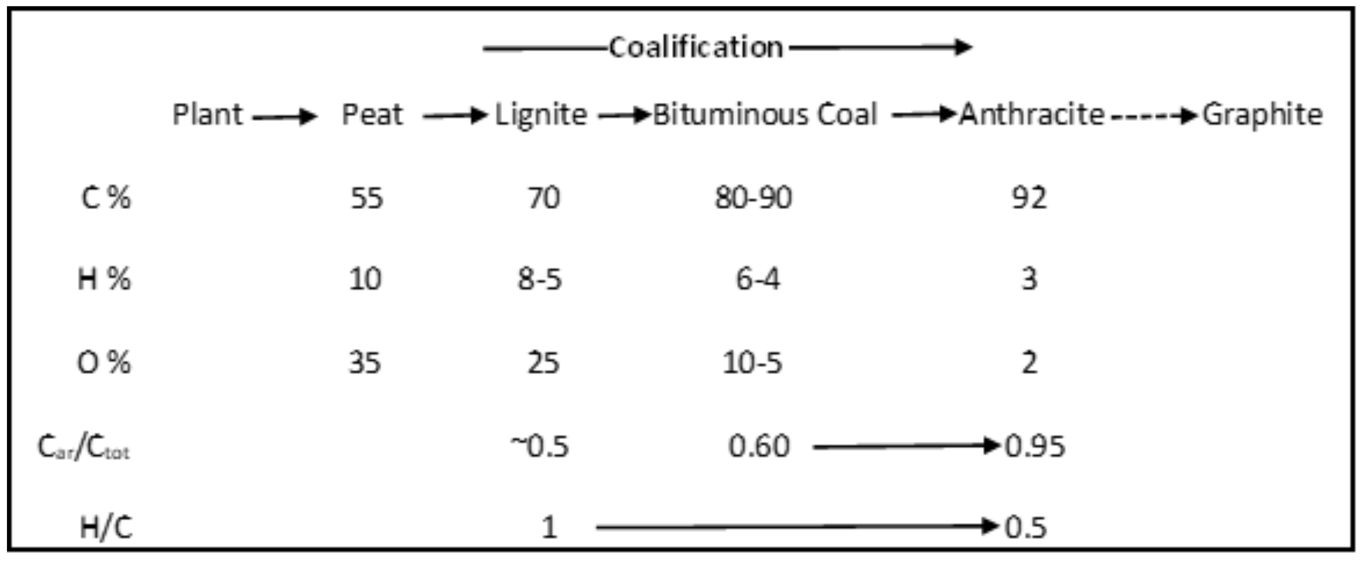
Corg is most commonly present in precious metal ores (Au/Ag) and polymetallic ores (Cu/Pb/Zn), however, with declining ore head grades, carbonaceous copper ores are becoming more commonplace. In addition to variations in composition, Corg also varies in morphology and in its association with other minerals. As seen in Figure 1 above, depending on the degree of coalification and thus based on composition, it can be present in either the lignitic-, bituminous-, anthracitic-, and even graphitic form. In terms of morphology, it may exist as fines of less than 5 microns, coarse flakes, poorly liberated inclusions, oil droplets, etc. Furthermore, carbon can be present in many forms of association, namely, liberated, locked, associated with values, and/or associated with gangue. Despite these differences in presentation, the defining characteristic of carbonaceous gangue is its intrinsic hydrophobicity which makes it naturally floatable and detrimental to sulfide flotation circuits in many ways. Carbon presents mills with many issues both in the flotation step and in downstream processes. Any strategy to manage carbonaceous gangue that includes either carbon depression, carbon preflotation or both, should not treat these approaches as point solutions and should give careful consideration to the three factors of carbon mentioned above as well as their implications to processing.
Challenges Faced
Flotation processes can be detrimentally impacted by carbonaceous gangue at head grades of 0.1 wt.% although head grades greater than 2.5 wt. % are often processed. Mills encounter many challenges when processing ores with high carbon content and careful consideration should be given to the flowsheet, reagent requirements, and mineralogical associations. As alluded to previously, the impact of carbonaceous gangue on sulfide flotation is complex and multifaceted and leads to some of the following detrimental effects in processing:
- Adsorption/consumption of reagents, especially collectors and frothers.
- Stabilization of the froth, resulting in overflowing of cells.
- Production of low grade concentrates due to recovery of gangue with carbon content or by entrainment.
- Slow kinetics and crowding out of values by carbon and associations frequently results in reduced values recovery.
- Downstream issues can include preg-robbing, froth management and smelter limitations.
- Plant variability or disruption with sudden increases in carbon head grades.
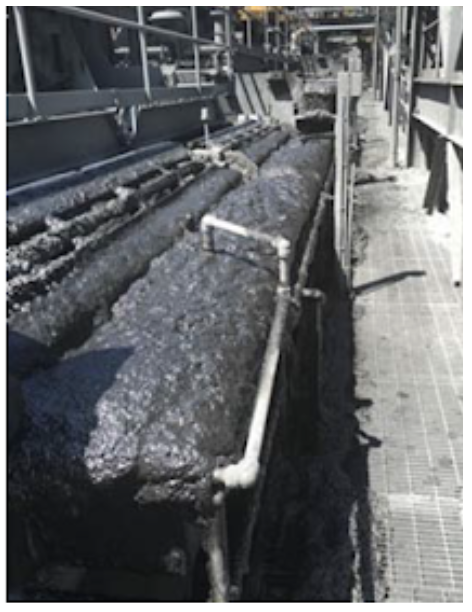
The mill flowsheet design can have a big impact on the options that can be selected for dealing with carbon, for example by limiting the capacity to accommodate preflotation stages or providing enough residence time for satisfactory separation. Due to its fineness, high porosity and hydrophobicity, Corg has a tendency to adsorb reagents, rendering them unavailable to the process. This generally results in much higher reagent dosage requirements of as high as up to 3x those of normal ranges. Due to its fine particle size, flotation of carbonaceous gangue causes persistent, stable bubbles that impact the froth phase through a confluence of effects such as froth phase crowding, stabilization, and destabilization. These frothing issues can lead to slow value flotation kinetics, reduced value recovery, overflowing of cells (see Figure 2), force plants to operate with reduced air flowrates and increased froth depths, contribute to operational variability, and complicate process control. Carbon often has complex mineral association and requires ultrafine grinding for complete liberation. Mineral association requires particular consideration because perfect selectivity may not be possible with any processing method (Figure 2). Also, poor liberation may lead to only partial carbon rejection or recovery in any stage of a process. Furthermore, fresh carbon surfaces may be generated in a regrind circuit that could greatly impact the cleaners. Corg can lead to smelter penalties because the materials are combustible. In gold operations, Corg can also result in preg-robbing which can reduce the recovery of gold by cyanide leach processes downstream.
In some cases, mines stockpile high carbon ores or batch process high carbon ores with no mitigation strategy. This in turn can lead to challenges in mine planning and lost revenues. The best carbon management strategy is one that holistically considers the Corg surface chemistry, composition, mineralogy, reagent scheme, and processing method.
Traditional Strategies / Syensqo Recommendations
Traditionally, carbonaceous sulfide ores are processed by bulk flotation whereby both the carbon and sulfide values report to the same concentrate. This approach may be acceptable under specific circumstances such as when the treated ores contain a sufficiently low Corg head grade or when additional processing of the concentrate is performed to eliminate deleterious effects of carbon in downstream operations. One specific case of the latter is the bulk flotation of double-refractory gold ores, in which the concentrate is treated either by pressure oxidation or roasting in order to destroy the carbon, thus effectively mitigating preg-robbing downstream. When present in sufficiently high abundance, however, the presence of Corg requires deliberate intervention in order to mitigate processing challenges and improve metallurgical outcomes. The majority of mines deal with high carbonaceous gangue via two methods: carbon depression or carbon preflotation.
Carbon Depression
The two most important factors impacting carbon depression are mineral associations and entrainment. Carbon is frequently associated with value minerals or it is poorly liberated. Therefore, the application of a carbon depressant tends to focus more on achieving satisfactory flotation behavior or metallurgy and less on completely depressing the carbon. One common practice is to add only sufficient depressant to improve froth mobility rather than targeting complete depression, particularly in rougher circuits or with low carbon head grade ores. Such low depressant dosages may reduce value losses due to carbon association. On the other hand, the addition of significant amounts of depressant may be necessary to achieve satisfactory concentrate grades, and this approach may be more common in the cleaners and when processing ores with higher carbon head grade. When evaluating depressants, it can be important to critically analyze selectivity data to consider mineral association and poor liberation. Also, given that Corg may be further liberated after regrind stages, there may be a need to add carbon depressants in multiple stages accordingly. Generally, due to its fine particle size, carbon recovery via entrainment can also be significant, and thus selection of an appropriate frother is key. To evaluate contribution by entrainment, it is always recommended that water recovery be measured during any lab testing program.

Syensqo Recommendations
The use of chemical depressants to inhibit carbon flotation is a versatile industrial practice. Numerous small organic molecules and polymers have been described as carbon depressants2,3. Based on our experience, the following reagents are our recommendation for effective carbon depression.
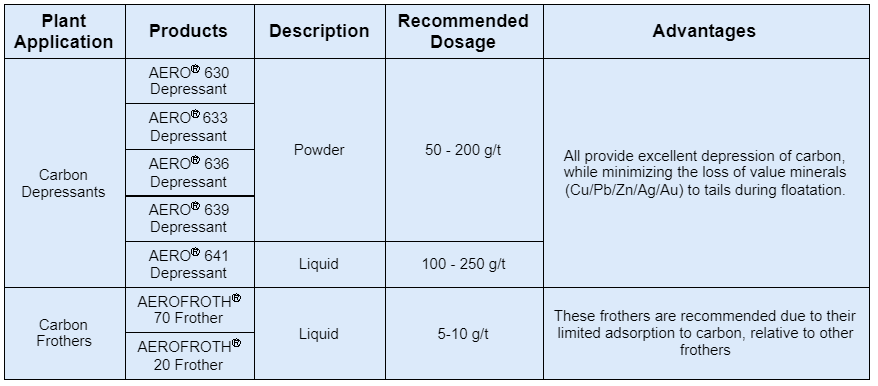
AEROⓇ 630 / 633 / 636 depressants - are dry powders, which needs to be prepared as 1%-5% solution. Typical dosage requirement is 30 g/t – 120 g/t depending upon the application. It is essential that AEROⓇ 633 / 636 depressants are prepared using proper equipment to allow full wetting and dissolution/aging of the product. AEROⓇ 633 / 636 depressants are typically added prior to collector and frother.
AEROⓇ 639 depressant - Ideal for customers that have existing infrastructure for dry powder preparation. Given remote locations, powder may be ideal to reduce transport costs and enable an improved treatment cost for the customer. Prepare a 10-40% solution, requires limited hydration time. Typical dosage requirement is 30 g/t – 120 g/t depending upon the application. Can be a weak pyrite depressant at very high dosages.
AEROⓇ 641 depressant - Ideal for customers that lack infrastructure for dry powder preparation. It is a 40% active solution that can be dosed directly in the process. It disperses and dissolves rapidly in the pulp permitting direct feeding even with short conditioning times. Typical dosage requirement is 60 g/t – 250 g/t depending upon the application. Can be a weak pyrite and pyrrhotite depressant at very high dosages.
AEROFROTHⓇ 70 / 20 frothers - These frothers are recommended due to their limited adsorption to carbon, relative to other frothers. AerofrothⓇ 70 will be the most selective frother and is recommended unless any additional strength is needed. When a stronger froth is needed, we recommend blending in AEROFROTHⓇ 20. Standard glycol frothers can adsorb strongly on carbon, which increases the required dosage and minimizes any impact of the glycol. Conditioning time for frother should be kept to a minimum and stage addition is often advisable to minimize the amount of frother adsorbing to the carbon. Dosage determined by requirement to maintain froth.
Figure 3 shows an example of the use of AERO® 641 depressant on a carbon-containing Cu ore in which it is clear that, at a dosage of 200 g/t, carbon recovery and grade are minimized at the same time that Cu recovery and grade are maximized.

Carbon Preflotation
Given that carbonaceous gangue is typically naturally hydrophobic, it can be removed in a preflotation stage. This can be done through a flash float (as the carbon is generally soft, and grinds preferentially) or as a first stage of roughing. The main problem with this approach is usually the loss of values, removed with the carbon, either by association, their own floatability, or entrainment. Preflotation can be particularly advantageous when the Corg is associated with gangue minerals. For example, a pilot plant investigation on carbonaceous Cu ore from Mt. Isa used preflotation to remove naturally floatable pyrite that was rimmed with Corg4. Typically only a limited proportion of the carbon is removed (20%-30%). This removes the most “active” carbon but reduces value losses, vs. floating more, and also may be necessary due to poor carbon liberation. In response, some mines have moved into multiple stage preflotation, where multiple cleaning stages have been added to reduce the loss of value minerals that would otherwise be lost to entrainment. Since a significant amount of values can report to the preflotation concentrate via entrainment, these cleaning stages can be essential to minimize losses. In order to maintain selectivity of separation, preflotation reagents typically consist of only a frother and optionally a carbon collector or even a sulfide depressant.
Syensqo Recommendations
The following are our recommended solutions for effective carbon preflotation.
| Plant Application | Products | Description | Recommended Dosage | Advantages |
| Carbon Preflotation | AEROⓇ 735 Promoter | Liquid | 40 -120 g/t | Selective carbon preflotation collectors that minimize valuable metallurgical losses in Cu, Polymetallic and gold ores |
| Carbon Preflotation | AEROⓇ 736 Promoter | Liquid | 40 -120 g/t | Selective carbon preflotation collectors that minimize valuable metallurgical losses in Cu, Polymetallic and gold ores |
| Carbon Preflotation Frothers | AEROFROTHⓇ 70 Frother | Liquid | 10-40g/t | Frothers can be used with or without carbon collectors, to minimize value losses |
| Carbon Preflotation | AEROFROTHⓇ 88 Frother | Liquid | 10-40g/t | Frothers can be used with or without carbon collectors, to minimize value losses |
AEROⓇ 735 / 736 promoter - Carbon collectors with improved frothing properties. These products allow greater control of carbon preflotation relative to use of frothers alone. The amount of carbon recovered can be controlled without the generation of excessive froth. Dosages should be determined for each plant application, but can range from 40-120 g/t.
AEROFROTHⓇ 70/ 88 frothers - These two frothers are industry standards for carbon flotation. Dosages should be determined for each plant application, but typically range from 10-40g/t.
Figure 4 shows an example of a gold ore in which the addition of AERO® 736 promoter leads to equal carbon recovery with ~ 5.0% less Au recovery as compared to the standard.

References
- Haenel, M. W. Recent progress in coal structure research. Fuel 1992, 71, 1211-1223.
- Nagaraj, D. R.; Ravishankar, S. A.: Flotation Reagents - A Critical Overview from an Industry Perspective. In Froth Flotation - A Century of Innovation; Fuerstenau, M. C., Jameson, G., Yoon, R.-H., Eds.; Society for Mining, Metallurgy, and Exploration: Littleton, Co, 2007; pp 376 - 424.
- Nagaraj, D. R.; Farinato, R. S.; Arinaitwe, E.: Flotation Chemicals and Chemistry. In SME Mineral Processing & Extractive Metallurgy Handbook; Dunne, R. C., Ed.; SME: Englewood, CO, 2019; Vol. 1&2; pp 967-1010.
- Grano, S. R.; Griffin, L. F.; Johnson, N. W.; Smart, R. S. C.; Ralston, J.: Treatment of Naturally Hydrophobic Gangue Minerals at the Copper Concentrator of Mt Isa Mines Limited. In Australian Inst. Mining Metallurgy 4th Mill Operators Conference: Burnie Tasmania, 1991; pp 121-128.
- Mathews, J. P.; Chaffee, A. L. The molecular representations of coal – A review. Fuel 2012, 96, 1-14.