
Executive Summary
In the flotation of polymetallic ores, zinc flotation is typically carried out on the tails of Copper (Cu) and Lead (Pb) circuits. Copper sulfate (CuSO4) is normally added at this stage in order to activate the zinc sulfide minerals (mainly sphalerite), however, it is also known that gangue iron sulfides (mainly pyrite) can be activated as well, in particular at low to moderate dosages. Despite this fact, operations are able to achieve acceptable selectivity against iron sulfides and consequently to meet concentrate grade targets. Since copper sulfate accounts for a large portion of the total reagent costs, there have been efforts to lower its dosages or even eliminate its use.
Research by Syensqo of a wide range of chemistries has shown that:
a) sphalerite can be recovered by flotation without the use of CuSO4, however, more importantly
b) that relatively high dosages of CuSO4 are essential to achieve selectivity against pyrite.
This latter finding has resulted in a complete rethinking of the role of CuSO4 in sphalerite flotation and indeed in a paradigm shift. Given this fact, Syensqo offers strong and effective zinc collectors that at the same time offer excellent selectivity against iron sulfides and allow for reduction of CuSO4 dosage as compared to conventional collector chemistries. The following report details the work that led to these important conclusions.
General Comments / Major Considerations
Polymetallic ores are made up of a variety of sulfide value minerals, particularly galena and other Pb sulfides, zinc sulfides, copper sulfides, and gold and silver values. The head grades of value minerals in polymetallic ores can vary significantly: 0-3% Pb, 0-3% Cu, 0.5-20% Zn, 0-400 ppm Ag, 0-2 ppm Au, 1-40% pyrite, 0-3% Corg (organic carbon). Variation in gangue mineralogy, such as silicates, iron sulfides, and organic carbon, can further complicate the flotation behavior of an ore. These ores are the primary source of Pb, Ag, and Zn globally.
Standard practice in polymetallic ore flotation is to have a primary bulk circuit in which copper, lead, silver, and gold are selectively floated while rejecting zinc and iron minerals. Sequential flotation circuits are also operated in which Cu and Pb are floated sequentially in the primary circuit to generate separate concentrates. Cu and Pb minerals are naturally more hydrophobic and more readily floated compared to zinc and iron. Selectivity against Zn and Fe is improved by using selective collectors, particularly AEROPHINE® 3418A and also depressants, such as zinc sulfate, sodium sulfite, sodium metabisulfite, and sodium cyanide; when gold and/or silver are present, however, zinc cyanide complex is used instead sodium cyanide. Syensqo also offers benign polymeric depressants such as AERO® 7261A to sharpen the separation between value and gangue minerals (see Syensqo Recommendations section for the specifics). The primary circuit is typically operated at pH lower than ~10.5 to promote galena flotation.
The primary circuit tailings are sent to the zinc circuit, where the Zn is floated selectively from the iron sulfide and silicate gangue. The pulp pH is typically elevated to ~11-12 with lime to reject pyrite and copper sulfate is added to activate the zinc minerals. The collectors traditionally used in the zinc circuit are xanthates, particularly sodium isopropyl xanthate, however, Syensqo has an entire suite of effective collectors as will be discussed in a later section. Sodium cyanide may also be used in order to depress iron sulfides as well.
The main zinc sulfide minerals are sphalerite and marmatite with varying amounts of iron in the lattice which, in turn, impacts its floatability. The main iron sulfide minerals are pyrite and marcasite. It has been shown that sphalerite (save for inadvertent activation) is poorly floated by short-chain xanthates (e.g. ethyl and isopropyl) but is floated by collectors like amyl xanthate (5-carbon alkyl chain). Therefore, there has always been a long-standing question as to whether sphalerite can be floated without the use of copper sulfate. In natural samples, inadvertent activation of sphalerite does occur even with trace amounts of activating ions like Cu2+, Pb2+, Ag+ stemming from other minerals, process water or naturally occurring at the sphalerite surface6, 10, and thus it is expected that sphalerite will have a given degree of floatability in typical ore samples. Therefore, in practice, deliberate activation of zinc sulfide minerals is achieved by the use of copper sulfate as mentioned earlier.
The currently accepted mechanism of activation of zinc sulfide minerals with copper ions involves the exchange of Cu2+ ions from solution with Zn2+ in the sphalerite (or marmatite) crystal lattice followed by reduction of Cu2+ ions to Cu+ ions (and concomitant oxidation of sulfur sites) as expressed in the following formula:

It has been observed, through spectroscopy, that the resultant activated surface resembles electronically that of covellite (CuS). Sulfide collectors then readily adsorb onto these Cu+ sites leading to flotation of sphalerite. There is also a kinetic component to this process in which Cu ions diffuse within the bulk of the sphalerite crystal, and thus activation changes with time, however, this is not an issue in the time scales of flotation. Aside from this exchange process, Cu ions are involved in other bulk and surface processes that occur in parallel such as hydrolysis and subsequent precipitation of Cu hydroxides, dissolution of the same hydroxides, and reactions with collector molecules as shown in Figure 1. Cu hydroxides, by their very nature, will have a tendency to render sulfide minerals hydrophilic and consequently less floatable.
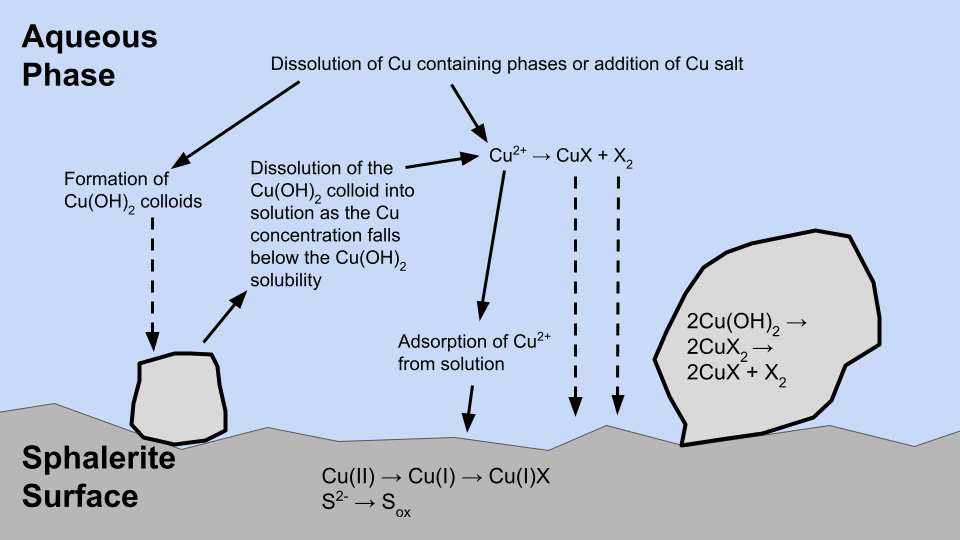
Iron sulfides (e.g. pyrite) are also activated by Cu2+ (and Pb2+) ions, in which Cu hydroxides exchange with Fe hydroxides at the surface. By contrast with sphalerite, the Cu ions do not diffuse within the bulk of the iron sulfide lattices. In addition, the thermodynamic driving force for activation is larger for Zn sulfides as compared to Fe sulfides. One question, that emerges from these considerations is: how come operations are able to achieve good separation of zinc and iron sulfides in the presence of copper sulfate? In fact, this point has been recognized and articulated upon by Finkelstein: “The picture which we have drawn of the chemistry of activation provides no explanation for the selectivity in the flotation of sphalerite and pyrite which is important in practice and is often observed.”3
One thing to keep in mind is that these concepts, as put forth by Fuerstenau and others4, are only part of the picture given the complexity of the environment in a real flotation process brought about by the multiple mineral and aquatic species present. Therefore, they should be used together with other prevailing concepts to rationalize the resultant observations in actual practice.
Based on what is known and reported in the literature on the use of copper sulfate in Zn flotation, Syensqo set out to answer two questions:
- Can sphalerite (or marmatite) be floated without the use of copper sulfate? and
- How are plants able to achieve acceptable selectivity of Zn and Fe sulfides while using copper sulfate?
Regarding the first question, Syensqo did research on molecules with a very wide range of chemistries representing some used in practice as well as others that are not. What we found after extensive flotation testing on various ores is that, indeed, sphalerite can be floated without the use of copper sulfate as shown in Figure 2.

However, the main result was that, without copper sulfate and regardless of collector chemistry, higher zinc recoveries went hand-in-hand with a lack of selectivity against iron sulfides (see Figure 3). As a consequence, acceptable selectivity against Fe sulfides (with high Zn recoveries) can, in general, only be achieved by using copper sulfate. This result goes against the conventional thinking that copper sulfate only serves to activate Zn and Fe sulfides. We propose that, although activation of sulfides does occur, copper sulfate also leads to depression of iron sulfides. This represents a change in paradigm of the role of copper sulfate in Zn/Fe separation.

Review of the literature suggests that there may be two ways in which depression of iron sulfides can occur:
a) Cu oxyhydroxide precipitation depression of iron sulfides through surface contamination pathways; and
b) by a mechanism involving destabilization of the froth.
In the first case, depression of iron sulfides by copper sulfate parallels that of depression of zinc sulfides by zinc sulfate (Senior, 1991). Copper sulfate is known to hydrolyze in the range of pH from 6 to 13, resulting in the formation of colloidal copper oxyhydroxide species which precipitate onto sulfides and, given their hydrophilicity, tend to depress said sulfides. Single mineral studies have lent support to this mechanism in which they acted as depressants1, 5. The depressant effect was more pronounced, the larger the copper sulfate dosage was in relation to that of the collector9. Note, that another possible way in which selectivity against iron sulfides may arise is through an increase in Zn flotation kinetics, however, this was not apparent in our studies.
In the second mechanism, froth destabilization may occur through increased hydrophobicity of floating particles in the froth zone or by formation of Cu-xanthate species. This effect on froth stability is well known in the flotation of platinum group metal ores where copper sulfate is added for activation of iron sulfide (e.g. pyrrhotite) but results in instability of the froth, the degree of which will depend on ore mineralogy7. This was indeed observed in some, but not all tests conducted by us, and thus cannot account for all selectivity obtained against Fe.
To summarize, the key findings of our research on copper sulfate’s role in Zn flotation are:
- ZnS flotation without deliberate activation is achievable on both pure ZnS that is free of metal activation and real ores when using the proper collector in the right conditions.
- Metal activation plays a critical role in Zn vs. Fe selectivity and deliberate activation with CuSO4 at typical plant dosages is required for Fe rejection.
- Zn vs. Fe selectivity is achieved in practice through the dual role of CuSO4 as both an activator and an iron sulfide depressant. Overdosing CuSO4 can improve Zn vs. Fe selectivity.
Collectively, this constitutes a paradigm shift of the role of CuSO4 in Zn flotation, more explicitly:
Old paradigm says: metal activation is required to achieve ZnS flotation.
New paradigm says: while metal activation is certainly beneficial to ZnS flotation, its role in Fe rejection is the primary reason why large copper sulfate dosages are needed for plant operation.
Technical Note. The CuSO4 Demand Curve.
Every zinc sulfide ore requires a certain amount of CuSO4 to float all of the ZnS with a given collector under given pulp conditions. This CuSO4 demand should be empirically determined through the definition of a CuSO4 demand curve, which is a plot of zinc recovery vs. copper sulfate for a specific ore. The demand curve typically has an S-shape using standard short chain collectors, as depicted in Figure TN1. The S-curve of zinc recovery varies between ores due to many factors, including inadvertent metal activation, Zn head grade, and ore composition; it will also be different for different collectors for a given ore.

Figure TN1 shows a typical copper demand curve for a low-grade polymetallic ore. The demand curve in this example plateaus with full Zn recovery between 150 and 200 g/t CuSO4. The goal of an effective reagent scheme is to shift this curve to the left (see dotted curve in Figure TN1) in order to achieve equivalent or better zinc recovery at lower doses of copper sulfate. The key attribute, however, of such a reagent scheme or technical solution, regardless of Zn recovery, is that: it must achieve satisfactory selectivity against Fe and non-sulfide gangue. Therefore one must evaluate a reagent scheme where the goal is to lower the dosage of CuSO4 for a given Zn and Fe recovery; or, to maintain Zn recovery at equal CuSO4 dosage while increasing selectivity against FeS.

In fact, our research has shown that benefits obtained from using Syensqo collectors over xanthates will depend, in general (though not exclusively), on the head grade of the ore treated. In high grade ores, for a given CuSO4 dosage, Syensqo collectors lead to equal or better Zn recovery at significantly reduced FeS recoveries. This effect is illustrated schematically in Figure TN2, and is represented by the intermediate curves on both the left and right panels. Thus switching to Syensqo's selective collectors (which are strong for sphalerite) allows for the reduction of CuSO4 dosage in plants that use xanthates (inherently non-selective), and which rely on high dosages of the copper sulfate to achieve selectivity against Fe (a counterintuitive effect as we have discussed previously, but one that is based on actual practice). In the case of lower grade ores, oftentimes it is impossible to reduce CuSO4 dosage given that it is essential for achieving acceptable Zn recoveries and, instead, selectivity against Fe is the focus, which is easily attained by use of our tailored collectors. In a few instances, it has also been observed (see case studies) that Syensqo collectors lead to higher or comparable Zn recovery as compared to xanthate, however, these instances are not robust and have shown to be sensitive to flotation conditions.
In summary, the CuSO4 demand curve should be established for a given ore when evaluating reagent schemes for the Zn flotation circuit, where both Zn recovery and Fe recovery should factor in the analysis. Furthermore, ore head grade and plant metallurgical objective will dictate the focus of the evaluation, i.e. whether it is reduction in CuSO4 or selectivity against FeS at a given CuSO4 dosage.
Challenges Faced
What follows is a list of challenges faced by polymetallic mines in Zn flotation:
- Copper sulfate accounts for almost 40% of all reagent costs (as shown in Figure 4) and thus is a main driver for plants to curtail its use.

- Achieving selectivity against iron sulfides that report to the concentrate by true flotation. More importantly, regardless of Zn recovery, selectivity against Fe is a must when evaluating any reagent scheme if any practical application is expected, however, CuSO4 has been proven to be a requirement towards this goal.
- In massive sulfide ores, with pyrite content in the several tens of % by mass, a fixed recovery of iron sulfides may occur due to entrainment alone, which in turn may impact grade. Use of depressants have little to no effect to mitigate this issue, however, measures related to froth stability and water recovery or froth washing may help in these cases.
Traditional Strategies / Syensqo Recommendations
In the bulk flotation circuit of polymetallic ores (to recover Cu and Pb), selectivity against Zn and Fe is achieved with the use selective collectors such as Syensqo's AEROPHINE® 3418A and also depressants, such as zinc sulfate, sodium metabisulfite, and sodium cyanide as previously stated. The primary circuit is typically operated at pH lower than ~10.5, more specifically, between 6-9 in order to promote the flotation of galena. Soda ash is preferably used to maintain pH in the slightly alkaline range, though many plants use lime without detriment to galena recovery. Polymeric depressants such as AERO® 7260 and AERO® 7261 may also be added to sharpen the separation between value- and gangue sulfides. Examples of the latter are pyrite and pyrrhotite. In addition, the presence of carbon may require the use of a preflotation step/stage prior to the Cu/Pb rougher and/or the use of carbon depressants (please refer to our Carbon Management Strategies section for more details on Syensqo solutions for this issue). Figure 5 is a diagram of a typical polymetallic ore plant flowsheet.

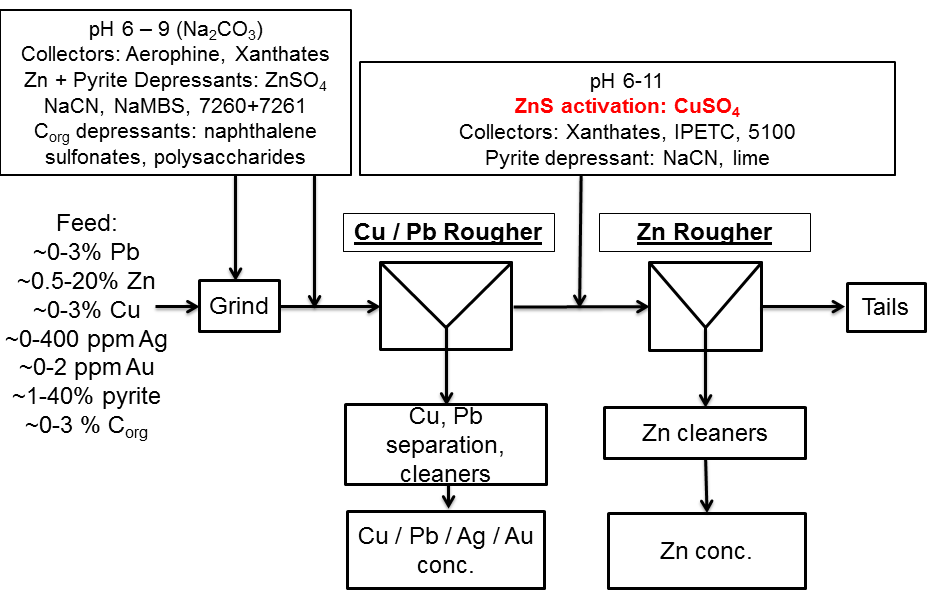
The tails of the Cu/Pb rougher make up the feed to the Zn circuit in which the objective is to float Zn sulfide minerals selectively from iron sulfides. As already mentioned, xanthates are the collectors traditionally used in the zinc circuit, and in particular, sodium isopropyl xanthate. Syensqo's AERO® XR series (xanthate replacement formulations), AERO® 5100 formulations, or AERO® 3894 are used in some mines. Xanthates are effective at floating zinc sulfide minerals, however, they also impact selectivity against iron sulfides in a negative way due to their inherent non-selectivity. In addition, our research has demonstrated that AERO® 5100 improves selectivity against iron sulfides with a lower CuSO4 dosage as shown in Figure 6. Another recommended collector that achieves similar performance is AERO® XD-5002.
| Final Zn Recovery vs. CuSO4 Dosage | Final Fe Recovery vs. CuSO4 Dosage |
 |  |
Figure 6. CuSO4 demand curve (left) and Fe recovery vs. dosage curve (right) for a polymetallic ore showing the benefit of using AERO® 5100 in the Zn circuit, where at the critical CuSO4 dosage much less Fe is recovered as compared to potassium amyl xanthate (PAX). Both collectors were added at 50 g/t.
We recommend the following collectors for Zn flotation: AERO® 3473, AERO® 3477, AERO® 3739, AERO® 3740, AERO® 3894, AERO® 5100, AERO® 6404, AERO® 7048, AERO® 7279, AERO® 7376, AERO® 9863, AERO® MX-3753, AERO® MX-3754, AERO® MX-5148, AERO® MX-5160, AERO® MX-5193, AERO® MX-6222, AERO® MX-7015, AEROFLOAT® 211, AEROFLOAT® 721, AEROPHINE® 3404, AEROPHINE® 3406, AEROPHINE® 3410, AEROPHINE® 3416, AEROPHINE® 3418A, Reagent S-9323.
Please refer to the case studies below for application of our reagents in achieving Zn recovery and selectivity against iron in operations of varying ore head grades and characteristics.
References
- Albrecht, T. W. J.; Addai-Mensah, J.; Fornasiero, D. Critical copper concentration in sphalerite flotation: Effect of temperature and collector. Int. J. Min. Process. 2016, 146, 15-22.
- Chandra, A. P.; Gerson, A. R. A review of the fundamental studies of the copper activation mechanisms for selective flotation of the sulfide minerals, sphalerite and pyrite. Adv. Colloid Interface Sci. 2009, 145, 97-110.
- Finkelstein, N. P. The activation of sulphide minerals for flotation: a review. Int. J. Min. Process. 1997, 52, 81-120.
- Fuerstenau, M. C.; Clifford, K. L.; Kuhn, M. C. The role of zinc-xanthate precipitation in sphalerite flotation. Int. J. Miner. Process. 1974, 1, 307-318.
- Iskra, J.; Laskowski, J. Coper ions in the flotation process: effect of CuSO4 on flotation of 'methylated' quartz. Trans. Inst. Min. Metall. 1969, 78, C113-114.
- 6Mielczarski, J. The role of impurities of sphalerite in the adsorption of ethyl xanthate and its flotation. Int. J. Min. Process. 1986, 16, 179-194.
- Nyabeze, W.; McFadzean, B. Adsorption of copper sulphate on PGM-bearing ores and its influence on froth stability and flotation kinetics. Miner. Eng. 2016, 92, 28-36.
- Senior, G. D.; Trahar, W. J. The influence of metal hydroxides and collector on the flotation of chalcopyrite. Int. J. Miner. Process. 1991, 33, 321-341.
- Steininger, J. The depression of sphalerite and pyrite by basic complexes of copper and sulphydryl flotation collectors. Trans. SME/AIME 1968, 24, 34-42.