Executive Summary
After a bulk Cu-Mo flotation concentrate is generated, this product is sent to a separate Cu-Mo separation circuit. The aim of this circuit is to recover the small amount of high value molybdenite from a preponderance of Cu sulfide minerals and a minor amount of pyrite and non-sulfide gangue. The approach taken to this end is to undermine collector-sulfide interactions, in particular those with Cu, Fe and sulfides other than molybdenite. Sodium hydrosulfide (NaHS) has been the workhorse of the Cu-Mo industry for achieving collector desorption and consequently, Cu depression. NaHS, however, is a highly hazardous chemical in that there is potential for generation of the lethal hydrogen sulfide (H2S) gas. Furthermore, the high propensity of NaHS to oxidize (a property that’s key for its effectiveness) leads to the need for use of large quantities of the same, especially when air is used as flotation gas. Other inorganic alternatives to NaHS, such as Nokes’ reagents and cyanide, for example, also suffer from being highly dangerous to handle and not good for the environment. In response, Syensqo has developed benign, SHE-favorable depressants that are highly effective at depressing Cu sulfides and other sulfide gangue, these are AERO® 7260 and AERO® 7361. These products allow for significant reduction of NaHS, thus enabling plants to reduce all risks associated with the handling of NaHS or other inorganic depressants. The following is a discussion of major aspects of Cu-Mo separation and Syensqo's solutions for this industry.
General Comments / Major Considerations
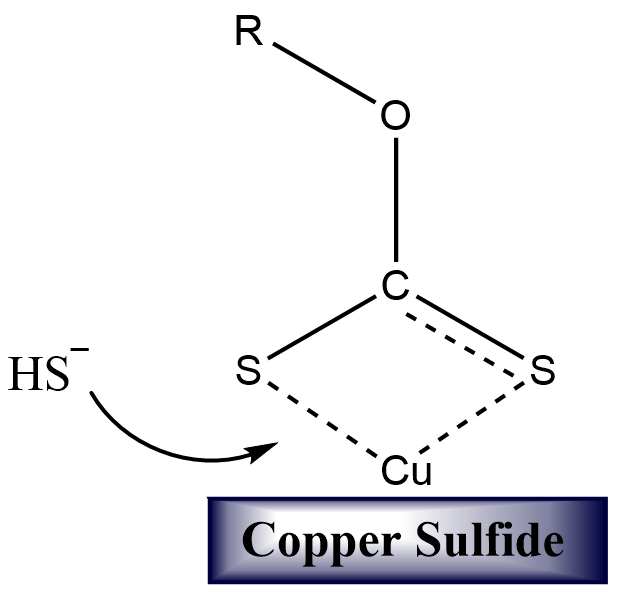
The main goal of a Cu-Mo separation circuit is to selectively separate and recover the small amount of the high value MoS2 (molybdenite, ~0.5-1.0%) from a preponderance of Cu sulfide minerals and minor amounts of pyrite and non-sulfide gangue. The way in which this is accomplished is by use of reagents and reagent combinations that are able to either undermine the Cu sulfide - collector attachment (as well as those of other unwanted sulfides), specifically adsorb and depress the Cu sulfides, or both. Another fortunate characteristic of Cu-Mo ores that works in favor of the desired separation is that molybdenite is inherently hydrophobic. However, there is still a need to enhance molybdenite’s hydrophobicity (and thus flotation kinetics) by deliberate addition of molybdenite collectors in order to sharpen the separation. The most common depressant, sodium hydrosulfide (NaHS) is a reducing agent that, when added into solution, dissociates to generate HS- ions. Because adsorption of most common collectors (anionic) is a redox process, HS- ions undermine the bonds of the collector molecules with copper sulfides as shown in Figure 1. MoS2 floatability is largely unaffected by the presence of HS- ions and thus NaHS is very selective.
The redox conditions prevalent in the pulp are monitored by an oxidation-reduction probe (ORP) where the more reducing the conditions, the lower (or more negative) the ORP value as measured in millivolts (mV; against a Ag/AgCl reference). The efficiency of removal of collectors from Cu sulfide mineral surfaces by NaHS or other depressants (like Nokes’ reagents) is influenced by the collector used. The strength of collector adsorption on Cu sulfide minerals varies from collector to collector, i.e. it is influenced by the type (structure) of the collector. Depending on their strength of adsorption, some collectors will require greater chemical energy to be desorbed; in the example given, NaHS provides this chemical energy. Likewise, for a given collector, different sulfide minerals also will hold on to the collector to different degrees and consequently different ORP values will need to be reached before collector desorption takes place. This suggests that there is an electrochemical window for every collector and mineral combination in which depression is achieved. As can be envisioned, the situation gets more complicated in a real ore in which many different Cu sulfide minerals may be present as well as more than one collector may be added. Therefore, for a given Cu-Mo ore type with diverse Cu mineralogy, there will be an electrochemical window (ORP range) in which the collectors will be desorbed and acceptable Cu depression can take place. Figure 2 shows a typical case in Cu-Mo separation (batch test) in which NaHS is added as depressant.
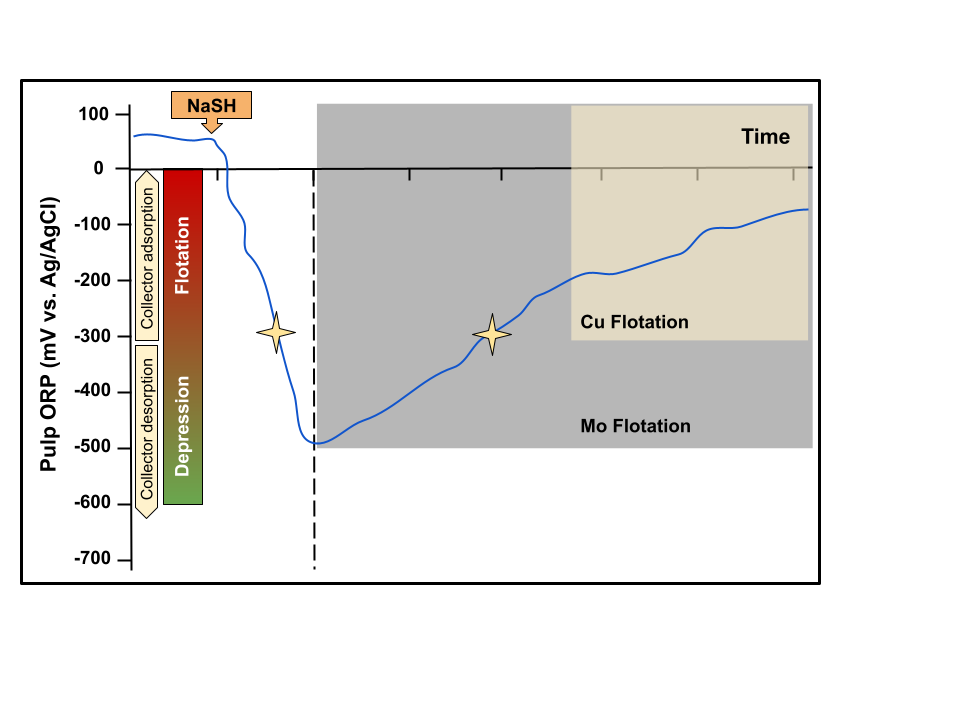
Note that when air is turned on (in a batch test) as indicated by the dashed line, the ORP starts to rise, given that NaHS starts to oxidize. In plant practice, this translates to large amounts of NaHS required to maintain the reducing conditions needed for Cu depression. One approach taken at some operations to maintain the reducing conditions is to use N2 (nitrogen) as flotation gas, thus precluding the oxidation of NaHS and typically reducing the amounts of NaHS used by 30-50%; this however means that the plant must incur in costs of N2.
Needless to say that one major consideration in handling NaHS is the generation of H2S gas, which is highly toxic. Therefore, the pH of the pulp needs to be kept above a given level (> 7 but preferably > 9) to avoid generating dangerous levels of the toxic gas. Addition of NaHS naturally elevates the pH of the pulp, however, many times caustic (NaOH) is co-added to control pH levels as well.
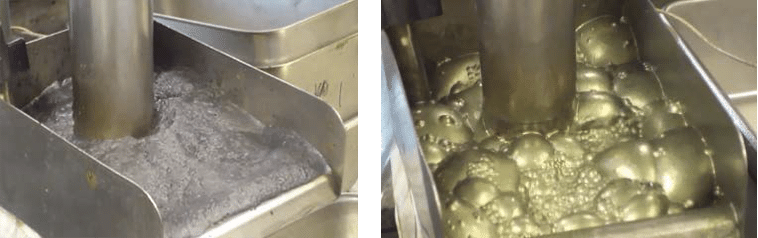
Cu-Mo separation is a very visual operation as the color and texture of Cu sulfides in the froth completely differs from MoS2 as seen in Figure 3. The example given is for a predominantly chalcopyrite-containing ore in which the contrast between a molybdenite-rich froth and a chalcopyrite-rich froth is high. This is not the case for ores with high content of chalcocite in which the Cu color is also dark.
Different MoS2 polytypism, morphology and particle size will dictate the floatability and likely sensitivity to depressants (other than NaHS) during the separation stage. In like manner, ores with secondary Cu mineralogy will also present challenges in achieving concentrate grades based solely on the higher Cu content of the minerals in this class such as bornite, chalcocite, covellite, etc. although other factors such as release of Cu ions can complicate separation due to activation of iron sulfides or nuisance sulfide gangue.
Challenges Faced
The following are some of the challenges faced in Cu-Mo separation stages:
- Low grade Mo in the feed to the separation circuit.
- Presence of secondary Cu minerals.
- Strong and persistent froth requiring use of froth-control reagents.
- Need for high dosages of NaHS which requires handling of large amounts due to preparation.
- Presence of high levels of talc that preclude the production of a Mo concentrate, although a Cu concentrate can be obtained.
- Under-dimensioned cells that do not leave enough room for Mo recovery.
- Some operations have tight specifications on Cu grade to the Mo concentrate (<1%).
- Large amounts of insolubles that impact final concentrate grade.
- Presence of divalent ions such as Ca2+, but in particular Mg2+ that can have a negative effect on molybdenite flotation at pH > 10. These can arise from dissolution of carbonate minerals or can be present in the water itself (e.g. if it's brackish).
Traditional Strategies / Syensqo Recommendations
Bulk Flotation
Due to the importance of the reagents used in the bulk circuit the following is a brief description of this part of the circuit prior to Cu-Mo separation. As discussed in the Cu-Mo Ores section, molybdenum is obtained as a by-product of the processing of Cu porphyry ores. Typical Mo feed grades are between 0.01% to 0.05%. A bulk concentrate rich in MoS2 and Cu sulfide species is obtained in a roughing stage by the use of standard collector reagents which may include alkyl dithiophosphates, functionalized thionocarbamates, dithiophosphinates and dialkyl thionocarbamates. Hydrocarbon oil, oily xanthate ester, oily dithiocarbamate, and functionalized thionocarbamate are also typically added to enhance recovery of MoS2 and any gold values. This bulk concentrate may then be placed in a thickener in order to increase its percentage content of solids, after which it may go either into a pretreatment stage or a conditioning stage.
Cu-Mo Separation
In the Cu-Mo separation circuit, the molybdenite is traditionally floated using hydrocarbon oil, while the Cu sulfides and pyrite are depressed as described below.
As mentioned before, during the conditioning stage, Cu sulfide and pyrite depressants are added from any of the following: sodium hydrosulfide (NaHS), sodium sulfide (Na2S), Nokes’ reagents (thiophosphorus or thioarsenic compounds), (NH4)2S and/or Syensqo's benign polymeric depressant, AERO®7260. NaHS is by far the most used depressant, however, many operations are trying to move away more and more from its exclusive use due to its negative health, safety and environmental profile. Traditionally, hydrocarbon oil is added for flotation of MoS2, however, Syensqo offers AERO® MX-2410, an effective MoS2 collector that can also lower frother dosage requirements.
By virtue of adding NaHS (or Na2S, or (NH4)2S), the oxidation-reduction potential of the pulp (as measured by a Pt or Au electrode with Ag/AgCl reference) drops and is aimed to be below -500 mV (vs. Ag/AgCl) at high pH (11-12) for effective depression of Cu sulfides. In some operations (mainly in South America), nitrogen will be used as the flotation gas instead of air in order to avoid rapid oxidation of NaHS in the pulp and thus lowering the required dosages and making the process more efficient. AERO® 7260 can also be co-dosed with NaHS (or Na2S, or (NH4)2S) or Nokes’ reagents for a more effective separation under slightly more oxidizing conditions. When using Nokes’ reagents, close control of the pulp potential and/or redox conditions is not necessary. In the final molybdenite cleaning stages, some operations are using cyanide to depress residual copper sulfides and pyrite; this is usually necessary when using Nokes’ reagents. In some cases, the final molybdenite concentrate may have to be subjected to a cyanide or a ferric chloride leach treatment to remove residual copper.
Other inorganic depressants that are much less commonly used are K4(Fe(CN)6) and K3(Fe(CN)6), which work best under oxidizing conditions and a lower pH range of 6-9. Other ways of oxidizing the Cu sulfide surfaces or undermining collector layers on Cu sulfides that were tried in the past included pretreatment of the ore between the bulk rougher and Cu-Mo separation stages. Oxidizing agents such as hypochlorite or hydrogen peroxide were used at one time to improve the efficiency of the separation downstream. Similarly, a steaming or roasting process was used in the past to strip collector coating from Cu sulfides and pyrite, prior to the addition of ferrocyanide. Examples of organic depressants that are much less common include sodium thioglycolate, carboxymethyl trithiocarbonate and other similar chemistries. After the Mo rougher, MoS2 concentrates undergo a series of cleaning steps to obtain a final Mo concentrate of > 54% grade.
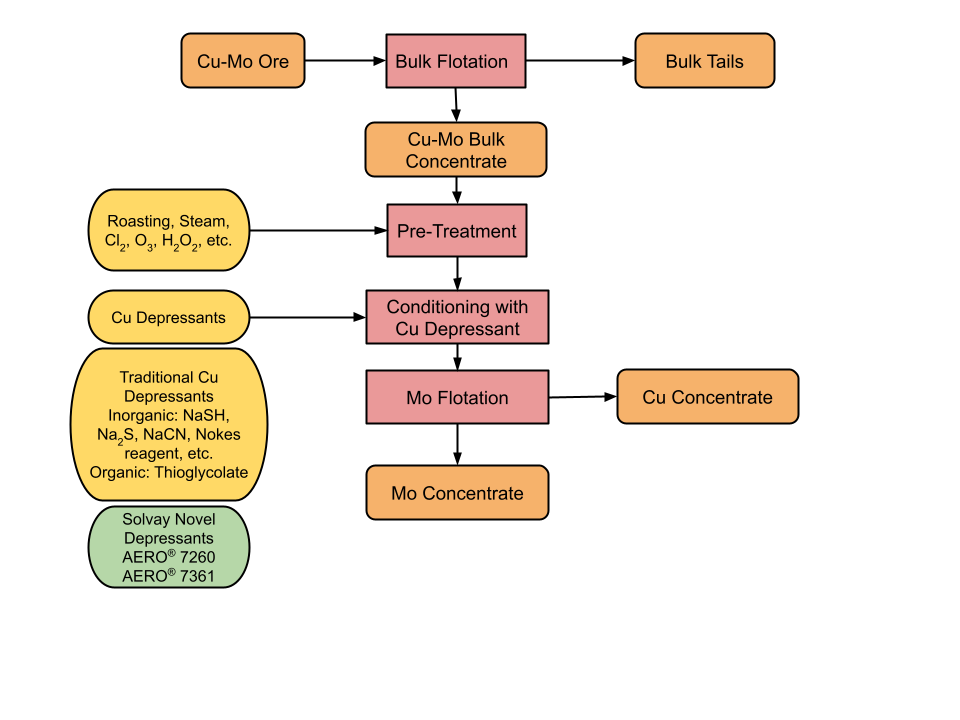
Syensqo has also recently developed AERO® NR-7361, a highly effective Cu depressant, that can be used alone, in conjunction with AERO® 7260 or with NaHS to significantly lower the dosages of NaHS used. AERO® NR-7361 works very well between pH of 5 - 7. AERO® NR-7361 can reduce the NaSH usage by 60 - 100%, lowering down production cost and improving the SHE element of the plant. Our Cu depressants, namely, the polymeric AERO® 7260 and AERO® NR-7361, are benign alternatives that can replace the hazardous inorganic depressants mentioned above and are able to improve the efficiency of the separation process. Figure 4 is a general flowsheet of Cu-Mo operations that summarizes the information discussed in this section. For a more in-depth discussion of mineralogical considerations, reagent safety and depressant application in Cu-Mo separation as well as details on AERO® NR-7361 please refer to our AERO® NR-7361 Section.