Executive Summary
Copper porphyry ores that contain economic quantities of molybdenite, are processed in a manner to produce a bulk Cu-Mo concentrate. Subsequently, the Cu sulfides and pyrite are separated from molybdenite in the Mo circuit by depressing Cu sulfides and pyrite while simultaneously floating the naturally hydrophobic molybdenite. Despite molybdenite’s inherent hydrophobicity, recovery of this mineral is generally lower and less consistent than that of Cu sulfides. The reason for this poor and inconsistent performance is multifaceted and oftentimes related to many properties of the mineral such as morphology, polytype, particle size and to a lesser extent, degree of liberation; it also relates to external factors such as ions and/or detrimental gangue minerals present in the pulp.
In addition, given that operational strategies and reagent schemes are sometimes optimized for Cu flotation, Mo flotation suffers as a result. Processing of these ore requires a holistic approach in which collectors, frothers and depressants work together to achieve optimum metallurgical results. The following details aspects of Cu-Mo sulfide ores and their processing together with Syensqo's suite of recommended reagents for this specific application.
General Comments / Major Considerations
When processing Cu porphyry ores with economical quantities of molybdenite in the feed (with an approximate range between 0.005% and 0.100% Mo), plants will produce a bulk Cu-Mo concentrate that is further separated downstream to generate individual Mo and Cu concentrates as final products. This has been the practice of many Cu mines around the world for decades, in which Mo is beneficiated as a byproduct. However, due to demand from the Chinese steelmaking industry, the year 2004 marked the time in which molybdenum prices increased by a factor of 10, and thus ever since, maximizing the recovery of this metal became the primary focus of Cu-Mo operations1. Roughly 88% of Mo in current use is for metallurgical applications (USGS 2020 Report) with 7 mines in the US producing it currently as a byproduct. Other important elements recovered as by-products of Cu-Mo processing are Rhenium (Re), Tellurium (Te) and platinum group metal elements (PGEs) (Park et al., 2020). Cu is mainly present in the form of chalcopyrite, but secondary copper minerals such as chalcocite, bornite, and covellite are also common in varying amounts. Molybdenum on the other hand is present only as molybdenite (MoS2). Molybdenite is a layered mineral consisting of S-Mo-S sheets that are held together by van der Waals forces (Figure 1).
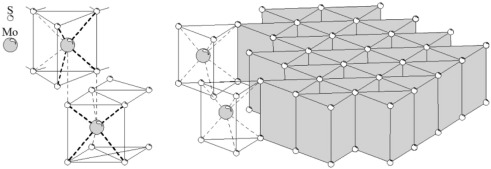
The planes consisting of sulfur atoms are referred to as basal planes or “faces” and are inherently hydrophobic, giving molybdenite its characteristic, naturally-floating properties. On the other hand, the planes perpendicular to the basal planes are considered the edge planes, which are formed by cleavage of Mo-S bonds and thus consist of Mo sites (typically as MoO3); the edge plane is hydrophilic and therefore the morphology of molybdenite particles (as characterized for example by basal/edge areal ratio) can impact its overall floatability.
Although an inherently hydrophobic mineral, molybdenite recovery is usually lower and more variable than Cu recovery and is sensitive to many physical and chemical factors beginning at the bulk roughing stage. In fact, recovery of Cu sulfides is mainly controlled by degree of liberation, whereas molybdenite recovery is less so2,3. Molybdenite recovery has also been shown to be inversely correlated with pulp solids density, and in particular, coarse molybdenite particles (+ 150 microns) are the most responsive to this factor4. The polytype of molybdenite is also important in determining its floatability, with 2H (hexagonal) molybdenite said to be fast-floating and 3R (rhombohedral) molybdenite being slow-floating5. Whereas the former is normally linked to orebodies with high-Mo-grade and high potassic alterations, the latter is linked to low-Mo-grade orebodies with no link to any specific orebody alteration. The fineness of molybdenite particles may also impact its floatability where, as previously mentioned, hydrophilic edge planes may be more represented relative to the more hydrophobic face planes at finer grinds. The presence of some ore types can also result in negative impact on molybdenite flotation, e.g. at Rio Tinto’s Kennecott Cu-Mo operation in Utah, processing of skarn ore (with high content of carbonate minerals) results in lower molybdenite recoveries, presumably due to precipitation of divalent ion hydrolysis products or coating of gangue slimes onto molybdenite6,7,8 (Triffett and Bradshaw, 2008; Vasuvedan et al 2012; Bhambhani et al 2019). Furthermore, use of seawater as process water at pH around 10 and above has been shown to negatively affect molybdenite (and to a lesser extent Cu sulfides), where the culprit is believed to be precipitation of colloidal Mg(OH)2(s), which may precipitate onto molybdenite as well as migrate to the bubble’s air-water interface in turn affecting particle-bubble interactions9,10 (Laskowski and Castro, 2012; Nagaraj and Farinato, 2014). Aside from recovery of Cu and Mo values, another major focus of the bulk roughing stage is the rejection of unwanted nonsulfide gangue minerals, for example clays and Mg silicates, as well as sulfide gangue, typically in the form of pyrite. Due to their inherent hydrophobicity and thus similar flotation behavior as molybdenite, talc and pyrophyllite, are examples of two non-sulfide gangue minerals that present problems both in bulk Cu-Mo flotation and Cu-Mo separation, given that they tend to report to both the bulk concentrate as well as to the Mo concentrate during the separation stage. This can cause dilution of concentrate grade, or, when present in sufficiently large amounts, talc and pyrophyllite will even preclude the production of a Mo concentrate. To date this is a problem that has not been satisfactorily addressed, however, Syensqo's Mineral Processing Research and Innovation group has new and emerging technology with potential to meet this processing need. For more information on physical and chemical means tried in the past for Mo-talc separation consult a recent review on the topic written by Yuan et al.11.
The cleaned bulk concentrate is then sent to a Cu-Mo separation circuit in which Mo is floated off and Cu sulfides and pyrite are depressed. This separation is normally carried out under highly reducing conditions which are achieved by the use of sodium hydrosulfide (NaHS) or sodium sulfide (Na2S). The aim is destabilization of collector adsorption onto Cu sulfides as well as formation of hydrophilic products at the Cu sulfide surfaces resulting in a sharper separation between Cu sulfides and molybdenite, where the latter is unaffected by these inorganic depressants. Despite their effectiveness, the handling and use of these inorganic depressants is increasingly less desirable due to their high toxicity (potential of producing fatal concentrations of H2S gas at low pH) as well as environmental concerns. In this regard, polymeric depressants are more attractive, given their favorable safety and environmental profile and effectiveness for Cu and Fe depression. For more details refer to the Cu-Mo separation section. Typical final Cu concentrate grades are > 22%, and those of the final Mo concentrate fall in the 48+% range, with Cu grades of < 3%.
Challenges Faced
Some of the challenges faced in flotation of Cu-Mo ores are the following:
- Loss in molybdenite recovery due to presence of detrimental divalent ions in solution (e.g. Ca2+ and Mg2+). For example, when using seawater, brackish water, hypersaline water or when processing skarn ores.
- Loss in molybdenite recovery due to molybdenite polytypism (2H vs. 3R MoS2).
- Loss in molybdenite recovery and grade due to crowding out in the froth phase by talc or pyrophyllite; in extreme cases, it is not possible to make saleable Mo concentrate.
- Loss in Cu and Mo concentrate grade due to presence of talc, clays or other NSG.
- Poor selectivity in the bulk Cu-Mo flotation stage, which results in the reporting of impurities to the bulk Cu-Mo concentrate (for example Pb, Zn, As), in turn negatively impacting the purity of the final Cu or Mo concentrates.
- Mo losses in the fine and coarse size ranges.
- Undersized Mo circuits which are bottlenecks for increasing throughput in the bulk circuit. When processing ores containing slow floating molybdenite, it is quite challenging to attain acceptable Mo recoveries in such undersized circuits due to insufficient residence time.
Traditional Strategies / Syensqo Recommendations
Traditionally, xanthate and alkyl dithiophosphates are used as copper collectors in combination with oily xanthate esters and modified thionocarbamates to enhance the recovery of molybdenite and gold associated with Cu-Mo ores. Several hydrocarbon oils such as diesel or fuel oil are added to enhance flotation of molybdenite, the idea being to take advantage of non-specific interactions of the oils with the hydrophobic basal planes of molybdenite and/or hydrophobic patches from other adsorbed collectors, in such a way that these can act as extenders. The bulk roughing stage is run typically at pH 9.5-10.5, with lime traditionally used as a pH modifier and also to aid in the depression of pyrite. After processing through stages of cleaning, the bulk concentrate is sent to a molybdenite circuit for separation of molybdenite and Cu sulfides. This is typically achieved with use of sodium hydrosulfide or sodium sulfide to maintain the pulp potential to less than a prescribed value, typically < -380 mV, above which Cu sulfides start to float. Addition of these inorganic depressants at depressant dosages also raises the pulp pH to ~12. Some operations use nitrogen gas instead of air in order to avoid oxidation of NaHS (or Na2S) and thus maximize reducing conditions throughout the flotation cell bank. Presence of non-sulfide gangue (such as talc or other silicates) can further complicate the separation.
Syensqo recommends our oily collector AERO® 3302 which is excellent for copper and gold in Cu-Mo ores. With Mo particularly in mind, we also recommend AERO® MX-724, AERO® MX-7021, AERO® 7152 and AERO® MX-2400 series. These collectors have found acceptance at a number of plants in the bulk Cu-Mo circuit to enhance the recovery of molybdenite. These collectors also demonstrated selectivity against pyrite, as well as the selective AERO® 5160, AERO® MX-5149, AERO® MX-5152, and AERO® XD-5002. In view of their high efficacy for molybdenite, and selectivity for copper sulfides, all of the above should be the primary choice in collector combinations for treating these types of ores. Their use has also increased recovery of accessory gold values sometimes associated with these ores. When there is presence of secondary copper mineralization, AERO® 3302, AERO® 7048, AERO® MX-7021, AERO® 7152 and AERO® XD-5002 are recommended. AERO® 3302 promoter can be added to the grinding mill in dosages of around 10-50 g/t. It is also common practice to add 20-50 g/t of hydrocarbon oil, such as diesel or fuel oil, to enhance the flotation of molybdenite. Syensqo also offers products such as AERO® MX-5190, AERO® XD-103, AERO® 3513, AERO® 7106 promoters which have proven to be very effective in the same role. For Cu-Mo separation, Syensqo offers AERO® 7260 and AERO® 7361 which are excellent Cu depressants with a better safety and environmental profile as compared to NaHS.