Executive Summary
AEROPHINEⓇ 3418A, one of Syensqo's leading proprietary chemistries for froth flotation, is one of a kind in terms of performance and safety. Since its inception in 1965, it has been proven to be an excellent collector with application for many ore types, including Cu-, Cu-Au-, polymetallic-, precious metal-, Ni- and Cu-Ni ores leading to enhanced separation between value and sulfide gangue minerals as well as effecting better separation between value sulfides downstream under specific conditions. The following provides detailed information on the application of this unique collector and its formulations.
General Comments / Major Considerations
AEROPHINEⓇ 3418A (diisobutyl dithiophosphinate, sodium) is one of Syensqo's proprietary base chemistries. It is a molecule based on phosphine, which imparts unique properties relative to conventional chemistries such that AEROPHINEⓇ 3418A is now recognized as an excellent and versatile collector for complex polymetallic, copper-bearing and nickel ores. This collector and its formulations are currently a go-to for mines in more than 30 countries. It is also part of our new, broader AEROPHINEⓇ series of formulations which are tailored to specific applications.
Historical Background
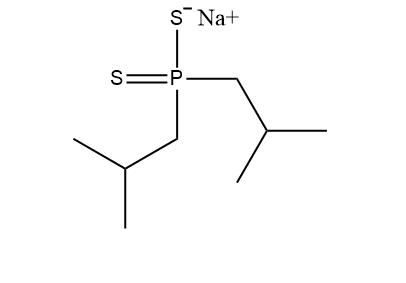
The idea of a phosphine based collector dates back to 1964-67 when dithiophosphinates were found to be effective in sulphide mineral flotation 23, 13, 15. The technology development work proved that this type of collector chemistry had many benefits over existing traditional chemistries in the market at that time, including, xanthates, dithiophosphates, mercaptobenzothiazoles, and thiocarbamates. Although not commercially available for most of the 1970s, three patents24, 25, 26 were granted to American Cyanamid Company (now Syensqo) which describe the use of dialkyl dithiophosphinate for the effective flotation of base metal sulphide ores. The flotation collector known today as AEROPHINEⓇ 3418A Promoter became commercially available for use in the mineral industry in 197913.
Though originally developed for the flotation of copper and activated zinc minerals22, AEROPHINEⓇ 3418A was found to have a much wider range of applications as discovered through years of development work. With the growing number of successful applications of AEROPHINEⓇ 3418A during the 80’s and 90’s at many complex sulphides ore bodies, other existing operational mines began investigating its use. In the early 2000’s, several mine sites that historically used alternative collector chemistry began testing its effectiveness on their ores27. In many cases, operations switched to using AEROPHINEⓇ 3418A and many of these operations still use the chemistry today. Also, on a more fundamental front, numerous studies of the adsorption of AEROPHINEⓇ 3418A on sulfide minerals and precious metals have been conducted using a number of techniques including electrochemistry, wettability and spectroscopy which have provided a scientific basis and lent support to the results achieved in plant practice21, 1, 2, 3, 4, 5, 6, 7, 8, 9, 10, 11, 12, 14, 16, 17, 18, 19, 20, 23.
Today AEROPHINEⓇ 3418A use is widespread around the globe as a Cu, Pb, and activated Zn collector in the processing of complex polymetallic ores of Cu-Zn, Cu-Pb-Zn and Pb-Zn, which frequently have significant quantities of associated Ag and Au. Naturally, it is used in Cu ores with economical amounts of Au. It is also applied in Cu porphyry ores for selectivity against pyrite and other sulfide gangue including those of penalty elements. Finally, and more recently, it has found application in Cu-Ni ore flotation by itself and in Cu-Ni-specific formulations. The majority of these operations have found the collector chemistry to bring significant value to their operations by increasing secondary precious metal recoveries. This is a significant economic driver for many operations, which rely on the precious metals revenue streams within their concentrates.
AEROPHINEⓇ 3418A helps polymetallic mines and copper mines with precious metal content improve silver flotation, with recovery gains of 3 to 5 percent, and increase gold recovery by 1 to 2 percent. These results are often achieved using significantly lower dosages than competing chemistries while delivering a return on investment (ROI) of up to 500 percent or greater, leading to significant metallurgical gains and improvements to Net Smelter Return (NSR) for mining operations.
AEROPHINEⓇ 3418A offers improved flotation rates and superior selectivity against non-value metals, driving excellent separation efficiency compared to xanthates and DTP collectors. Its increasing use as a base metal ore collector is due to its high selectivity for the separation of copper from copper-zinc ores and lead from lead-zinc ores, rejecting iron sulfides, zinc sulfides, arsenopyrite and penalty element sulfides. In addition, AEROPHINEⓇ 3418A has found application in Cu-Ni ores in which, on its own, leads to sharper Cu-Ni separation. In formulations (as in our AEROⓇ NP series), it has shown to improve Cu kinetics and selectivity against pyrrhotite in bulk Cu-Ni flotation and improve selectivity of Cu-Ni separation in matte flotation.
AEROPHINEⓇ 3418Acan be added to different locations within the circuit. Due to its versatility, AEROPHINEⓇ 3418A is compatible with a wide range of circuit configurations. Aside from ease of use, itoffers an improved toxicity profile, another distinct advantage over competing chemistries such as xanthates. It is also safer for employees to handle as it does not decompose into byproducts or offgas (Elizondo-Álvarez et al 2021). And unlike competing products, AEROPHINEⓇ collectors are not considered “dangerous goods” and, therefore, are not subject to Transportation of Dangerous Goods (TDG) requirements.
Challenges Faced
The following lists some of the most common challenges faced by our customers:
- The need to increase precious metal recoveries (Au, Ag, electrum) to copper concentrate.
- The need to increase the efficiency of separation between Pb and Zn in Pb/Zn ores.
- The need to increase the efficiency of separation between Cu and Zn in Cu/Zn ores.
- The need to increase Cu concentrate grade by rejecting iron sulfide gangue.
- The need to increase Cu flotation kinetics.
- The need to use less collector, thus avoiding related process issues and improving process stability.
Traditional Strategies / Syensqo Recommendations
Traditionally, xanthates and dithiophosphate derivatives alone have been used to treat these ores, however, their use has inherent issues related to poor selectivity against unwanted sulfide gangue minerals as well as issues with froth-activity that in turn leads to higher carryover of water and mass to the concentrate. Furthermore, the inherent instability of xanthates requires constant makeup of stock solutions leading to consistent handling of hazardous solids and, in addition to exposure of workers to CS2 gas.
By contrast, plant usage of AEROPHINEⓇ 3418A promoter indicates that it exhibits strong collecting power for copper sulphide minerals, galena, nickel sulphide minerals, and activated sphalerite, while achieving excellent selectivity against iron sulphide gangue minerals such as pyrite, pyrrhotite, marcasite, and arsenopyrite. AEROPHINEⓇ 3418A promoter is recognized in the industry for the recovery of native silver and silver sulphide minerals. Similarly, it has been shown to be very effective for gravimetric gold, electrum, and other precious metal alloys. For many ores the dosage required is typically considerably lower than that needed for the traditional collectors such as a dithiophosphate and xanthate.
Table 1 shows a list of ores for which AEROPHINEⓇ 3418A and its formulations can provide benefits.
Table 1. Ore types which benefit from use of AEROPHINE® 3418A and its formulations.
| Ore Type | Mineral Values | Major Minerals | Syensqo Recommendations |
| Copper | Cu/Au Cu/Au/Ag | Chalcopyrite Secondary copper sulfides Free gold & electrum Gold & Silver associated with sulfides | AEROPHINE® 3409 AEROPHINE® 3418A AEROPHINE® 3421 AEROPHINE® 3422 |
| Polymetallic | Cu/Pb/Zn Pb/Zn Cu/Zn Au/Ag/Cu/Pb/Zn | Cu sulfides Galena Sphalerite Silver, Gold & electrum Tetrahedrite/Tennantite Gold & Silver associated with sulfides | AEROPHINEⓇ 3406 AEROPHINEⓇ 3407 AEROPHINEⓇ 3409 AEROPHINEⓇ 3410 AEROPHINEⓇ 3418A |
Precious Metals | Au/Cu and Auriferous Pyrite | Cu sulfides, electrum, pyrite, arsenopyrite refractory gold | AEROPHINEⓇ 3416 AEROPHINEⓇ 3418 |
| Nickel | Ni Ni / Cu | Pentlandite Millerite Chalcopyrite | AEROPHINEⓇ 3418A |
Flotation Reagents for Copper-Gold Ores
AEROPHINEⓇ 3418A and AEROPHINEⓇ collectors, such as AEROPHINEⓇ 3421 and AEROPHINEⓇ 3422, can be used as the primary collector in flotation of porphyry copper ores that contain significant amounts of gold and silver. These collectors are highly effective in the recovery of coarse middlings and can therefore be used even at coarse grind. Additionally, AEROPHINEⓇ flotation collectors can be highly beneficial in flash flotation where a targeted level of selectivity and enhanced recovery of the fast floating, liberated particles is needed.
Gold-Copper Ores
In ores where Au has greater value than Cu, AEROPHINEⓇ 3418A and AEROPHINEⓇ collectors enable flotation at lower pH than xanthates, reducing lime usage and thus improving Au recovery. Having greater stability than xanthates allows them to be used under harsher low pH conditions where xanthates decompose to produce toxic H2S gas. In ores with auriferous pyrite, AEROPHINEⓇ collectors can be used in the rougher stage for selective Cu recovery followed by a non-selective collector to recover pyrite. This pyrite can then be reground and additional AEROPHINEⓇ collectors added to recover liberated Au and Cu values. AEROPHINEⓇ 3409 and AEROPHINEⓇ 3410 have shown great performance in North American Cu-Au operations.
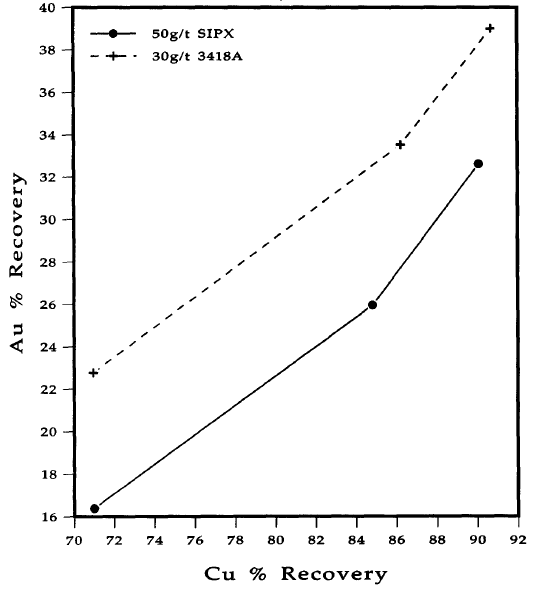
Figure 1 features an example of how AEROPHINEⓇ 3418A can increase gold recovery to copper concentrate in a copper ore application. AEROPHINEⓇ 3418A has a faster flotation rate and increases overall copper recovery, all while at 40% of the dosage of xanthate.
Flotation Reagents for Complex Sulphide Ores
AEROPHINEⓇ collectors are the flotation reagents of choice when treating Cu/Zn, Cu/Pb/Zn and especially Cu/Au/Ag/Pb/Zn ores. These ore types frequently have very high levels of pyrite and other iron sulphides. AEROPHINEⓇ collectors are highly recommended over xanthates when selectivity against iron sulphides (pyrite, pyrrhotite and arsenopyrite) is required.
Copper-Lead-Zinc Ores
AEROPHINEⓇ collectors are critical in providing optimum separation efficiency to generate high value concentrates in these complex circuits. Using a selective promoter in the early stages of sequential flotation helps to maintain selectivity through subsequent stages. Requiring low dosages, they provide excellent selectivity and enhanced flotation rates of base metals of choice and precious metals to make economical concentrates possible. AEROPHINEⓇ 3418A and AEROPHINEⓇ blends are commonly used collectors in these applications.
Lead-Zinc Ores
AEROPHINEⓇ 3418A collector is especially effective as the primary collector for galena, particularly where selectivity is desired against iron and zinc sulfides. It is an exceptional collector for silver minerals and argentiferous galena. AEROPHINEⓇ blends are often used as primary and secondary collectors, such as AEROPHINEⓇ 3407, AEROPHINEⓇ 3409 and AEROPHINEⓇ 3410.
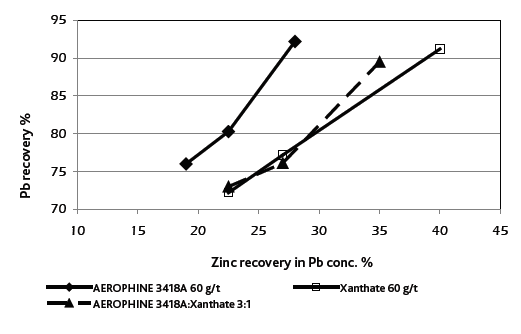
The example shown in Figure 2 looks at AEROPHINEⓇ 3418A’s selectivity against zinc in lead flotation vs. xanthate at equivalent dosages. AEROPHINEⓇ 3418A, an excellent base metal ore collector, provides superior Zn rejection, while increasing overall Pb recovery.
Copper-Zinc Ores
AEROPHINEⓇ 3418A promoter is especially effective as the primary flotation collector for chalcopyrite, particularly where selectivity is desired against iron and zinc sulfides. It is an exceptional collector for silver minerals and gold electrum. AEROPHINEⓇ blends are commonly used collectors, such as AEROPHINEⓇ 3406, AEROPHINEⓇ 3409 and AEROPHINEⓇ 3410.
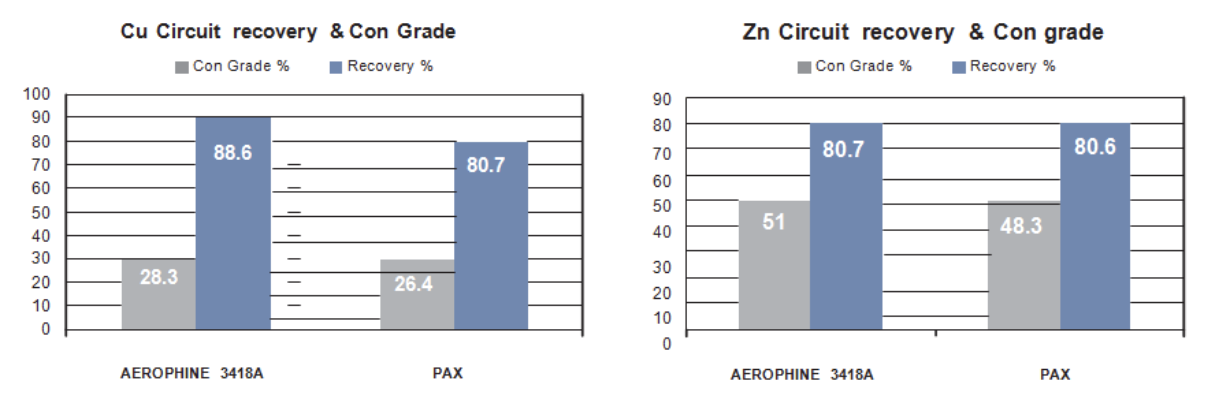
In this example, ore from a chalcopyrite-sphalerite deposit was being milled at a rate of approximately 10,000 tonnes per day. The concentrator used a conventional flow sheet of copper flotation followed by copper sulfate activation and zinc flotation. After successful laboratory tests, AEROPHINEⓇ 3418A, was introduced for a full-scale, ten-day, plant trial. The standard mill collector and frother were potassium amyl xanthate and MIBC, respectively. Table 2 shows the conditions during the respective periods of each collector.
Table 2. Conditions prevalent during the trial period with each collector.
| AEROPHINE® 3418A | Xanthate | |
| Heads, % Cu | 0.97 | 0.84 |
| Heads, % Zn | 1.21 | 1.59 |
| Cu collector dosage (g/t) | 17 | 24 |
| Zn collector dosage (g/t) | 0 | 10 |
Copper recovery increased by 8%, and collector dosage was reduced by 50% as shown in Figure 3. Frother consumption was unchanged. AEROPHINEⓇ 3418A also induced minor improvements in zinc grades and recoveries. Zinc recovery in the copper concentrate and copper recovery in the zinc concentrate were essentially the same for both collectors. The improvements experienced in copper metallurgy alone more than justified the change to AEROPHINEⓇ 3418A.
Flotation Reagents for Precious Metal Ores
AEROPHINEⓇ formulations can provide significant improvements in flotation performance for mines that produce a high grade Ag, Au or Ag-Au concentrate. Increased flotation rates and selectivity for precious metals make them ideal primary and secondary collectors for precious metal flotation. Commonly used products include AEROPHINEⓇ 3416 and AEROPHINEⓇ 3418A.
Flotation Reagents for Copper-Nickel Ores
AEROPHINEⓇ 3418A has been historically known to provide good selectivity on various Cu-Ni ore bodies against pyrrhotite and MgO. Its use can reduce the quantity of xanthate required, while increasing Cu flotation kinetics and providing improved metallurgy. Additionally, it does not produce CS2 or COS, which is a significant advantage in terms of health and safety when compared to xanthates.
Sequential Copper-Nickel Flotation
In sequential flotation, pH is raised to pH 11 with lime and a starvation dosage (6 g/t – 15 g/t) of AEROPHINEⓇ 3418A promoter is used. This allows selective flotation of a high grade copper concentrate with minimal nickel content. Slurry pH is then reduced to about pH 9 and a nickel concentrate is produced.
Bulk Copper-Nickel Flotation
In bulk Copper-Nickel flotation AEROPHINEⓇ 3418A can reduce the quantity of xanthate required, while increasing Cu and Ni flotation kinetics to provide improved metallurgy for both chalcopyrite and pentlandite, and enhanced selectivity against pyrrhotite and MgO.
Syensqo also offers specialty AEROⓇ NP series designed specifically for treating Ni and Cu-Ni ores, which have formulations specific for application at many stages of the process: bulk Cu-Ni flotation, Cu-Ni separation or matte flotation.
Application Notes
For more information on the practical application of AEROPHINE 3418A please consult the technical data sheet.
References
- Bagci, E, Ekmekci, Z, & Bradshaw, D (2007), Adsorption behaviour of xanthate and dithiophosphinate from their mixtures on chalcopyrite, Minerals Engineering, Volume 20, Issue 10, August 2007, Pages 1047-1053.
- Basilio, C.I., Yoon, R.H, Nagaraj, D.R., & Lee, J.S. (1991). Adsorption mechanisms for modified thiol-type collectors; SME Annual Meeting, Denver, Preprint 91-171.
- Basilio, C.I. Kim, D.S., Yoon, R.H., Leppinen, J., & Nagaraj, D.R. (1992). Interaction of Thiophosphinate collectors with precious metals. SME Annual Meeting, Phoenix, Preprint 92-174.
- Brinen, J.S., Greenhouse, S., Nagaraj, D.R., & Lee, J.S. (1993). SIMS and SIMS imaging studies of adsorbed dialkyl dithiophosphinates on PbS crystal surfaces. Int. Journal of Mineral Processing, 38 (1993) 93-109.
- Brinen, J.S. & Nagaraj, D.R. (1994). Direct Observation of a Pb-Dithiophosphinate Complex on Galena Mineral Surfaces using SIMS. Surface and interface analysis, Vol 21, 874-876.
- Farinato, R.S. & Nagaraj, D.R. (1992). Time dependent wettability of mineral and metal surfaces in the presence of thiol surfactants. J.Adhesion Sci. Technol. VoL 6. No. 12.pp. 1331-1346.
- Gorken, A, Nagaraj, D.R., & Riccio, P. (1992). The influence of pulp redox potentials and modifiers in the flotation separation of complex sulfide ores with dithiophosphinate. Proc. Of the Third Int. Symp. on Electrochemistry in Mineral and Metal Processing, Ed. Woods, R and Richardson, P.E., The Electrochemical Society, NJ.
- Güler, T, Hiçyilmaz, C, Gökağaç, G, & Ekmekçi, Z,(2004). Voltammetric and drift spectroscopy investigation in dithiophosphinate–chalcopyrite system, Journal of Colloid and Interface Science, Volume 279, Issue 1, Pages 46-54.
- Güler,T, & Hiçyilmaz, C (2004) Hydrophobicity of chalcopyrite with dithiophosphate and dithiophosphinate in electrochemically controlled condition, Colloids and Surfaces A: Physicochemical and Engineering Aspects, Volume 235, Issues 1–3, Pages 11-15.
- Güler, T, Hiçyilmaz, C, Gökağaç, G, & Ekmekçi, Z, (2006). Adsorption of dithiophosphate and dithiophosphinate on chalcopyrite, Minerals Engineering, Volume 19, Issue 1, Pages 62-71.
- Hope, G, Woods, R, Boyd,S, & Watling, K, (2003). A spectroelectrochemical investigation of the interaction of diisobutyldithiophosphinate with copper, silver and gold surfaces: I. Raman and NMR spectra of diisobutyldithiophosphinate compounds, Colloids and Surfaces A: Physicochemical and Engineering Aspects, Volume 214, Issues 1–3, Pages 77-85.
- Hope, G, Woods, R, & Watling, K, (2003). A spectroelectrochemical investigation of the interaction of diisobutyldithiophosphinate with copper, silver and gold surfaces: II. Electrochemistry and Raman spectroscopy, Colloids and Surfaces A: Physicochemical and Engineering Aspects, Volume 214, Issues 1–3, 12 Pages 87-97.
- Mingione, P.A., (1990). Use of AEROPHINE® 3418A Promoter for sulphide minerals flotation, CMP Proceedings – Paper No. 26, pp. 485-508, Ottawa, ON.
- Nagaraj, D.R. & Brinen, J.S. (1997). SIMS Analysis of Flotation collector Adsorption and Metal Ion Activation on minerals: Recent Studies. Trans. Ind. Inst. Metals, vol.50, No.5, Oct. 1997, pp.365-376.
- Nagaraj, D. R., & Farinato, R. S. (2014). Major innovations in the evolution of flotation reagents. Mineral processing and extractive metallurgy, 100, 159-175.
- Pecina-Treviño, E.T., Uribe-Salas, A, & Nava-Alonso, F (2003). Effect of dissolved oxygen and galvanic contact on the floatability of galena and pyrite with Aerophine 3418A, Minerals Engineering, Volume 16, Issue 4, Pages 359-367.
- Pecina-Treviño, E.T., Uribe-Salas, A, Nava-Alonso, F, & Pérez-Garibay, R (2003). On the sodium-diisobutyl dithiophosphinate (Aerophine 3418A) interaction with activated and unactivated galena and pyrite, International Journal of Mineral Processing, Volume 71, Issues 1–4, Pages 201-217.
- Pecina-Treviño, E.T, Uribe, Nava, A.F., & Finch, J.A., (2006). The role of copper and lead in the activation of pyrite in xanthate and non-xanthate systems, Minerals Engineering, Volume 19, Issue 2, Pages 172-179.
- Pecina-Treviño, E.T, Uribe, A., Finch, J.A., Nava, F., (2006). Mechanism of di-isobutyl dithiophosphinate adsorption onto galena and pyrite, Minerals Engineering, Volume 19, Issue 9, Pages 904-911.
- Piantadosi, C, Roger St.C Smart, (2002). Statistical comparison of hydrophobic and hydrophilic species on galena and pyrite particles in flotation concentrates and tails from TOF-SIMS evidence, International Journal of Mineral Processing, Volume 64, Issue 1, Pages 43-54.
- Tercero, N., Nagaraj, D. R., & Farinato, R. (2019). A critical overview of dithiophosphinate and dithiophosphate interactions with base metal sulfides and precious metals. Mining, Metallurgy & Exploration, 36(1), 99-110.
- Thomas, W., (Ed.). (2010). Mining chemicals handbook- 2010 edition, Cytec Industries, Inc., Chapter 2. Meriden, CT.
- Wang, S.S. & Avotins, P.V. (1982). The use of dialkyl dithiophosphinates in sulfide flotation. SME Annual Meeting, Dallas, Preprint 82-155.
- Wystrach, Vernon P.; Peters, & Grace A., (1964). Salts of 2-cyanoethylphosphinodithioic acids, US 3138605 19640623.
- Wystrach, Vernon P.; Rauhut, Michael M.; & Freyberger, Wilfred L (1966) Froth flotation of ores by secondary dithiophosphinic acids or their salts or esters, DE 1214171 19660414.
- Wystrach, Vernon P.; Rauhut, Michael M.; & Freyberger, Wilfred L. (1967). Dithiophosphinate promoters for improved flotation of sulfides, US 3355017 19671128.
- Zhou, J, Martin, C, Blatter, P, Bossé, P-A., & Robitaille, J, (2005). The process mineralogy of precious metals in LaRonde flotation products and its effect on process optimization. Proceedings of International Symposium on the Treatment of Gold Ores, Calgary, AB. August 2005.