Executive Summary
Due to ever decreasing head grades, volatility of metal prices and the processing challenges faced, Ni and Cu-Ni ores plants are required to innovate in order to manage. The Ni and Cu-Ni flotation collector market, however, is dominated almost exclusively by the use of xanthates as a single type of chemistry. Though effective, xanthates nevertheless have several drawbacks, oftentimes not being able to provide the flexibility needed in processing of these ores. In addition, xanthates also present disadvantages in terms of product stability (and thus inconsistency in performance) as well as hazards related to its handling and storage. In response, Solvay has developed its AERO® NP series, which takes into account the needs of the Ni and Cu-Ni sulfide industry and provides the required processing flexibility, operator safety and many other functional- and operational benefits.
General Comments / Major Considerations
Processing of Ni and Cu-Ni ores is dependent on many factors as discussed at length in our “Ni and Cu-Ni Ores” section. From Solvay’s interaction with several Ni and Cu-Ni operations around the globe we are able to identify a few characteristics and trends in the industry:
- More and more, ores with ever decreasing head grades are being encountered.
- Ore characteristics and corresponding processing challenges are segmented by region around the globe. For example, ores in Western Australia are very different from ores in Sudbury, Canada, each with their characteristic challenges in terms of gangue management and Ni recovery improvement.
- Metal prices drive process efficiency and often force mines to innovate in order to stay competitive.
- The market is dominated by single chemistry solutions, namely, xanthates.
Though generally effective, the use of xanthates often leads to inflexibility in the processing of Ni and Cu-Ni ores resulting in many issues such as loss of selectivity against pyrrhotite, difficulty in achieving a sharp Cu-Ni separation downstream, froth instability (xanthates in the presence of certain gangue), inability to operate below a given pH (due to rapid decomposition of xanthates), as well as issues related to operator and environmental safety like generation of carbon disulfide (CS2) gas, handling of flammable solids during preparation, and emanating stench from concentrates. In addition, there are often issues related to product quality that result in inconsistent performance. All said, it is unreasonable to expect that xanthates alone can address the multiple challenges faced by mills in floating Ni and Cu-Ni ores.
Challenges Faced
By meeting with customers as well as leaders in industry and academia, Syensqo identified and classified the needs of the Ni and Cu-Ni sulfide market into four main categories. The following table lists these industry needs together with their corresponding processing challenges, common strategies used to handle them and Syensqo's approach.
Table 1. List of needs and challenges of the Ni and Cu-Ni sulfide flotation industries together with common strategies and Syensqo's approach to addressing them (currently unmet need in italics).
| Industry Needs | Processing Challenges | Common Strategies | Syensqo Solutions |
| Increase Ni Recovery |
|
|
|
| Selectivity against Pyrrhotite (Po) |
|
|
|
| Selectivity for Cu against Ni |
|
|
|
| Selectivity against MgO |
|
|
|
Traditional Strategies / Syensqo Recommendations
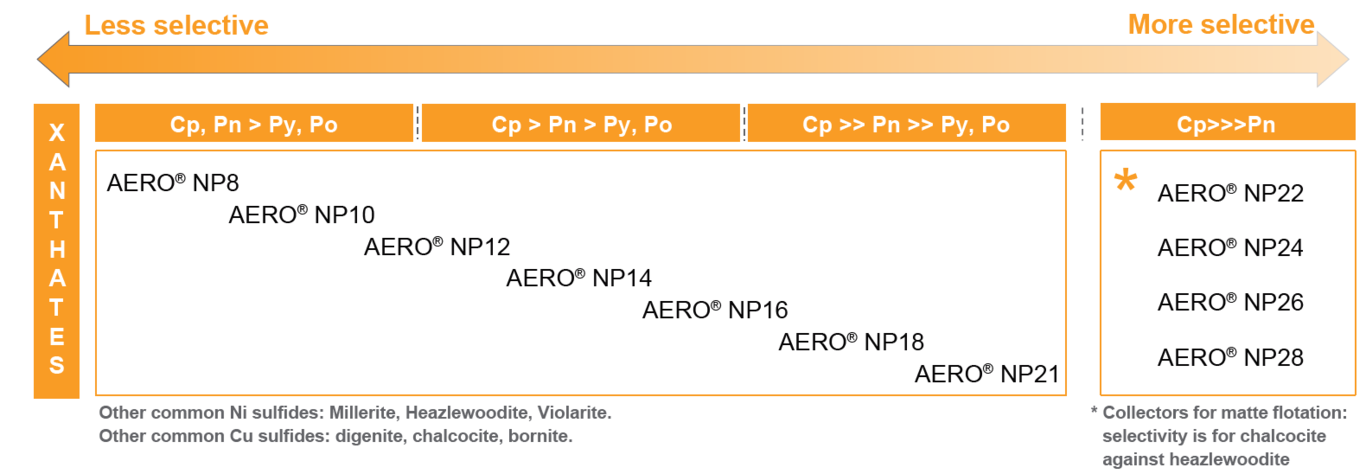
As an alternative to xanthates and based on the identified needs of the Ni and Cu-Ni sulfide ore industry, Syensqo has developed the AERO® NP series of collectors. These collectors offer a wide range of selectivities and are thus suited for application at various stages of the process, from bulk flotation to Cu-Ni separation to matte flotation. Figure 1 shows a relative scale of selectivities covered by collectors in the AERO® NP series, where for comparison, xanthates fall all the way on the non-selective end. On the most selective end (to the extreme right), we have our collectors designed specifically for Cu-Ni matte flotation, i.e. with separation of chalcocite from heazlewoodite in mind. In comparison to xanthates, these collectors have shown superior and more steady performance when applied under slightly acidic conditions (pH 4-5). Their inherent selectivity against iron sulfides can be taken advantage of by operating at slightly lower pH thereby leading to potential savings in lime or soda ash costs. Finally, an added advantage of this series of collectors is that they are liquid products and therefore do not require make up of stock solutions, thus minimizing their handling by operators.
Ni Ores
The principal sulfide minerals in nickel ores are pentlandite, millerite, pyrite and pyrrhotite, as is the case in some of the high-grade ores of Western Australia. Pentlandite, arsenopyrite and pyrrhotite are predominant in the case of the low-grade large open-pit operations of the world. Platinum group metals (PGM) and gold can be present in economically important amounts in both types of ore bodies, i.e. high- and low-grade. As discussed in the Ni and Cu-Ni ores section, depending on whether pyrrhotite is present in large quantities, selectivity against this iron sulfide may be a primary focus during processing. However, where there is little sulfur content in the head (typical of low-grade, ultramafic, finely-disseminated ores), recovery of all sulfides, including pyrrhotite may be ideal. In the case where pyrrhotite is nickel bearing, or contains important PGM values, it may be necessary to activate the pyrrhotite with copper sulfate and make a bulk flotation concentrate for maximum nickel recoveries.
Additionally, talc or talcose type minerals may be associated with these ores, which include silicates with some degree of talc alteration (e.g. talc-altered serpentines) and Ni-containing talc minerals such as, for example, willemseite. Other silicates such as serpentines (chrysotile, lizardite) can have an impact on pulp rheology or lead to formation of slimes, in turn impacting both value grades and recoveries. Flotation pH can be either neutral or alkaline, using soda ash or lime. In some operations, better nickel recoveries and grades are achieved using soda ash in preference to lime as has been pointed out1. Aside from modifying pH, soda ash can help to prevent delamination of certain silicates thus avoiding increases in pulp viscosity, aid in precipitating activating metal ions and/or lead to dispersion of slimes that can potentially coat value minerals leading to improved separation between value and gangue minerals.
Syensqo's polymeric depressant, AERO® 7261A, should be considered where pyrrhotite and/or arsenopyrite minerals are to be depressed. For depression of talc and talcose gangue, AERO® 8860GL should be tried; whereas for dispersion of other silicate fines we offer Cyquest® 3223 and Cyquest® 40E. Generally, an alcohol frother such as OREPREP® OTX-140 can be used for high kinetics and low persistence (also when significant talc is present in the ore), on the other hand a stronger frother like OREPREP® F-549 may be preferred for massive sulfide ores for carrying of coarser particles to the froth.
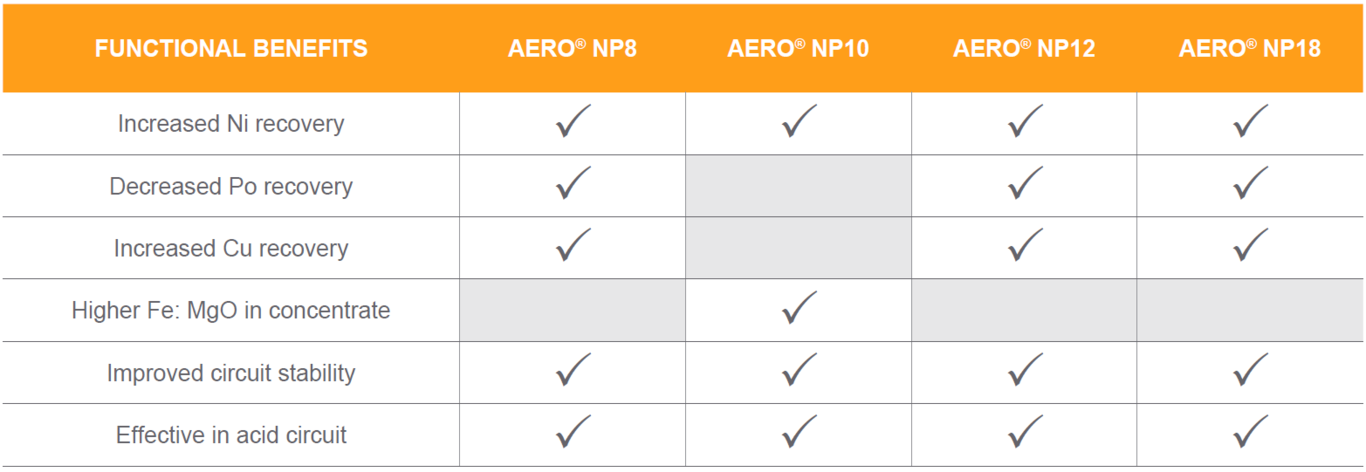
The following are Syensqo's recommended collectors for primary Ni operations together with their functional benefits (Table 2). These should be tried on their own as well as together with xanthates as there is often synergy between these two classes of collectors.
Table 2. Ni ores: Partial xnathate replacement with AERO® NP collectors.
Cu-Ni Ores
The principal sulfide minerals in Cu-Ni ores are chalcopyrite, pentlandite and pyrrhotite. Other secondary Ni minerals such as violarite, millerite, and more rarely, bravoite and awaruite may also be present. Platinum group metals (Pt, Pd and Rh) and gold can be present in economically important amounts. As pyrrhotite is usually nickel- or PGM-bearing, it may be necessary to manage pyrrhotite recoveries to avoid significant Ni losses in roughing stages and even to activate it with copper sulfate and make a bulk flotation concentrate for maximum copper and nickel recoveries. This is usually done at natural to slightly alkaline pH with a powerful xanthate such as isobutyl or amyl xanthate (20-50 g/t), however, given their non-selective nature, xanthates may lead to challenges at Cu-Ni separation stages downstream. Results from test work conducted by Syensqo personnel on various copper-nickel ores, with the objective of bulk floating chalcopyrite, pentlandite and pyrrhotite demonstrate the synergistic effect of the conjoint use of xanthates and AERO® NP collectors. At collector ratio of 1:3 or even 1:2 xanthate to AERO® NP collectors, higher flotation rates and recoveries were achieved than with the use of xanthate alone. For bulk flotation in which selectivity against pyrrhotite is not an issue, Syensqo also offers our line of xanthate replacement (XR) chemistries.
It was Canadian practice for many years to either:
- Recover the magnetic pyrrhotite by magnetic separation ahead of flotation and then float chalcopyrite, pentlandite and some nickeliferous pyrrhotite with xanthate in a natural pH circuit; or
- Float these latter minerals first using a strong xanthate such as amyl xanthate, followed by magnetic recovery of the pyrrhotite from the flotation tailing.
In most large operations, this practice has been largely discontinued in part because pyrrhotite with hexagonal crystallographic form is now often encountered which is not ferromagnetic and said to be more floatable compared to pyrrhotite of monoclinic crystallographic form which is ferromagnetic and relatively less floatable.
When it is undesirable to recover the pyrrhotite with the copper and nickel sulfides, chalcopyrite and pentlandite can be floated together without the use of copper sulfate, which is the most common practice. This is accomplished by using a collector such as AERO® NP8, AERO® NP10 and AERO® NP12 collectors with, if needed, a small amount of xanthate or one of Syensqo's FM100 recommended xanthate replacements such as the XR series, the AERO® MAXGOLD 900 family or other FM-100 formulations. Syensqo's polymeric depressant, AERO® 7261A depressant has been proven to be excellent at depressing pyrrhotite and other gangue minerals under mild alkaline conditions in nickel circuits with little impact on pentlandite and should be considered as a more environmentally friendly alternative to diethylenetriamine (DETA) or cyanide.
If the copper content justifies it, the copper-nickel concentrate is separated into a copper concentrate and nickel tailing by depressing the nickel-bearing minerals with lime to pH 12 and cyanide, usually 200-500 g/t of bulk concentrate. Starch or dextrin may be used to assist in depressing the nickel bearing minerals.
Copper-nickel separation can then be accomplished in the same manner as described but can be made sharper by the use of AERO® NP14, AERO® NP16, AERO® NP18 or AERO® NP21 collectors. For example, at the plant level, use of AERO® NP18 has led to a sharper Cu-Ni separation, higher stability of the circuit and to less MgO carryover to the copper concentrate.
Some operations carry out a Cu-Ni sequential flotation from the outset, in which, there is a Cu roughing/cleaning circuit using a selective collector at starvation dosages to float the Cu and not the Ni. The tails of the Cu circuit then feed the Ni circuit in which Ni is recovered and Po is rejected; the Ni circuit will oftentimes include a regrind mill before the cleaning stage. Xanthates are typically used in the Ni circuit. Syensqo recommends AERO® NP18 or AERO® NP21 for the Cu circuit and AERO® NP10 (with or without xanthate) for the Ni circuit.
The presence of talc or talcose type minerals and serpentines requires the usage of a modifier. Syensqo's polymeric modifiers, AERO® 8860GL GCA depressant and AERO® 7261A depressant, have demonstrated strong talc and serpentine depressing abilities and should be evaluated; other available products are dextrin, guar gum or, as practiced in some Australian nickel operations, CMC (carboxymethyl cellulose) or some similar colloid for their depression. For dispersion of silicate slimes, we recommend Cyquest® 3223 and Cyquest® 4000. Again, an alcohol frother such as OREPREP® OTX-140 or AEROFROTH® 70 can be used for high kinetics and low persistence and are preferred for improved selectivity against the talc. For a stronger frother, OREPREP® F-549 may be used for massive sulfide ores with no problematic silicate gangue for help in carrying coarser material to the froth.
One more relevant application of the AERO® NP series is that of recovery of Cu from valleriite, a mineral that does not float under normal alkaline conditions and which could carry a significant percentage of Cu in the feed. The mineral is floatable under slightly acidic conditions (pH 4-5), conditions under which xanthates have been shown to not perform well. AERO® NP8 has been shown to be the best collector for this purpose, demonstrated to lead to > 10% increase in Cu recovery at the plant level.
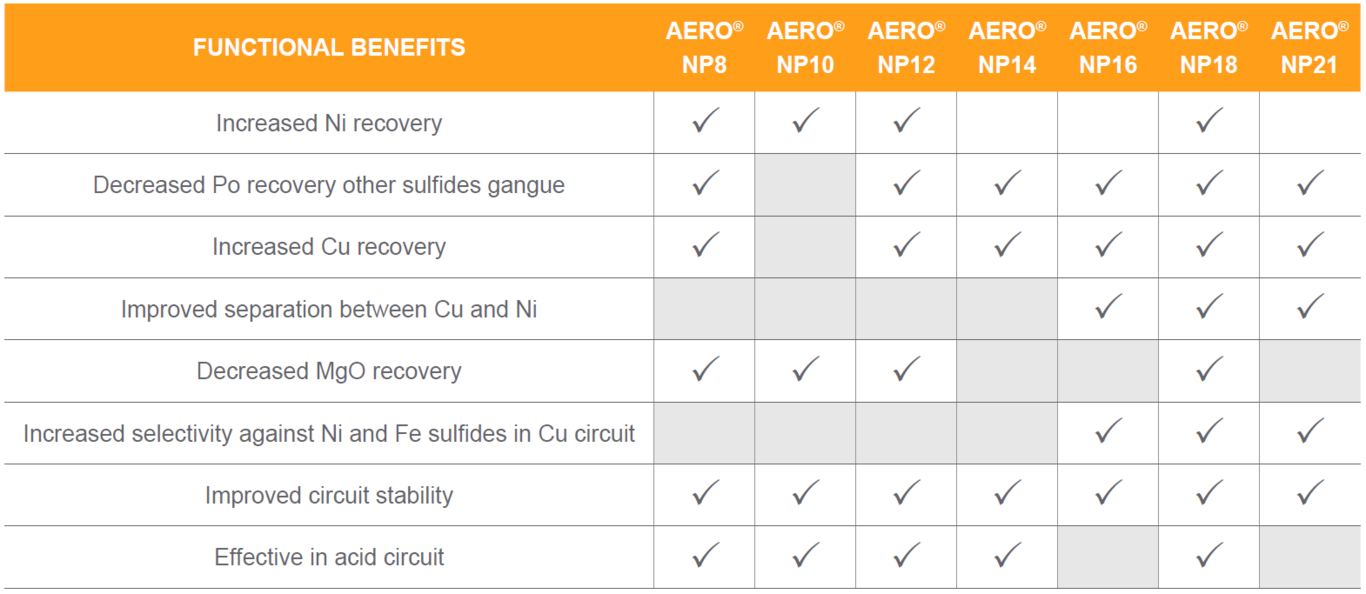
The following are Syensqo's recommended collectors for Cu-Ni operations together with their functional benefits (Table 3). Once more, these should be tried on their own as well as together with xanthates as there is often synergy between these two classes of collectors.
Table 3. Cu-Ni ores: Partial xanthate replacement with AERO® NP collectors.
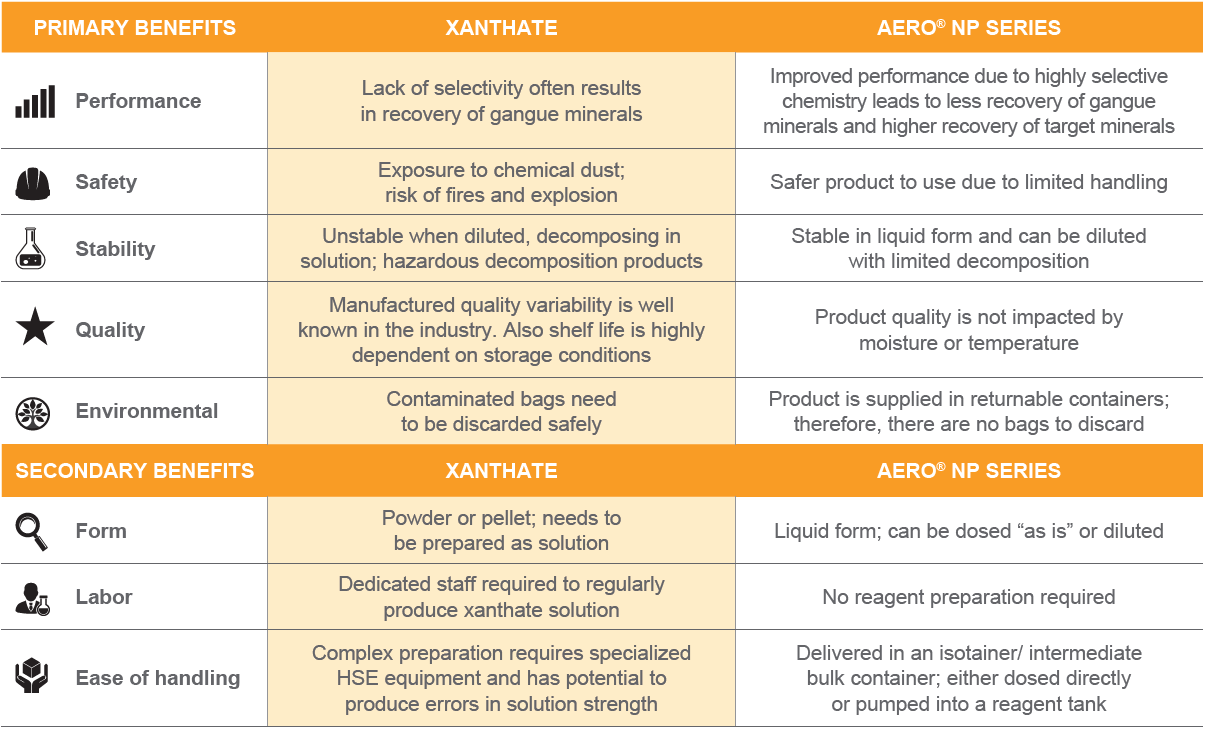
Lastly, Table 4 also lists the operational benefits of using AERO® NP series over xanthates.
Table 4. Benefits of using AERO® NP Series collectors as compared to xanthates.
Please contact our technical experts to help you with the application of these reagents.
AERO® NP Series Product Line
AERO® NP8 - This collector exhibits selectivity against pyrrhotite while maintaining nickel recovery. It can be used on its own or in conjunction with xanthate, in which case it can assist in increasing nickel recovery and reducing xanthate requirements. Given its stability, this product is particularly well- suited for use in lower pH circuits, such as in the processing of some ultramafic ores.
AERO® NP10 - This product is the strongest of the AERO® NP Promoters. It can be used as a bulk Cu-Ni collector in massive sulfide nickel ores to maintain or even increase nickel recoveries when used with xanthates. In ores with low sulfur and high silicate content in the feed, this promoter can support higher iron-to-sulfur ratios in the concentrate. This product can also be used in lower pH circuits.
AERO® NP12 - This product is a selective collector for nickel and copper-nickel ores. A key feature is its effectiveness over a variety of ore types. It can be used on its own—giving maximum selectivity vs. pyrrhotite—or in conjunction with xanthate—in which case it can be used to increase nickel recovery and significantly reduce xanthate requirements. This product is also suited for use in lower pH circuits.
AERO®NP14 - This product is a highly selective collector for nickel and copper-nickel ores. It exerts high selectivity against pyrrhotite while maintaining nickel recovery. The product can be used on its own, but it is mainly used as a secondary collector in conjunction with xanthate. Additionally, in alkaline circuits, AERO® NP14 can assist in reducing frother requirements.
AERO®NP16 - This product is a highly selective copper collector used in the process of separating copper-nickel ores. It is used to improve copper flotation kinetics over xanthates, while exerting high selectivity against pyrrhotite. AERO® NP16 Promoter is typically used as the primary copper collector in sequential copper-nickel flotation or in conjunction with xanthate in copper-nickel bulk circuit applications.
AERO® NP18 - This product is a highly versatile collector that can be used in many flotation processes. It supports selective copper flotation in copper-nickel sequential flotation, as a bulk collector for copper-nickel flotation or to enhance copper flotation in the copper-nickel separation stage.
AERO® NP21 - This product is a highly versatile collector that is most often used as a secondary collector in bulk copper-nickel flotation or for selective copper flotation in copper-nickel sequential flotation. It can also be used to enhance discrimination against nickel and iron sulfides in copper-nickel separation stages.
AERO® NP22-28 - These products were developed for use as copper collectors in copper-nickel matte separation and provide flexibility in applications in which frother addition can be tuned or even eliminated as required by the specific process. Their use replaces highly toxic products used in this application.