
Executive Summary
The world’s supply of lead (Pb), zinc (Zn) and to some extent copper (Cu), derives from the processing of so-called complex polymetallic sulfide ores. The complexity in processing of such ores stems from many contributing factors. One factor includes the presence of sulfide gangue such as pyrite/marcasite, pyrrhotite and arsenopyrite as well as non-sulfide gangue including carbonaceous matter, carbonates and silicates. Deportment of precious metals, like gold and silver, as well as the required concentrate to which they need to report to is another important factor. Furthermore, there is typically high variability in value sulfide content that contributes to difficulty in achieving selectivity among the various minerals. Achieving selectivity among value sulfides can be further impeded by the inadvertent activation of given value or gangue sulfide minerals by Cu or Pb ions in solution. The fine-grained nature of the ores is yet an additional contributor to complexity given that it often can lead to poor liberation, or even generation of fine particles which are in turn difficult to recover by flotation. Finally, tarnishing of value minerals or the presence of Pb, Zn or Cu in oxide minerals can lead to poor recoveries of each. Depending on the content of Pb, Zn, Cu, complex polymetallic sulfide ores can be classified as either Cu-Pb, Cu-Zn, Pb-Zn or Cu-Pb-Zn ores. Reagent selection for the processing of these ores is key in achieving optimal metallurgical outcome. In addition, safety, health and environmental considerations also drive selection of selective reagents in order to minimize use of toxic and hazardous chemicals as in the case of cyanide use for Cu depression, for example. The following is a discussion of the processing of complex polymetallic sulfide ores, mentioning the traditional approaches taken as well as Syensqo's suite of reagents to address many of the processing challenges faced.
General Comments/Major Considerations
Ores which contain sulfide minerals of copper, lead, and zinc are typically referred to as complex, polymetallic ores. A selective differential flotation of these ores continues to be a challenging task for flotation operators1, 6, 10, 15. If there are sufficient quantities of copper, lead, and zinc, it is usually economically justifiable to produce three separate concentrates for each of the metals of value. A few operations have opted to produce a fourth concentrate of value which is a bulk Pb-Zn concentrate7, 8, 16.
The complexity of the separation stages can be compounded by the presence of gangue sulfide minerals such as pyrite, marcasite, and pyrrhotite. Some operations may also produce a pyrite concentrate if it is advantageous to enhance the selectivity of subsequent separation stages, to isolate this mineral from the tailings stream, or to produce a concentrate which contains precious metals such as gold.
Precious metals, particularly silver and gold, are often present in the ore which may pose additional challenges for economic recovery. It is preferable to have the gold values recovered to the copper concentrate and have the silver values recovered to either the copper concentrate or lead concentrate. Operations generally get no credit for precious metals in the zinc concentrate.
Because of the highly variable content of each valued mineral, each complex polymetallic orebody can be considered unique. Therefore, each orebody requires an appropriate selection of collectors, modifiers, and conditions in order to selectively separate each metal of value into a separate copper concentrate, lead concentrate, and zinc concentrate.
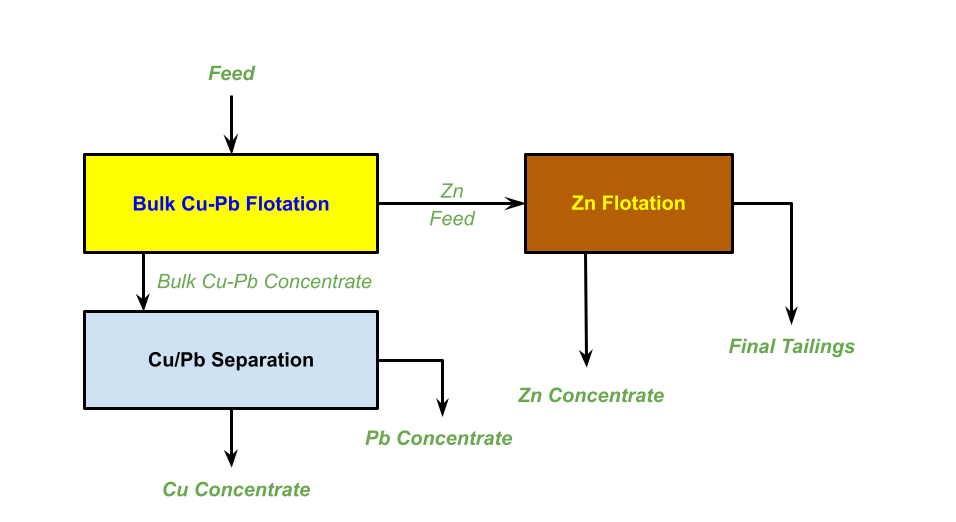
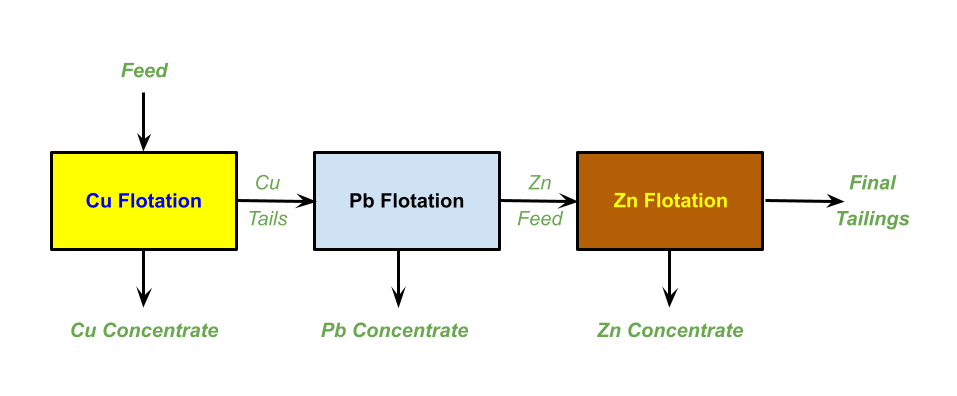
Regardless of the relative content of each mineral in a complex polymetallic ore, the methods and sequence of flotation separation stages are similar amongst all orebodies which contain sulfide minerals of copper, lead, and zinc. Typically, complex polymetallic ores of copper, lead, and zinc are separated by one of two methods. One method requires the flotation of a bulk Cu and Pb concentrate followed by a Cu/Pb separation stage. The second method requires the sequential collection of a copper concentrate, followed by the collection of a lead concentrate. The collection of the zinc concentrate is carried out on the tailings from the copper and/or lead circuit.
Mineralogy
Typically, complex polymetallic sulfide ores contain varying contents of the valued minerals chalcopyrite, galena, and sphalerite. These ores can be broadly classified as Cu-Pb, Cu-Zn, Pb-Zn, or Cu-Pb-Zn ores depending upon the content of each metal. The ores usually contain some sulfide gangue minerals such as pyrite, marcasite, pyrrhotite, and sometimes arsenopyrite. The content of any one of the sulfide minerals can vary quite widely from one ore body to another and therefore the separation treatment of an ore will be unique and will vary with the mineralogical characteristics of the ore.
Lead Minerals
Galena (PbS) is the most predominant lead mineral in complex polymetallic sulfide ores. Galena is friable and because of its relatively high specific gravity tends to report to the cyclone underflow. This can result in over-grinding of the galena leading to unwanted fines generation. Fine particles are more difficult to recover because these fines tend to float much slower.
Lead can also occur in the minerals anglesite (PbSO4) and cerussite (PbCO3) and it is not unusual to have these minerals associated with complex polymetallic sulfide ores. Since anglesite and cerussite are not sulfide minerals, they are more difficult to recover than galena in a sulfide flotation circuit and can be the source of significant lead losses in a sulfide flotation circuit. Also, these oxide minerals of lead are much more soluble than galena and can contribute significant lead ions to the flotation system resulting in an inadvertent activation of sphalerite.
Copper Minerals
The most common copper mineral in complex polymetallic sulfide ores is chalcopyrite. However, the secondary copper minerals like bornite, chalcocite, and covellite can also be present in complex polymetallic sulfide ores. The secondary copper minerals are generally more soluble than chalcopyrite and can contribute significant copper ions to the flotation system resulting in an inadvertent activation of sphalerite. This can result in the incorrect deportment of the sphalerite to the copper concentrate.
Zinc Minerals
The most common zinc mineral in complex polymetallic sulfide ores is sphalerite ((Zn,Fe)S) including marmatite. Zinc can also occur in oxide minerals like smithsonite and hydrozincite, which are carbonates, and hemimorphite and willemite, which are silicates. These oxide minerals of zinc do not float well in a typical sulfide flotation circuit and will require alternate flotation conditions for their recovery.
Gangue Sulfide Minerals
The most common sulfide gangue minerals are pyrite and pyrrhotite. Marcasite and arsenopyrite can also occur with some ores.
Non-Sulfide Gangue Minerals
There are a wide variety of non-sulfide gangue minerals including carbonates (Mississippi Valley Type ores), silicates, and carbonaceous matter.
Challenges Faced
- Inadvertent deportment of minerals into the inappropriate concentrate such as sphalerite into the copper and lead concentrate or lead into the copper concentrate.
- Fine grained nature of most ores resulting in either poor mineral liberation or the production of fine particles which are difficult to recover by flotation.
- The selection of modifiers, particularly depressants, which result in minimal adverse impact upon the safety and health of operators and the surrounding environment (SHE).
- The selection of flotation collectors which achieve more selective separation and minimize the requirement for depressants.
Traditional Strategies / Syensqo Recommendations
Flotation of Cu-Pb-Zn Ores
In order to produce a bulk copper-lead concentrate or sequentially float a copper and a lead concentrate it is usually necessary to treat the feed with modifiers for the purpose of depressing the sphalerite and the gangue sulfide minerals. Minor amounts of copper ions or lead ions, which are solubilized during grinding, can activate the sphalerite.
Sphalerite and gangue sulfide mineral depression is most commonly accomplished with the use of cyanide in combination with zinc sulfate. Typically, the amount of zinc sulfate is usually three to five times that of cyanide. When gold and silver are present, it is preferable to premix zinc sulfate or zinc oxide with cyanide to form the zinc cyanide complex in order to prevent dissolution of the gold and silver. A ratio of 2:3 (by weight) Zn to NaCN is utilized in preparing the zinc cyanide complex. This complex can be prepared by following these instructions.
Other modifiers used to depress sphalerite and gangue sulfide minerals include the use of lime, a sulfoxy compound, or sodium hydrosulfide or sodium sulfide. These depressants may also be used in combination with each other to achieve the desired selectivity. The depressants are usually added to the grinding stage or to a conditioning stage prior to copper flotation. The stage addition of depressants may be required. Negeri and Pouskouleli12 and Quast and Hobart17 have each provided an excellent summary and description of the chemical mechanisms responsible for many of the depressants in use for sphalerite depression.
The minerals of copper and lead, primarily chalcopyrite and galena, can be floated together in a bulk flotation stage as shown in Figure 1 or can be sequentially floated9 as shown in Figure 2. In a sequential float, usually the copper minerals are floated first followed by the flotation of galena. Sphalerite flotation follows the flotation of the copper and lead minerals.
The most common reason for a bulk Cu-Pb flotation stage is because the ore is finely disseminated, and a very fine grind would be required to achieve mineral liberation. Over-grinding of the feed material to achieve improved mineral liberation can create a host of new problems. Over-grinding can negatively impact the Zn flotation stage and can also create very fine particles which are difficult to float and especially difficult to float selectively.
A bulk Cu-Pb flotation stage may also be desirable when it is not possible to sequentially float the Cu followed by Pb due to circuit design limitations. For instance, a Cu-Zn operation with historically low Pb content may have no provision to float a separate Pb concentrate on the occasions that the Pb content increases to higher-than-normal levels. The same may be true for Pb-Zn operations with historically low Cu content. The floatability of chalcopyrite and galena are quite similar under most circumstances so the operations would, in effect, have a bulk Cu-Pb flotation stage.
If a bulk Cu-Pb flotation stage is desired or required, then collectors such as AEROPHINE® 3418A11, 5, AEROFLOAT® 7310, or AEROFLOAT® 241 are the preferred collectors. Collector dosages in the 10 to 15-g/t/(%Cu+%Pb) is recommended. The adjustment of the pH level is usually accomplished with the use of soda ash; however, lime has also been used with success. The bulk concentrate may require a Cu/Pb separation stage depending upon the relative content of each mineral, the flotation response of each of the minerals to be separated, and the economic desire to produce a saleable concentrate. AEROPHINE® blends such as AEROPHINE®3407, AEROPHINE® 3409, AEROPHINE® 3410, AEROPHINE® 3416, AEROPHINE® 3420 can also be considered.
between the copper minerals and galena. One mineral or another, the copper minerals or the galena, requires depression and most choices of depressants are undesirable for safety, health, and environmental reasons. For instance, the use of dichromate for the depression of galena, although very effective, is almost never used anymore because of safety, health, and environmental reasons. The use of cyanide, although very effective for the depression of copper minerals, may not be permitted in some jurisdictions or the mine operator has safety or environmental concerns associated with the handling of cyanide. It remains to be a challenge to accomplish a selective copper and lead separation in a safe manner since there are few depressant chemistries available which have a greener profile than the commonly used depressants.
It is common wisdom that the minor mineral component be floated away from the major mineral component. If the lead minerals are dominant, then most operations now accomplish a Cu/Pb separation by the depression of galena using a sulfoxy compound such as bisulfite, metabisulfite, or SO2 in combination with a starch, dextrin, CMC, guar, or sometimes a polyphosphate. Syensqo's AERO® NR-7361 depressant has been successfully used and commercialized as an effective replacement for starch leading to better control of selectivity (Cu recovery vs. Pb depression) in the Cu/Pb separation circuit at low dosages (<80 g/t total rougher and cleaner dosages). At this low dosage, use of AERO® NR-7361, when compared to starch, leads to lower Cu grade in the Pb concentrate and thus higher Cu recovery into the Cu concentrate.Careful optimization of AERO® NR-7361 dosages gives operators the flexibility to maximize Cu recovery and maintain effective depression of galena in the roughers and cleaners.
If the copper minerals are dominant, then depression of the copper minerals is usually accomplished with cyanide. It is worth noting that a common (though not widespread) misconception in flotation is that cyanide will generally depress galena flotation, however, based on industrial practice as well as reports in the literature3, 4, 14, galena is not depressed by free cyanide at typical pH conditions of > 8. Nevertheless, galena flotation may be impacted if cyanide is used in the presence of of ferrous ions at pH < 813.
If a sequential float is desirable or necessary, flotation of the copper minerals is usually completed first followed by lead flotation of the copper circuit tailings. Any of the thionocarbamate collectors like AERO® 5100, AERO® 3894, or AERO® XD-5002 or formulations with these collectors can be used. The thionocarbamate collectors, especially Aero® 51001, are very selective and effective for the flotation of copper minerals and are not particularly good collectors for the flotation of galena, sphalerite which is not activated, or gangue sulfides. A collector dosage of 10-g/t/%Cu is recommended for AERO® 5100, AERO® 3894, or AERO® XD-5002 for the sequential flotation of copper minerals first. Minimal dosages of modifiers (depressants) may be required. Once the copper minerals are floated, the lead is then floated from the copper circuit tailings. This is accomplished by using a galena-specific collector such as AEROPHINE® 3418A11, 5, AEROFLOAT® 241, AEROFLOAT® 242, or AEROFLOAT® 7310 promoters. AEROPHINE® blends such as AEROPHINE® 3407, AEROPHINE® 3409, AEROPHINE® 3410 are also good for floating galena.
The zinc concentrate is then selectively floated from the tailings products from the Cu and Pb separation stage(s). Further discussion regarding the generation of a zinc concentrate can be found in the section Flotation of the Zinc (Sphalerite) Concentrate.
Flotation of Cu-Zn Ores
General practice in the treatment of copper-zinc ores is to float the copper concentrate first while depressing the zinc minerals. After copper flotation, the zinc minerals are reactivated with copper sulphate and floated selectively.
The separation of copper sulfides from sphalerite, including marmatite, particularly in the presence of iron sulfides, requires careful selection of an appropriate depression scheme and an appropriate selection of collectors and frothers. Typically, if conditions are found which are selective against pyrite, then sphalerite will not float unless the sphalerite has been inadvertently activated by either copper or lead ions. If the sphalerite is pre-activated by either copper or lead ions, then its floatability will be similar to the copper minerals. In this situation, the use of depressants will be required. Sphalerite flotation usually follows the copper flotation separation stage. The sphalerite is activated by copper sulphate and the pH level is adjusted to a more alkaline pH level by the addition of lime in order to maintain the selectivity against pyrite.
The depression schemes to prevent the flotation of pre-activated sphalerite are described in the section Flotation of Cu-Pb-Zn Ores. The pH modifiers, lime or soda ash, are usually added to the grinding stage in order to maintain a pH 8-10. If the flotation feed contains liberated precious metal values, soda ash is preferred as the principal alkalinity regulator. The depressants are also usually added to the grinding stage or to a conditioning stage prior to copper flotation.
When gold and silver are present, it is preferable to premix zinc sulfate or zinc oxide with cyanide to form the zinc cyanide complex in order to prevent dissolution of the gold and silver. This zinc cyanide complex can be prepared by following these instructions.
Technical Note. Preparation of Zinc Cyanide Complex
Ingredients:
- 100kg of technical grade zinc sulfate (ZnSO4-H2O) containing 36% Zn or 45 kg pure zinc oxide
- 55kg sodium cyanide
- 600 - 650 kg (litres) cool water
Instructions:
- Provide adequate ventilation during preparation of this reagent
- Mix the ingredients in a tank with 100% freeboard
- If using Zinc Sulfate
- Dissolve the zinc sulfate in the cool water
- Raise the pH level to al least pH8 using lime before any further steps are taken
- Add the cyanide under agitation and mix util disssolver
- If using Zinc Oxide
- Add zinc oxide into the cool water and agitate the slurry
- Add the cyanide under agitation and mix until dissolved
- Gentle agitation will be required to keep the fine zinc oxide in suspension
Safety Note:
Any preparation of a cyanide solution at pH levels below pH 8 can result in the evolution of hydrogen cyanide (HCN) gas which is extremely toxic and potentially lethal
A wide variety of collectors are available for copper flotation. These include several dithiophosphates, dithiophosphinate, thionocarbamates, and formulations of each of the foregoing. AEROFLOAT® 208, AEROFLOAT® 238, AERO® 3477, or AERO® 3501 promoters are commonly used dithiophosphate collectors for copper flotation from Cu-Zn ores. Typical dosages of the dithiophosphate collectors are 15-g/t/%Cu. For increased copper-zinc selectivity and increased rates of flotation AEROPHINE® 3418A11, 5, AEROPHINE® 3421, AEROPHINE® 3422 and AERO® 51001 are also used. Typical dosages for AEROPHINE® 3418A and AERO® 5100 are 10-g/t/%Cu. The use of an alcohol-type frother, such as OREPREP® F-501, AEROFROTH® 70, OREPREP® X-95 or AEROFROTH® 88 frothers, is preferred to both assist selectivity and to minimize the downstream effect upon the zinc flotation circuit.
Flotation of the Zinc (Sphalerite) Concentrate:
Sphalerite, including marmatite, usually always requires activation by copper sulfate. The amount of copper sulfate required for adequate zinc mineral activation varies but is of the order of 50-g/t/%Zn. The copper sulfate is added to a conditioning step, usually at the same point as, or after, lime addition. The optimum conditioning time will vary with different ores. The adsorption of copper ions will take place on the surfaces of the zinc minerals, which will then behave as the corresponding copper minerals. Some operations have found the sequence of addition of collector, lime, and copper sulfate can influence flotation results. The most favorable sequence of addition of lime and copper sulfate should be established experimentally, although lime is usually added prior to copper sulfate addition. Additional lime may be required after copper sulfate addition in order to increase the pH to the desired level.
Sphalerite is almost always associated with pyrite or pyrrhotite. Therefore, in order to obtain the highest and most economical concentrate grade, it is important to use:
- A selective collector or collector combination
- The appropriate copper sulfate dosage
- The appropriate collector dosage
- The appropriate pH level (8.5 -12.0)
- The correct order of addition of lime and copper sulfate
- The correct frother
There is increasing evidence that there are strong interactions between each of the factors listed above. Any test program should vary all these factors in a designed experimental program10, 12. Testing of one variable at a time will not reveal any interactions, if present, and will rarely reveal an optimum.
Either sphalerite alone or pyrite alone can be activated by copper ions. However, Dichmann2 has found that copper ions may make pyrite less floatable in the presence of sphalerite resulting in improved selectivity between sphalerite and pyrite. Further discussion on the role of copper ions for the selective flotation of sphalerite in the presence of pyrite can be found in the section Advancement in Zinc Flotation in Polymetallic Ores.
Nonetheless, pyrite activation may still take place during the conditioning step with copper sulfate. If this tendency exists, it can usually be overcome with the addition of lime to further raise the pH and depress the pyrite. It is, therefore, common practice to float sphalerite at pH levels from 8.5 to as high as 12.0. Cleaning of zinc concentrate is generally carried out at pH levels that are in excess of 10.
Once sphalerite is activated by copper sulphate, there is a wide selection of collectors available to selectively recover sphalerite while minimizing the recovery of unwanted gangue sulfide minerals. Dithiophosphate collectors like Sodium AEROFLOAT®, AEROFLOAT® 211, and AERO® 3477 are being used as the primary collector at many operations. AEROPHINE® 3418A is also used as the zinc collector at some operations. Thionocarbamates and its formulations, like AERO® 5100, AERO® 7279, AERO® 7048, AERO® 8222, and AERO® 4037 have also been used quite successfully for the flotation of sphalerite.
Xanthate Replacement (XR) series collectors such as AERO® 5160 and AERO® 3473 are also good sphalerite collectors that show selectivity against pyrite, arsenopyrite and pyrrhotite over a wide range of pH levels and have the potential to improve lime consumption. These reagents can help reduce the usage of copper sulfate and permit reduced pH levels in the zinc circuit.
Flotation of Pb-Zn Ores
General practice in the treatment of lead-zinc ores is to float the lead concentrate first while depressing the zinc minerals. After lead flotation, the zinc minerals are reactivated with copper sulphate and floated selectively.
The presence of large quantities of pyrite increases the problem of recovery and selectivity. Frequently, lead-zinc ores contain small amounts of copper minerals, as well as silver and gold. When free gold is present, the use of lime as an alkalinity regulator in the lead circuit may be undesirable, as it might have a depressing effect on free gold recovery. It has also been noted that zinc minerals may become activated by lime. Therefore, the use of soda ash as the pH regulator in the lead circuit may be necessary. If the ore contains a significant amount of soluble salts, the use of polyphosphates or CYQUEST® 3223 antiprecipitant may be beneficial.
Sulphoxy compounds like sodium sulfite or metabisulfite are finding increasing use as a sphalerite depressant. The sulfoxy compounds are often used in combination with cyanide and zinc sulphate. The use of sulfoxy compounds for sphalerite depression, when treating Pb-Zn ores, should be considered carefully and tested rigorously because the sulfoxy compounds can result in the depression of galena. However, in some cases, sodium sulfite or sodium metabisulfite are the only depressants used. Similar to the treatment of Cu-Zn ores, the depressants are usually added to the grinding stage.
In the case of unoxidized lead-zinc ores, flotation of the lead is accomplished as previously described in the section Flotation of Cu-Pb-Zn Ores. Collector choices include AEROPHINE® 3418A, AEROPHINE® 3407, AEROFLOAT® 241, AEROFLOAT® 242, or AEROFLOAT® 7310 promoters. Aerophine promoters should be considered first since they are excellent collectors for galena, native silver, and argentiferous lead ores11, 5. AEROPHINE® blends such as AEROPHINE® 3407, AEROPHINE® 3409, AEROPHINE® 3410, AEROPHINE® 3416 and AEROPHINE® 3420 can also be used. AEROFLOAT® 25 and AEROFLOAT® 31 promoters have been used in the past, however these two collectors, for a variety of reasons, are rarely used anymore.
In the case of tarnished or partially oxidized galena, the AERO® 400 Series promoters, particularly Aero® 404 Promoter, should be considered as an auxiliary collector.
Alcohol-type frothers, such as OREPREP® F-501, AEROFROTH® 70, OREPREP® X-95 and AEROFROTH® 88 frothers, are generally preferred for improved selectivity especially in the lead flotation stage.
Some lead-zinc ores contain carbonaceous shale or graphitic compounds, which tend to dilute the lead concentrate, retard the lead flotation rate, cause an unmanageable froth condition, or consume large amounts of collector and frother with no benefit. The use of AERO® 636 depressant, in amounts up to 100 to 300-g/t in the lead roughing circuit and lesser amounts in the cleaning circuit, can alleviate these conditions. There are also cases where the carbons are pre-floated with AERO® 736 before the lead-zinc float circuit. For a more complete discussion of mitigation strategies for carbon please see the section on Carbon Management Strategies.
After flotation of the lead minerals, the pH of the zinc circuit feed (lead circuit tailings) may require adjustment with lime, conditioned with copper sulfate, and floated as described in the section Flotation of the Zinc (Sphalerite) Concentrate.
The undesired presence of dolomite or magnesite fines in the zinc concentrate may be reduced using lignin sulfonate, quebracho, or similar tannin extract and is usually added to the zinc cleaner circuit.
Several operations recover a pyrite concentrate after flotation of the lead and zinc minerals. This is usually accomplished by adding sulfuric acid to the zinc circuit tailings to lower the pH to between 7 and 8.5. The pyrite is floated with isobutyl or amyl xanthate, AERO® 5100, AERO® 7152, AEROFLOAT® 31, AERO® 404, or AERO® 407 promoters. Soda ash has been used to counteract the depressing effect of lime upon pyrite, by precipitating the calcium ions as their carbonates. It is also possible to float the pyrite with the foregoing collectors without pH adjustment when a small amount of copper sulphate is added to reactivate the pyrite.
References
- Bruce, T.J. & So, P. (1996, September). Improved Copper-Lead Separation Using Aero® 5100 Promoter. Paper presented at 17th CIM District 6 Meeting, Kamloops, BC and Minerals Engineering ’98, Edinburgh, Scotland.
- Dichmann, T.K. (2000). The Role of Copper Ions in Sphalerite and Pyrite Flotation Selectivity. McGill University. https://escholarship.mcgill.ca/concern/theses/zw12z7151
- Grano, S., Ralston, J., Smart, R.St.C. (1990) Influence of Electrochemical Environment on the Flotation Behavior of Mt. Isa Copper and Lead-Zinc Ore. International Journal of Mineral Processing, 30(1-2):69-97.
- Guo, B., Peng, Y., Espinosa-Gomez, R. (2014) Cyanide Chemistry and Its Effects on Mineral Flotation. Minerals Engineering, 66-68:25-32.
- Guitard, E., Bruce, T., Bruey, F., Nagaraj, D.R., Riccio, P., Thomas, W. (2015). Aerophine® 3418A Promoter – The Canadian Collector – 50 Years Of Improved Metallurgy In Various Applications. CIM.
- Kim, J.Y., Stowe, K. G., Chryssoulis, S. L. (1995). Effects of Lead Ions in Sulphide Flotation. Canadian Institute of Mining, Metallurgy and Petroleum.
- Koichiro, K. & Iyama, K., (1982). Recent Development In Computer Control Using On-Stream XRF Analyser For “Kuroko” Flotation Process Of Dowa Mining Co. Society for Mining, Metallurgy & Exploration.
- Lane, G.S, & Richmond, G.D. (1993). IMPROVING FINE PARTICLE FLOTATION SELECTIVITY AT HELLYER. IMPC.
- Liu, Q & Zhang, Y. (2000). EFFECTS OF CALCIUM IONS AND CITRIC ACID ON THE FLOTATION SEPARATION OF CHALCOPYRITE FROM GALENA USING DEXTRIN. Minerals Engineering, 13(13), 1405-1416. https://doi.org/10.1016/S0892-6875(00)00122-9
- Marais, P. (1980). Some Practical Considerations in the design and operations of a plant for DIFFERENTIAL FLOTATION OF MIXED SULPHIDES, ESPECIALLY COPPER AND ZINC. The Journal of the South African Institute of Mining and Metallurgy, 1980(11)385-394.
- Mingione, P.A. (1990). Use of Aerophine® 3418A Promoter for Sulfide Minerals Flotation. Proceedings of the Canadian Mineral Processors Conference. Paper 26.
- Negeri, T. & Pouskouleli, G., (1993) Screening Cu-Zn Flotation Factors Using Plackett-Burman Statistical Design Of Experiments. In Pouskouleli, G. (Ed.), Total Quality Research and Development. The Metallurgical Society of the Canadian Institute of Mining, Metallurgy and Petroleum.
- Popov, S.R., Vucinic, D.R., Calic, N.M. (1988) Effect of the Depressing Agents FeSO4 and NaCN on the Surface Properties of Galena in the Flotation System. International Journal of Mineral Processing, 24(1-2):111-123.
- Prestidge, C.A., Ralston, J., Smart, R.St.C. (1993) The Role of Cyanide in the Interaction of Ethyl Xanthate with Galena. Colloids and Surfaces A: Physicochemical and Engineering Aspects, 81:103-119.
- Purdy, K. L., (1975) ESCA Characterization Of Flotation Products From A Lead-Zinc-Copper Concentrator On The New Lead Belt Of Southeast Missouri. Society for Mining, Metallurgy & Exploration.
- Trusiak, A., (1981) Computer Control of Brunswick Mining's No.12 CuPb Flotation Circuit, Canadian Institute of Mining, Metallurgy and Petroleum.
- Quast, K. & Hobart, G., (2006), Marmatite depression in galena flotation, Minerals Engineering, 19(6-8), 860-869. https://doi.org/10.1016/j.mineng.2005.10.022.