
Syensqo offers a number of organophosphorous extractant chemistries within its CYANEX® product range. Due to the wide variation of CYANEX applications, an in-depth discussion of each is not included, however the more common applications are discussed in further detail in the following links.
| SX Application | Product |
| Cobalt/Nickel Separation | CYANEX® 272 |
| Impurity Removal from Co/Ni Feeds | DEHPA |
| Zinc Extraction | DEHPA, CYANEX® 272 |
| Uranium Extraction | DEHPA, CYANEX® 923 |
| Rare Earth Separation | CYANEX® 572, CYANEX® 801 |
| Molybdenum Extraction | CYANEX® 600 |
| Lithium Extraction | CYANEX® 936P |
| Recovery of Organic Acids; Nb/Ta Separation | CYANEX® 923 |
Additional information on these or the other commercial applications mentioned may be obtained by contacting a Syensqo representative.
Organophosphorous extractants
Syensqo's CYANEX solvent extraction reagents are derivatives of organophosphines. Phosphinic and thiophosphinic acids form complexes with metal cations, whereas phosphine oxides and sulfides are solvating agents.
Chelating Reagents
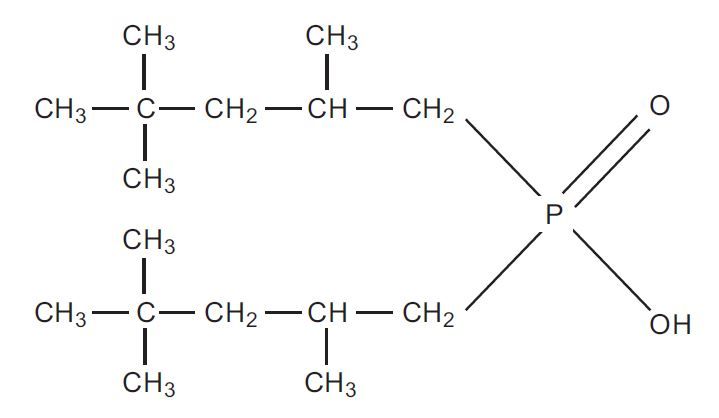
Dialkylphosphinic acid (such as CYANEX 272 extractant) and Dialkyldithiophosphinic acid (such as CYANEX 301 extractant), shown below, are chelating extractants. The reagents load metal ions in exchange for protons or other metal ions. These extractants are widely used in Co / Ni separations.
The typical reactions may be summarized by the reversible reactions:
LH + M+1 ⇄ LM + H+1 practical example: LH + NaOH → LNa + H2O
2LH + M+2 ⇄ L2M + 2H+1 practical example 2LH + CoSO4 ⇄ L2Co + H2SO4
3LH + M+3 ⇄ L3M + 3H+1 practical example 6LH + Fe2(SO4)3 ⇄ 2L3Fe + 3H2SO4
Where LH represents the protonated ligand and LM represents the ligand metal complex. As shown, the reactions work on a pH swing (i.e. metal is exchanged for protons) however the reaction may also proceed at relatively neutral pH where one metal is exchanged for another.
For example:
2LM1 + M2+2 ⇄ L2M2 + 2M1 practical example 2LNa + CoSO4 → L2Co + Na2SO4
CYANEX 272 extractant
CYANEX 272 extractant is an organo phosphinic acid developed specifically for the separation of cobalt from nickel by solvent extraction. CYANEX 272 has found wide applications due to its high selectivity (especially for cobalt over calcium and magnesium), low aqueous solubility, and high chemical stability. The ability to separate Co and Ni is one to two orders of magnitude higher than other extractant chemistries, making it unique. Besides cobalt/nickel purification, other commercial applications include iron and zinc removal and the purification and separation of the heavy rare earth lanthanides.
CYANEX 301 extractant
This sulfur-containing compound is a much stronger acid than its analogous oxy-acid, CYANEX 272 extractant. As such, it is capable of extracting many metals at low pH (<2).
Although there has been significant interest in the extractant and it has been used commercially, it does not discriminate amongst certain heavy metals which can result in poisoning of the ligand. Use of CYANEX 301 requires pretreatment of the feed and some additional unit operations/processing steps to be viable. Applications include the co-extraction of cobalt and nickel from low pH acid leach solutions and zinc removal from acidic process effluents. Due to the challenges associated with this chemistry please contact a Syensqo representative to discuss process requirements.

CYANEX 801 extractant
CYANEX 801 extractant is an organo phosphonic acid. CYANEX 801 extractant is widely used in the separation of rare earths as well as in certain applications for the purification and separation of Ni and Co as well as impurity removal.

DEHPA
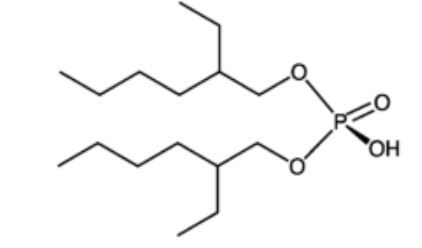
DEHPA (di-2ethylhexylphosphoric acid) extractant is an organo phosphoric acid which is used in many applications such as zinc solvent extraction, impurity removal in Co/Ni circuits, uranium extraction, and rare earth processing.
Other CYANEX chelating reagents
The CYANEX product range includes a few other formulations which operate via chelation chemistry. These are discussed further in other sections but include:
- CYANEX 600 - which is used for the purification and concentration of molybdenum from acidic streams. This reagent has significant advantages over the amine chemistry commonly used for molybdenum processing.
- CYANEX 572 - which is used for the processing of rare earth elements. This reagent is specifically used for the separation of the heavier rare earth elements and allows a reduction in acid and base usage.
- CYANEX 936P - which is used for Li recovery from brine streams or for the treatment of bleed streams from standard lithium processing. This reagent allows concentration of Li from dilute streams with high selectivity against other monovalent species
Solvating Reagents
Phosphine oxides work through a solvation mechanism and can be used to load a number of metal salts, as well as organic and inorganic acids.
These reagents tend to load the metal ions or organic and inorganic acids, along with an anion as a neutral salt. The salt can then be stripped from the organic phase by contacting it with water or an aqueous stream with a lower metal/salt content.
CYANEX 921 extractant
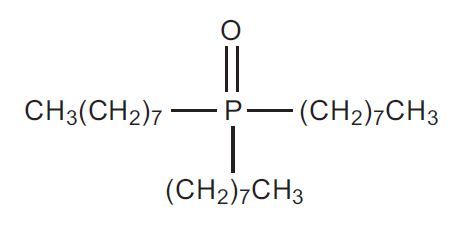
Commonly known as trioctylphosphine oxide (TOPO), CYANEX 921 has been used for many years with DEHPA (di-2ethylhexylphosphoric acid) to recover uranium from wet process phosphoric acid. It has also been used to extract acetic acid from industrial processing plant effluents. CYANEX 921 extractant possesses a high extraction coefficient for many other metals and organics such as phenol and ethanol. The neat extractant is a solid at room temperature, so material handling and solubility must be considered in the process design.
CYANEX 923 extractant
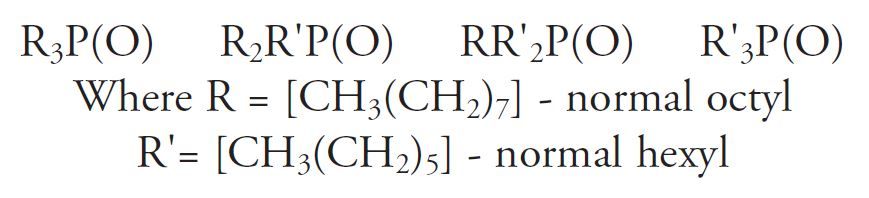
This product is a mixture of four trialkyl phosphine oxides that exhibits extraction properties similar to those of TOPO. It can be used as a replacement in applications using TOPO (e.g., CYANEX 921 extractant) with the advantages associated with handling a liquid versus a solid extractant. Being miscible with all common diluents, it has the further advantage that it can be used at higher concentrations than is possible with CYANEX 921 extractant.
CYANEX 923 extractant is particularly useful for the recovery of carboxylic acids, phenol and ethanol from effluent streams. It will also extract sulfuric, hydrochloric, nitric, perchloric, and phosphoric acids. Commercial uses have included the recovery of acetic acid from chemical processing plants, cadmium removal from hydrochloric/phosphoric acid mixtures, uranium extraction, and the bulk extraction of rare earths from phosphoric acid.
A typical reaction is shown below for these phosphine oxides.
R3PO + Mx+Y- ⇆ R3PO-MxY
Comparison of phosphorus based chelating extractants
CYANEX 272 and the other phosphorus based chelating reagents have an affinity for many metal ions dependent on the pH of the leach solution. Metal loading as a function of pH gives an indication of the relative selectivity of the extractants to the various metals. Those metal ions which load at lower pH values will be extracted in preference to those at the higher pH values. Many flowsheets therefore involve initial processing steps to remove the metals that will load in preference to the metal of interest.
Selectivity of organophosphorous acid-based extractants
The selectivity series for several metals using phosphoric, phosphonic, and phosphinic extractants has been reported:
Phosphoric acid based: Fe3+ > Zn > Ca > Cu > Mg > Co > Ni (DEHPA)
Phosphonic acid based: Fe3+ > Zn > Cu > Ca > Co > Mg > Ni (CYANEX 801)
Phosphinic acid based: Fe3+ > Zn > Cu > Co > Mg > Ca > Ni (CYANEX 272)
The optimum extractant is dependent on the specific feed, targeted metal, and separation requirements. Each reagent has its place, and a full assessment of the flowsheet options should be considered.