
Overview
An SX plant's performance depends as much on its physical operation as on its metallurgical operation. The physical operation, therefore, deserves equal attention. Several factors related to the plant's physical performance are measured during a circuit audit, but only some will be reviewed here. These are: mixer phase continuity, phase disengagement, entrainment, crud, organic quality and clay treatment.
Phase continuity
An organic continuous dispersion occurs when droplets of aqueous are dispersed in an organic matrix. Organic continuous operation is often used to minimize organic losses as the aqueous solution is dispersed and there are fewer organic droplets that need to combine and coalesce. It also promotes crud packing at the interface and the flow pattern through the settler is pushed down as the heavier aqueous droplets coalesce and settler beneath the interface.
Visually, organic continuity can be seen from sampling the mixer with an uneven separation of the organic and aqueous and stretching of the organic matrix as the aqueous droplets coalesce. The surface of the settler is also typically calmer with low surface air due to the settler flow pattern and less air entrainment.

An aqueous continuous dispersion occurs when droplets of organic are dispersed in an aqueous matrix. As a result of the aqueous being the matrix, the dispersion is conductive. As a general rule, aqueous phase continuity leads to reduced aqueous in organic entrainment. However, that is not always the case and each operation should evaluate its own preferred continuity. In some cases, organic losses have been minimized by an operation running aqueous and aqueous entrainment has been reduced by operations running under organic continuity. In contrast to organic continuity, aqueous continuity promotes an upward flow pattern within the settler as organic droplets coalesce and move up. As a result, crud tends to be more loosely distributed in the organic phase.
Observing aqueous continuity from a mixer is typically seen as a more defined interface with small organic droplets coalescing and moving upward. This upward flow pattern also generally leads to higher air present on the surface of the settler.

Phase disengagement time
The time that the aqueous and organic phases take to separate is called phase disengagement time, which is critical to plant performance. If phase disengagement is too rapid, then entrainment of the dispersed phase in the continuous phase will be high, as there will be insufficient time for the droplets to coalesce. Conversely, if phase disengagement is too slow, then the area that has not yet separated will move either over the organic weir or under the aqueous weir.
The time the two phases take to disengage is determined by several factors, including the degree of contamination or degradation of the organic phase, the presence of solids moving around the circuit, and the presence of interfacially active contaminants.
Entrainment
The separation of the two phases after mixing is never perfect. The residual or entrained phase carries forward to the next stage or leaves the SX circuit entirely. Cold weather and high PLS turbidity are two of the main reasons for increased entrainment. Entrainment can be measured by a number of means (centrifuging hand collected samples, mass balances based on impurity transfer or organic inventory or external coalescing equipment designed to capture entrainment to name a few).
aqueous-in-organic entrainment

Entrainment of aqueous-in-organic results in the transfer of impurities from the PLS into the electrolyte (in loaded organic) and transfer of electrolyte into the extraction section (in barren organic). The more common electrolyte impurities include iron, manganese, nitrate and chloride.
organic-in-aqueous entrainment

Entrainment of organic-in-aqueous is the primary source of organic loss. Mixers are commonly maintained in organic continuity if the aqueous from that stage leaves the SX plant system (i.e., raffinate). However, several situations require an operation to run in what many consider non-standard conditions, as a trade-off to allow a broader range of other operating parameters. Operations have run at extract O/A ratios below 0.5:1 at times, and consequently run raffinate stages with mixers in aqueous continuity. Despite the non-standard conditions, their organic entrainment losses remain similar to those measured under organic continuity with the proper mixer and settler optimization. The continuity/entrainment rule of thumb is meant to be a guide, and should not prevent operators from considering other options when there are significant benefits to testing these rules.
Crud
Crud is mostly a semi-stable blend of organic, aqueous, air, and fine particles. It collects at the weir end of the settler, typically at the interface between the organic and aqueous phases. The formation of some crud is unavoidable and happens in all SX plants. Periodically crud can build up on the floor of settlers (if there is a lot of heavier solid particles or use of flocculants) or can float on the organic surface – especially if there is a lot of air pulled into the mixer or the organic has been contaminated.
Contributors to crud formation are high PLS turbidity, organics in the leach solution, and other contaminants (e.g., engine oils). Crud tends to pack more densely when the mixer is operated in organic phase continuity. Packed crud at the interface doesn't usually cause a problem. However, crud suspended in the organic phase will move easily and, if left uncontrolled, will ultimately cause contamination of the electrolyte. Suspended crud occurs more often in settlers where the mixer is operated in aqueous phase continuity.
Crud is controlled by routinely pumping the settlers near the weirs and separating the organic by filtering or centrifuging. Crud movement is also reduced by maintaining proper organic band depths in settlers.
Applied properly, flocculants and coagulants in PLS streams can help reduce the amount of solids that enter an SX plant. Care should be taken that these products are not overdosed in the system. It is very important to allow for sufficient time and settling conditions so that the flocculated particles settle out of the PLS before they enter the SX plant. Alternatively, Syensqo has developed a PLS additive to reduce or prevent crud formation, which may be an easier application and more compatible option for SX circuits. ACORGA® CR60LT is being used commercially at many operations globally with valuable economic benefits related to crud formation and management.
There are many good references on how operations have been able to overcome crud challenges. There are also many inaccurate and faulty claims for a good metallurgist to be aware of and challenge.
Organic Quality and Clay Treatment
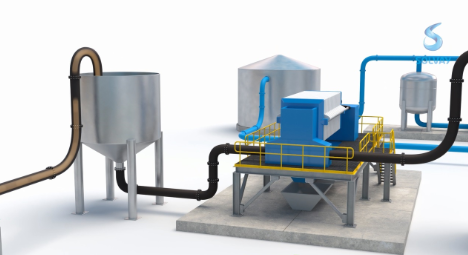
Over time the organic inventory accumulates contaminants from the PLS, electrolyte, or organic that are recovered and returned to the circuit. These contaminants tend to be interfacially active and can negatively impact the physical and metallurgical performance of the circuit. The organic contaminants result in higher phase break times, increased dispersion band depth, lower stage efficiencies10, reduced Cu/Fe selectivity and higher entrainments. In extreme cases the physical performance of the plant deteriorates to the point that the dispersion band overflows or underflows the weir resulting in high loss of organic, contamination of the electrolyte, and/or excessive electrolyte loss. In these extreme cases flows must be reduced to maintain operation resulting in a significant impact to production.
When the organic is contaminated with surface-active materials the phase disengagement time increases. To remove the contaminants, acid-activated bentonite or montmorillonite clay is applied at typical dosages of 10 - 30 gpl (1 - 3%). As part of Syensqo's technical service, clay treatment curves are regularly generated using circuit or reclaimed organic to understand the current quality and recommendations on treatment needs. In addition to clay dosage, process efficiency should be a focus for SX operations. Mixing conditions should be evaluated and aqueous removal from the organic ahead of clay addition is needed as aqueous will deactivate the clay leading to inefficiencies. Clay storage is also important to prevent weather and rain impacting efficiency. With proper clay treatment, the phase separation times of a plant can improve along with potential improvements to entrainments and in some cases Cu:Fe selectivity. This allows the phases to separate more rapidly.
Organic quality and contamination can be monitored by regular assessment of the interfacial tension. The interfacial tension of the organic phase (typically in reference to DI water to remove aqueous quality from the evaluation) is compared to that of the organic after a high clay treatment in the lab (5 - 10% clay). The delta IFT between circuit and treated organic represents the amount of contamination present. Typically, an organic with a delta IFT of 3 dynes/cm or less is considered of good quality. When the delta IFT exceeds 3 dynes/cm, there is an opportunity to improve the quality of the organic and the physical performance of the circuit. Phase disengagement times can also be used to determine changes in organic quality and are often used as a QC check after clay treatment and before returning to the circuit inventory. With proper clay treatment, the phase disengagement time is reduced. However, caution should be taken with phase disengagement QC checks as any remaining clay can result in a fast separation time and give a false positive indication of the quality. Filtration of the organic and aqueous phase is recommended after treatment to ensure an accurate representation of the separation time after clay treatment.
