
Background/Issue
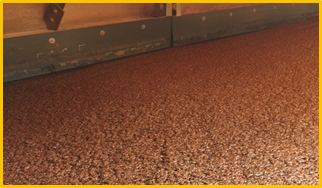
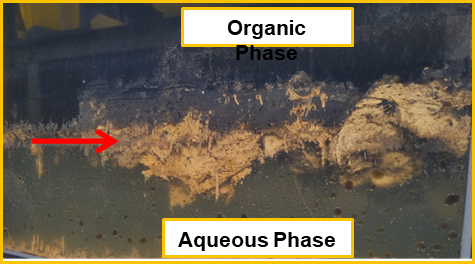
The formation of crud (a solid stabilized emulsion of aqueous and organic) is one of the most common challenges in a solvent extraction process. Although manageable, crud can have a significant impact on the operational costs as well as final product quality if not properly controlled. The amount of crud formed is highly dependent on the level of total suspended solids present in the PLS stream. It can present a significant problem in operations which have high levels of colloidal silica. Crud can and often does impact: phase continuity, entrainments (both O/A and A/O), plant throughput, plant down time, reagent consumption, and additional labor costs to process and treat the emulsion.
Corrective Actions
In order to deal with the formation of crud, plants are designed with additional unit operations to reduce the level of solids which enter the plant and to process the crud which forms and remove it from the system. A number of operational steps are also taken to minimize and manage crud formation. The following table shows some of the design and operational considerations to manage crud.
| Design / Operational Corrections | Impact |
| Installation of clarifiers, additional retention time in PLS pond, filters | Reduce the concentration of TSS entering the plant |
| Additional tanks, filter presses, 3 phase centrifuges, clay treatment | Crud removed from the system is centrifuged to separate the 3 components, returning aqueous and organic to the system; after organic has been treated. Clean organic largely free of solids and surfactants may be returned to the circuit for additional copper transfer. |
| Operation of all stages under organic continuity | Organic continuity packs the crud at the interface and allows operation with high Silica feeds (which may not be possible under aqueous continuity); reduces flexibility/flow capacity if there is insufficient organic pump capacity. |
| Flocculant addition | Reduce TSS into system, Can impact SX operation as flocculants enter the plant; often resulting in bottom crud and challenges with settler flow distribution; Can have an impact on picket fence performance and change flow pattern in settler. |
| Crud pumping from the weir or settler bottom | Crud is removed from the system along with additional organic and or Aqueous (labor intensive); Increasing likelihood of organic loss from the system, |
| Annual / routine dumping of settler | Loss of copper production as the plant is taken off-line and significant organic loss as solids are removed from the settler. |
| Installation of a diluent pre-wash | Capture some solids as a crud emulsion (diluent, solid, aqueous) in the absence of reagent. Reduces reagent loss as the emulsion is formed prior to the actual SX plant. |
As shown, crud is a significant consideration in the design and operation of a solvent extraction process. Although there are a number of methods to allow operations to treat crud or reduce the likelihood of its formation by limiting the solids into the plant, crud remains one of the most common complaints of operations. Regardless of the steps taken, on a commercial scale, solids still make it into the SX plant.
Syensqo Developments
- Syensqo's technical sales representatives assist operations with the completion of physical audits of the plant. The audit identifies where crud is present in the settlers, how it is moving and how to adjust the operational conditions to minimize its impact. They also assist in identification of crud composition, measurements of total suspended solids in both the aqueous and organic phases to ensure the equipment/unit operations for handling crud are being efficiently utilized. Finally technicians will measure surface and interfacial tension to identify the presence of surfactants.
- ACORGA® CB1000 was developed as an additive to better separate aqueous, organic, and solids. Once crud is pumped from the system, and the aqueous is decanted, CB1000 along with clay are used to break the emulsion separating the components and allowing higher organic recovery.
- Syensqo's ACORGA® CR60LT, a more recent development, is making a step change in solvent extraction processing. The aqueous soluble additive significantly reduces the amount of crud formed within the settler. This has been proven repeatedly on commercial scale plants. Additionally , operations have experienced other benefits as follows:
- A reduction in organic in aqueous entrainments (reducing overall reagent consumption),
- A reduction in Aqueous in organic entrainments (less risk of electrolyte contamination and minor electrolyte bleed requirements),
- Increased operational flexibility and plant throughput especially for operations with a highly siliceous feed.
- As a result of curd prevention, costs and resources associated with this problem are considerably reduced and invested in more important aspects of the operation.
Successful cases and references are demonstrated below. Please contact your local Syensqo representative to discuss applicability for your operation.
CASE STUDY: HEAP LEACH
A Cu heap leach operation had issues with excessive crud build up because of fine solids entering into the SX plant with the PLS1. Crud had been an issue for many years using both non-modified and modified extractants due to the variable turbidity. To manage the SX performance and minimize crud movement, the operation consistently decreased PLS flow (below design rates).
After successful pilot plant tests, ACORGA® CR60 reagent was applied to the SX plant. Benefits were seen immediately in reduced crud formation. The plant has been able to maintain nearly no crud in the extract stages, without any crud removal process, at dosages less than 5ppm. Because of the improvement in the settlers, the plant was able to increase PLS flow more than 10% above prior levels and maintain the flow continuously leading to higher Cu production.
CASE STUDY: HIGH SILICA PLS
An agitated leach operation2 had issues with excessive entrainments when running aqueous continuous due to phase separation issues related to high colloidal silica in the PLS solution. To continue operations and deal with the silica and high total suspended solids in the PLS the plant was forced to reduce PLS flow and operated extract stages in organic continuity at organic-to-aqueous mix ratios greater than 1.5:1. This severely limited Cu production.
ACORGA® CR60 reagent began to be used in the SX circuit. Crud formation was reduced and the plant was able to run the extract stages under aqueous continuity. The impact of ACORGA® CR60 on aqueous continuous phase separation for high colloidal silica feeds could be seen immediately when the additive was turned on and off, with extremely long phase separation times and dispersion buildup without the ACORGA® CR60 reagent. The plant was able to increase PLS flow 15% over previous maximum flow rates and hit record production in the first month of ACORGA® CR60 reagent usage.
CASE STUDY: HIGH ORGANIC ENTRAINMENT
Pilot plant testing was completed at another heap leach operation experiencing crud buildup along with excessive organic entrainment. Crud accumulation remained stable in the train treated with ACORGA® CR60 reagent throughout the 6 days of testing whereas crud in the untreated train increased more than 7-times.
After the promising pilot plant trial results, ACORGA® CR60 was introduced in the commercial plant. Significant reductions in crud formation and organic entrainment losses have been measured in the operation over an extended time period.