
Introduction
Sustainability has universally become a critical topic of discussion in view of the increasing challenges that the industry faces. This chapter focuses on the sustainable aspects of the chemicals used in mineral processing and recovery, and will describe how mining operations can benefit from competitive advantages when using sustainable chemical solutions. Due to the diversity and complexity of this topic, equally relevant social-political aspects of sustainability will not be addressed.
Sustainable mineral development is supported by three major factors: chemical, mechanical, and operational. Typically the optimization of mechanical and operational factors are subject to significant capital investments; meanwhile chemicals can frequently have greater benefits and impact in five major areas of sustainable mineral development: energy efficiency, water efficiency, waste management, environmental footprint, and converting mineral resources into reserves. While many issues of sustainability can be addressed through mechanical or operational improvements, the potential impact of reagents has been overlooked.
Albeit a recent trend, the key concepts of sustainability are not new to either the chemical or mining industries. The three foundational blocks of sustainability social, environmental, and economic accountability have been handled by the industry through actions such as focusing on worker's safety, limiting the impact of mining on the surroundings, and increasing productivity. This concern for the overlap of the three basic fundamentals, shown in Figure 1, is the basis of the world's demand for sustainable efforts.
The importance for sustainable solutions has become more critical in the face of significant changes in the global balance. Population growth, urbanization, and industrialization have reached outstanding levels causing depletion of our natural resources and contributing to climate change. Energy and water have become limited and this represents a challenge both in availability and increasing cost. In fact, in alignment with the United Nation’s 17 Sustainable Development Goals (SDGs) adopted in 2015, many mining companies now produce annual reports on sustainability that state the energy intensity (i.e. energy per unit output or activity) of their mines and processes. Likewise for mineral resources, we have already used the easily treatable ores; the ones left are much more complex and demand more sophistication to be economically treatable. The carbon dioxide (CO2) emissions or, more generally, the CO2 equivalents (denoted by CO2e) of a mine’s processes also factor into the sustainability profile of their operations.
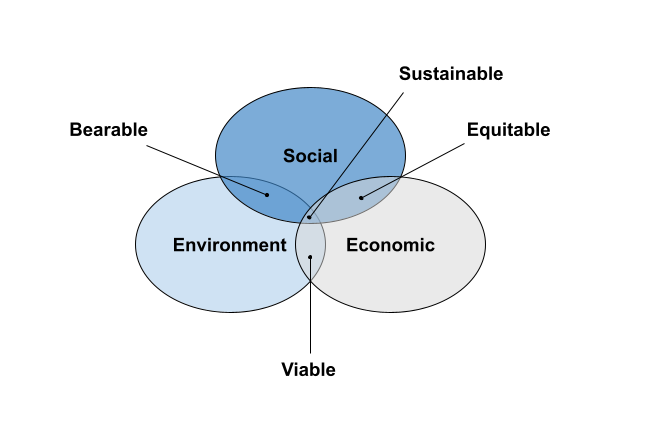
Another aspect brought with industrialization is the implementation of more restrictive regulations. The advent of REACH in Europe is an example of regulations tightening the control of chemicals produced or imported into the region, and a much stricter evaluation of environmental impact of new projects.
Today every company including the chemical and mining industries is focusing on asset optimization, specifically through technical solutions. Most organizations are extremely lean, and need to make sure that the time and resources are being used in the right projects and the people with the right set of skills are in the right place.
Syensqo also is in full alignment with the UN’s SDGs which requires us to rethink, and optimize our processes to serve the planet, our employees and our customers in a manner that is sustainable.
What follows is a discussion of sustainability frameworks and initiatives that are more specific to chemistry and the industry we serve, namely, mining.
Sustainable framework for the chemical and mining industries
Both the chemical and mining industries are facing a similar challenge: the need to maximize production while minimizing the usage of natural resources and waste generation. To achieve sustainable growth, mining and chemical industries have to earn the right to operate by making sound ethical and moral decisions in community affairs, civic responsibilities and environmental stewardship.
● Providing innovative and sustainable products that compete in a global economy
● Achieving the highest standards of safety, health and environmental stewardship
● Being responsible to our customers, employees, shareholders and other stakeholders.
To do so, Cytec follows the twelve principles of the green chemistry listed in Table 1. The objective is to create new innovative, safer reagents that can replace older, usually hazardous chemistries, while enhancing (or at least maintaining) the technical performance of traditional chemistries.
Since 2003, the CEO-led International Council on Mining and Metals (ICMM) has further defined the triple bottom line for the mining industry by developing industry specific areas of interest through their 10 Principles of Sustainable Development, seen in Table 2. Emphasis extends beyond the classic sustainable issues of protecting workers and the environment, and includes requiring ethical practices, contributing to improving the surrounding communities, and implementing transparent reporting with the public.
Such efforts have allowed the mining industry to address public concerns and aid in winning community support when establishing operational permits for new mines. Additionally, it has been argued that a focus on sustainable practice leads to lower labor costs, lower health care costs, lower production costs, lower regulatory burden, lower closure costs, lower cost of borrowing, lower insurance costs, and better investor relations.
| 01 | Prevention: It is better to prevent waste than to treat or clean up waste after it is formed. |
| 02 | Atom Economy: Synthetic methods should be designed to maximize the incorporation of all materials used in the process into the final product. |
| 03 | Less Hazardous Chemical Synthesis: Whenever practicable, synthetic methodologies should be designed to use and generate substances that possess little or no toxicity to human health and the environment. |
| 04 | Designing Safer Chemicals: Chemical products should be designed to preserve efficacy of the function while reducing toxicity. |
| 05 | Safer Solvents and Auxiliaries: The use of auxiliary substances (solvents, separation agents, etc.) should be made unnecessary whenever possible and, when used, innocuous. |
| 06 | Design for Energy Efficiency: Energy requirements should be recognized for their environmental and economic impacts and should be minimized. Synthetic methods should be conducted at ambient temperature and pressure. |
| 07 | Use of Renewable Feedstocks: A raw material or feedstock should be renewable rather than depleting whenever technically and economically practical. |
| 08 | Reduce Derivatives: Unnecessary derivatization (blocking group, protection / deprotection, temporary modification of physical/ chemical processes) should be avoided whenever possible. |
| 09 | Catalysis: Catalytic reagents (as selective as possible) are superior to stoichiometric reagents. |
| 10 | Design for Degradation: Chemical products should be designed so that at the end of their function they do not persist in the environment and instead break down into innocuous degradation products. |
| 11 | Real-time Analysis for Pollution Prevention: Analytical methodologies need to be further developed to allow for real-time in-process monitoring and control prior to the formation of hazardous substances. |
| 12 | Inherently Safer Chemistry for Accident Prevention: Substance and the form of a substance used in a chemical process should be chosen so as to minimize the potential for chemical accidents, including releases, explosions, and fires. |
| 01 | Implement and maintain ethical business practices and sound systems of corporate governance |
| 02 | Integrate sustainable development considerations within the corporate decision-making process |
| 03 | Uphold fundamental human rights and respect cultures, customs and values in dealings with employees and others who are affected by our activities |
| 04 | Implement risk management strategies based on valid data and sound science |
| 05 | Seek continual improvement of our health and safety performance |
| 06 | Seek continual improvement of our environmental performance |
| 07 | Contribute to conservation of biodiversity and integrated approaches to landuse planning |
| 08 | Facilitate and encourage responsible product design, use, re-use, recycling and disposal of our products |
| 09 | Contribute to the social, economic and institutional development of the communities in which we operate |
| 10 | Implement effective and transparent engagement, communication and independently verified reporting arrangements with our stakeholders |
The mining industry cannot rest on its laurels of past and current efforts. Limited resources and new environmental issues make it imperative that mines continue to challenge their processes. While mining has evolved from focusing on resource development strictly at a minimum cost to a more holistic approach, the industry must continue to drive sustainable improvement. It is becoming realized that sustainability now extends outside of environment and health, and it really is focused on adding value for profitability.
The chemical industry needs to assist the mining industry in developing sustainable solutions
The chemical industry should strive to become an active partner with the mining industry to quickly develop more sustainable solutions. Future collaborative efforts will simplify logistics planning, increase both workers' and the surrounding community's safety, and also increase profitability.
First, however, the chemical industry needs to become more aware of the impact it can make on the mining industry by understanding its needs. It will always be important to attain a high yield of desired metals or minerals, but from a higher perspective it is most important to provide the highest value. Chemical companies need to provide value to the mining industry by considering other areas that impact the overall mining operations: raw materials consumption, processing labor, product handling and fine fees. Implementing sustainable solutions will automatically provide monetary savings around these areas. Collaboration between the industries will be required to understand the core issues and adjust reagents to address the critical areas of concern.
Academia also needs to recognize and address the newer complexities of the industry; mining reagent research needs to expand beyond the classic fundamentals. Focusing on optimizing a single parameter of a single reagent (the ideal contact angle of a dialkyl dithiophosphate on chalcopyrite at a given size) with all other variables fixed doesn't give merit to the complexity of real life beneficiation. New research needs to focus on understanding the interaction of combined collectors, frothers and modifiers within differing water quality to fully understand the synergies and conflicts that occur among the variables. Likewise the interaction with alternate water quality including recycled processing water and salt water needs to be further researched, due to decreasing freshwater worldwide. Cytec has developed a statistically advanced process called the FLOTATION MATRIX 100. Refer to Chapter 2 – Flotation Reagent Fundamentals for more details, to help pinpoint the multiple influencers to optimize the chemical solutions package for a circuit.
Areas where the chemical industry can lead to a higher level of mining sustainability
Collaboration between the mining and chemical industries can improve sustainability in multiple aspects; from gaining investor interest, to protecting wildlife, to increasing community support, just to name a few. We'll focus on three notable sustainable benefits which include: improving the safety of chemicals, increasing operational efficiency, and increasing mining resources. We consider these areas to be some of the most time-critical issues and, thus, primary concerns for the mining industry.
Toxicity
As previously mentioned, toxicity and safe handling are key aspects in dealing with chemicals. Increasing concern over worker safety regarding hazardous exposure levels has led to the development of stricter regulations i.e. reducing exposure limits to Carbon Disulphide (CS2) in Canada from 10 ppm to 1 ppm on March 2007 (Source: Labour Department Canada: https://www.labour.gov.on.ca).
Frequently a mine's processing area is the most toxic non-storage location in a plant, with processing circuits and tailing ponds retaining the majority of a mine's dangerous goods. As a potential source of hazardous materials, the chemical industry can quickly improve a mine's safety by developing less toxic reagents. Newer chemistry has been developed to beneficiate the ore, while complying with the stricter regulations, and is also providing better metallurgical performance than the old guard.
For example, xanthate collectors are a traditional chemistry used in sulfide flotation. However, their combustible properties and release of CS2 during application presents a significant safety hazard to the mining industry. Recognizing this problem, Cytec set forth to develop more sustainable options while keeping or enhancing the metallurgical benefits. The novel solutions are liquid products that can be dosed directly in the process, substantially improving: handling and level of exposure of the personnel to product, stock safety management, residual generation and simplifying the plant operation.
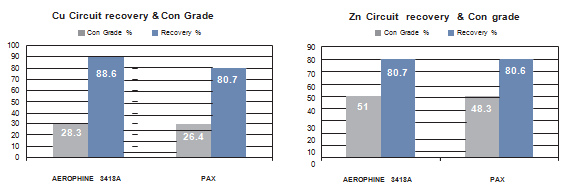
AEROPHINE 3418A promoter has demonstrated benefits in replacing xanthate by providing significant metallurgical improvements and other benefits such as significantly lower dosage and optimization of circuit performance, due to its unusually rapid flotation kinetics and stable grade-recovery relationships. Ore from a chalcopyrite-sphalerite deposit was being milled at a rate of approximately 10,000 tonnes per day. The concentrator used a conventional flowsheet of copper flotation followed by copper sulfate activation and zinc flotation. After successful laboratory tests, AEROPHINE 3418A promoter was introduced for a full-scale, ten-day, plant trial. The standard mill collector and frother were sodium amyl xanthate and MIBC, respectively.
| AEROPHINE 3418A promoter | Sodium Amyl Xanthate |
Heads, % Cu | 0.97 | 0.84 |
Heads, % Zn | 1.21 | 1.59 |
Reagent Consumption, g/t |
|
|
Cu Rougher Float | 17 | 24 |
Zn Rougher Float | 0 | 10
|
Figure 3 and Table 3 show that copper recovery was increased by 8%, and collector dosage was reduced by 50%. Frother consumption was unchanged. AEROPHINE 3418A promoter also induced minor improvements in zinc grades and recoveries. Zinc recovery in the copper concentrate and copper recovery in the zinc concentrate were essentially the same for both collectors. The improvements experienced in copper metallurgy alone, more than justified the change to AEROPHINE 3418A promoter.
On top of the metallurgical benefits described, the operations increased the sustainability by:
1. Reducing the exposure of the employees AEROPHINE 3418A promoter is used "as is", therefore, there is no exposure in preparation
2. AEROPHINE 3418/A promoter has a greener profile when compared to xanthate.
Efficiency of use of natural resources
One of the biggest issues that will face the mining industry over the next few decades is the depletion of our available resources, namely fresh water and power. Due to population growth and the increasing demands of society, human consumption is outpacing the speed with which the earth can replace the resources. As a result, companies need to find new methods to increase the efficient utilization of their resources.
Declining fresh water
Many mining intensive nations, such as Australia and Chile, have been suffering through multipleyear droughts. As water tables recede the concentrations of pollutants collect in the base of a reservoir until the water is no longer drinkable. Central China has witnessed the decline and disappearance of their Aral Sea and has had difficulties finding an acceptable replacement. Even regions that are not technically in drought, such as the Southwest United States, are seeing a marked drop in fresh water tables. In fact only a handful of the world's largest rivers even reach the sea today.
As a result, serious concern is developing in governments to ensure that the citizens of their regions have adequate access to clean water. Governments have taken various steps to protect their water including: implementing quotas of allowable water use, developing water reserve crediting systems, and simply denying the use of water for non-residential purposes. As a result, mines need to develop innovative solutions that focus on processing methods that reuse, reduce, or eliminate the need for fresh water. Cytec has sought to develop methods that more efficiently use water. Advancement in our technology has developed solutions that not only reduce the quantity of water required, but also simplify the processing steps and reduce energy and operational costs.
One example is the chemically enhanced magnetic separation for kaolin beneficiation. The kaolin beneficiation process, shown in Figure 4, involves dispersion, size classification, removal of colored impurities and drying or slurrities leads to a higher-brightness kaolin product. Higher brightness is one of the most sought-after properties in applications such as paper coating and paint.
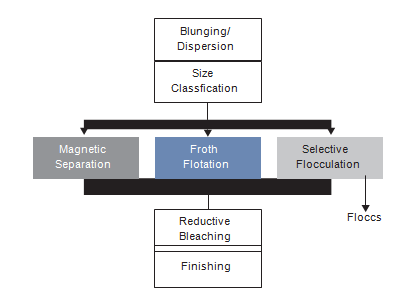
Although standard magnetic separation might appear to be the ideal sustainable process with high yield from high solids processing and low reagent dosing, it has some shortcomings. It has shown little success with finer impurities, even with the use of stronger magnetic intensities, and diamagnetic colored impurities are not removed. Thus the magnetic separation process needs to be optimized to achieve success.
Meanwhile, Cytec has been documenting the advantages that the chelating surfactant hydroxamate offers over conventional anionic collectors. These advantages include increasing energy conservation during preconditioning, eliminating contamination and downstream effects, enhancing yield without inadvertent activation of kaolin, simplifying and reducing processing steps, and increasing mining reserves by enabling "hard to beneficiate ores" to be processed.
Cytec developed the Enhanced Magnetic Separation technology (MagSep) to combine the sustainable characteristics of magnetic separation with the benefits of using hydroxamate chemistry. The combination results in hydroxamate selectively binding impurities with magnetite, increasing the magnetic attraction for contaminant removal at low intensity magnetic fields.
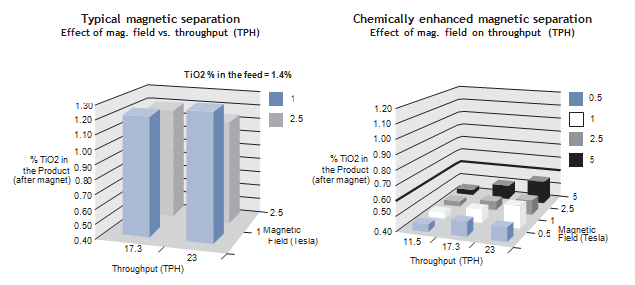
Specifically, MagSep allows removal of impurities at a magnetic field of 0.11 Tesla, enabling manufacturers to save energy and adapt existing magnet configurations. Figure 5 demonstrates the performance for titanium oxide removal at lower magnetic fields, given equal reagent dosages and conditions.
MagSep is a viable fine particle beneficiation process and a potential alternative to flotation and selective flocculation technology for kaolin to achieve high-brightness kaolin. When compared to existing technologies magnetic separation, flotation/selective flocculationMagSep emerges with synergistic advantages. Advantages can include extending current magnetic separation technology, competing with flotation and selective flocculation in efficiency, removing impurity minerals over a wider size range, removing non-magnetic impurities and providing high yields with a robust and simplified process.
In summary, MagSep has emerged as a powerful technology for removing impurities using lower doses, reduced energy and water consumption, and fewer processing steps. Combining specific functionalized reagent development with already existing magnetic separation technology allows mining companies to experience a quick and profitable sustainable solution.
Limited power supply
Increasing demand for technology around the world is forcing the power industry to produce more electricity every day. Independent of the concerns about the limited supply of fossil fuels or impact upon global warming, the power industry is facing difficulties in its ability to meet the increasing demand for power. Simply put, there aren't enough power stations being constructed to generate the power needed to meet this demand; thus, the world needs to learn how to ration the current energy among all electricity users.
Governments have handled this dilemma by institutionalizing roaming blackouts in areas where the demand exceeds the availability of power and developing carbon credit based initiatives. Additionally, power companies have increased the cost of energy, cutting into mining's profits and forcing mining companies to feel greater pressure to reduce their energy consumption. This can be very difficult since mining is a very energy intensive industry. However, the chemical industry can help mines to develop more efficient processes.
In alumina operations, problematic sodalite scaling develops in the heat exchangers and interstage piping used in the Bayer process for the production of alumina from bauxite ore. By eliminating the formation of the sodalite scale on the heater surfaces, the following benefits can be realized, 1) increased efficiency in the recovery of heat from steam produced in various unit operations, 2) increased evaporation which allows the plant to use more water in the countercurrent washing circuit for the recovery of caustic, 3) reduced production of new steam with the resulting reduction in emissions from the burning of carbon based fuel, and 4) reduced use of sulfuric acid resulting in less waste from cleaning of the heaters and less exposure to the workers.
The benefits from using MAX HT are summarized in Figures 6 and 7. Scaled heater tubes and declining heat transfer are changed into clean tubes and constant heat transfer when MAX HT was used.
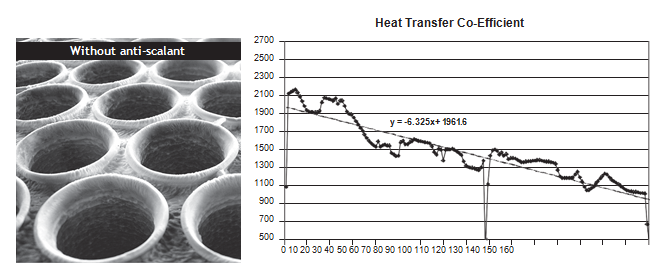
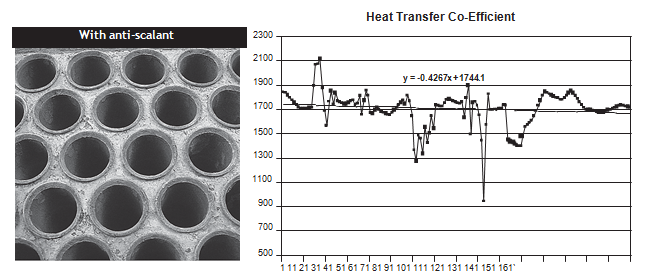
Sodalite scale inhibitor MAX HT is used commercially to eliminate and/or minimize scaling in evaporator and digestion heater tubes at dosages ranging from 20-40 ppm. Without the use of MAX HT, plants have minimal control on the rate of scaling in these heater tubes. MAX HT has allowed plants to gain control or completely eliminate the formation of sodalite scale in heaters.
MAX HT sodalite scale inhibitor has been used successfully in a number of Bayer process plants. The product is used to eliminate and/or minimize scaling in evaporator and digestion heater tubes at dosages ranging from 20-40 ppm. Typically, the on-stream time for a heater is increased from some 8-10 days to 45-60 days for digestion and 20-30 days to >150 days for evaporators. This ability to maintain a high heat transfer over a much longer life cycle between cleanings has resulted in a number of benefits. These benefits include reduced caustic consumption, improved mud settling, increased production, reduced energy consumption saving 0.25-1.25 million BTU per tonne of alumina, increased soda recovery, reduced digester and evaporator heater cleaning and maintenance, and steadier plant operation.
Conversion of resources into reserves
Since the objective of any mining company is to locate and beneficiate the ore that will provide the highest return, most of the sweet ores found at easily accessible locations have already been mined. Likewise, many mines currently own previously analyzed property with unprofitable ore, because the current enabling methods are not optimized enough to profit from the more complex mineralogy.
Today's mines face generating higher quantities of metal out of more complex ore to keep up with an ever increasing and demanding population. To solve the dilemma without cutting steeply into profits requires developing new processing methods that more effectively beneficiate the ore. Likewise, this would add value to mines where previously unprofitable resources are instantly converted into profitable reserves. Installation of new machines and processing loops can increase productivity, but it is less costly and much quicker to switch to more selective reagents.
In mining reagents, collectors and frothers are considered as major players to achieve successful flotation; however, modifiers are the unsung reagents that help optimize a plant's processes. Unfortunately, modifiers are often avoided because, although they can help to amplify gains, they can equally hinder gains when not properly understood and dosed without statistical analysis, as is also the case with collectors and frothers.
Cytec has been working to better understand the interactions and effects of modifiers. Current efforts are converting untreatable resources into profitable reserves as slimes are controlled with new modifiers. Cytec has been working on a nickel ore that has demonstrated untreatable slime characteristics.
Below, in Figure 8, are demonstrations of the test results showing the marked improvement when using a Cytec chemical system of frother, collector, and modifier, when compared to the standard reagent suite: xanthates and MIBC.
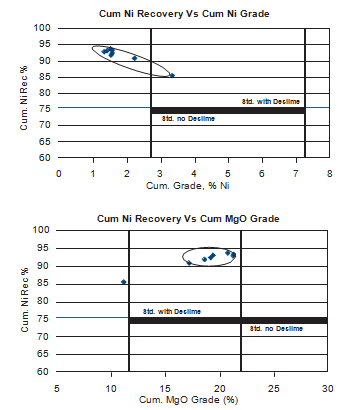
The metallurgical benefits are a significant increase in both nickel and sulfur recoveries from 75% to higher than 90%, while keeping the MgO content in the concentrate in specification. Other than that, the new chemical system, composed of collector, frother and modifier allows the elimination of the desliming circuit and the possibility of processing at higher solids which enables significant savings in energy and costs.
Conclusion
Sustainability will continue to become an ever increasing factor in the mining industry, as public awareness of environmental issues and attention to living a sustainable existence increase. In response, partnerships with investors, transporters, and communities will impose stricter sustainable measures for current and future mines. Transparent reporting of operations and sustainable initiatives will best assist mines in winning the confidence of their partners, while providing opportunity for a competitive advantage.
In most cases mines will most efficiently improve their sustainable efforts through collaboration with the chemical industry; this will allow them to implement changes both faster and cheaper than by adjusting physical processes. Furthermore, proper reagent optimization has the unique ability to add value outside the processing realm by expanding the utilizable reserves of mines, as it converts previously untreatable assayed resources into profitable reserves.
As presented, Cytec Industries Inc. is dedicated to guiding the mining reagents industry towards more sustainable solutions as we implement our own sustainable initiative. Through innovative dialogues, we continue to collaborate with mines to develop solutions that deliver the highest value, by conservation of raw materials and utilities, and reducing toxicity and maintenance expenses. Additionally, we use statistical multivariable analysis to accurately analyze the complexities of raw materials and operational variations.
Talk to your Cytec representative for more details.