
Components of a Cu solvent extraction plant
SX plants generally consist of mixer-settler units arranged in series with countercurrent flow. After mixing, the organic/aqueous dispersion is discharged into the settler where it flows through a distribution fence and then separates by gravity as it passes down the length of the settler. To aid coalescence, one or more picket fences, or other in-settler coalescing media, may be used.
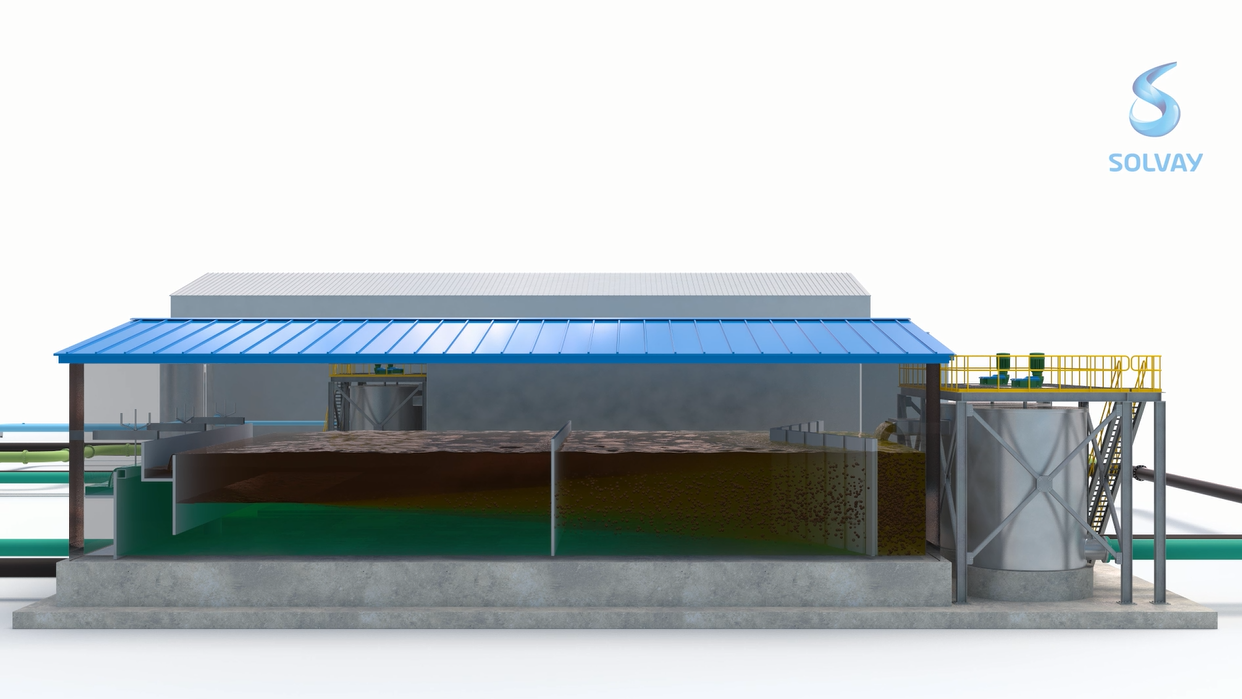
Final phase separation is achieved by a weir system. The organic phase flows over the upper weir and into a collection launder while the aqueous phase passes over a lower weir, into a similar launder.
One or more wash or scrub stages may be added to the circuit, primarily to prevent the entrainment of impure aqueous solution into the purified electrolyte.
Either a loaded or stripped organic tank is often placed between the extract and strip sections, to allow entrained aqueous to settle out. This tank also buffers volume changes in the system.
Operators often install the following additional equipment:
- Aqueous coalescers, to minimize entrainment of impurities from the PLS to the electrolyte. The coalescer allows the small aqueous entrained droplets to recombine into larger droplets that are more likely to settle.
- Organic coalescers, to minimize the transfer of organic from the SX plant to either the rich electrolyte or raffinate streams.
- Sparge columns/electrolyte (dual media) filters, to minimize organic entrainment in the electrolyte transferring to the tankhouse.
- Crud/clay treatment units including plate/frame filters, centrifuges, and holding tanks, to process contaminated plant organic and/or crud.
- Skimmers, belt mops, and other recovery systems, to reclaim organic from the surface of electrolyte and/or raffinate tanks.
The design of mixer-settlers has come a long way since the first commercial copper SX operation in the late 1960s. Contributions from numerous engineering houses over the years have led to designs with improved stage efficiency, lower entrainment, and better crud management. Syensqo works with engineering design and construction companies to develop the most appropriate circuit for given solution conditions.
Circuit configurations
The most efficient extraction is usually obtained by connecting several mixer settlers in series. The number of stages required and the manner in which they are configured will depend on feed conditions, reagent choice, and the objectives of the operation. Isotherms and McCabe-Thiele techniques are used to determine the optimum staging for different feed conditions. This is further discussed in the Isotherm and McCabe-Thiele sections.. The choice of optimum configuration and extractant is rarely a straight-forward answer and requires an in-depth assessment of both capital and operating costs.
Currently, the most prevalent copper solvent extraction circuit configurations are:
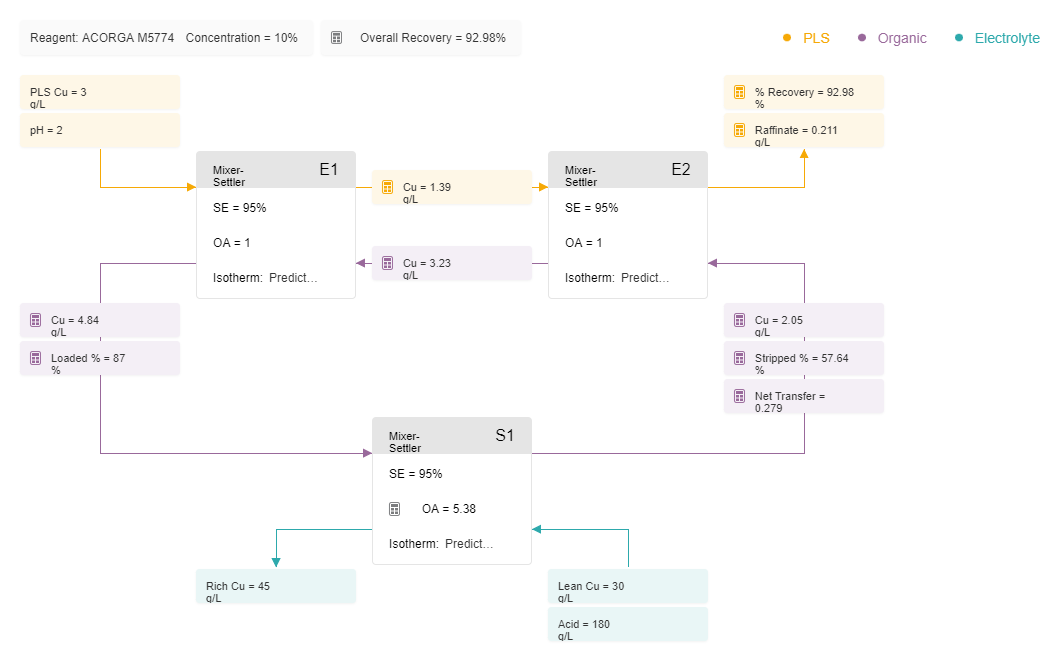
- 2+1 series (two extract stages in series followed by one strip stage):
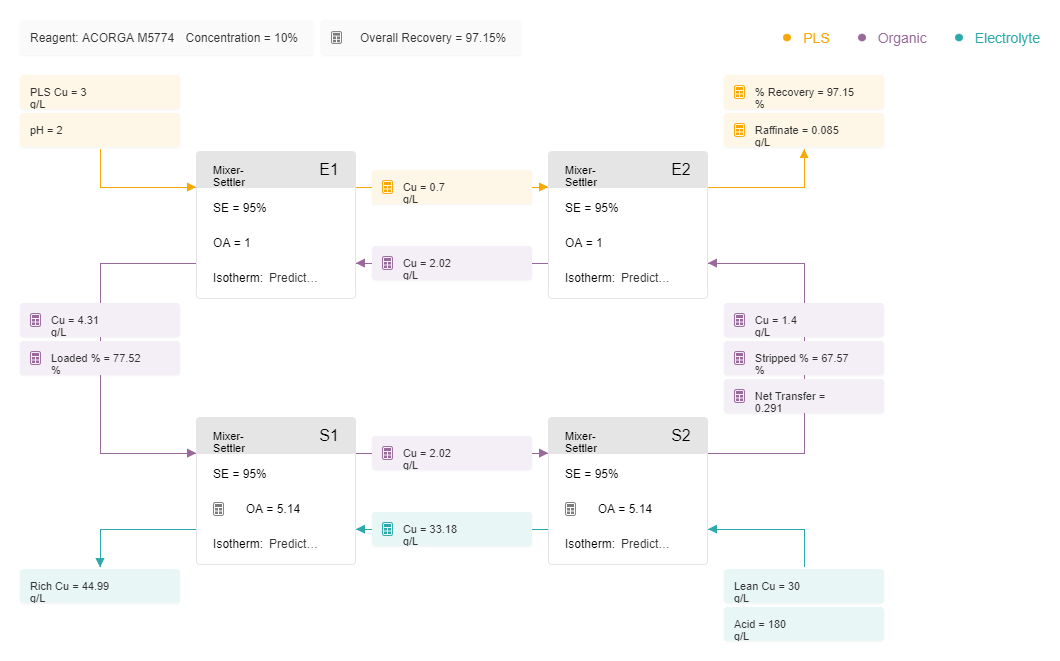
- 2+2 series (two extract stages in series followed by two strip stages):
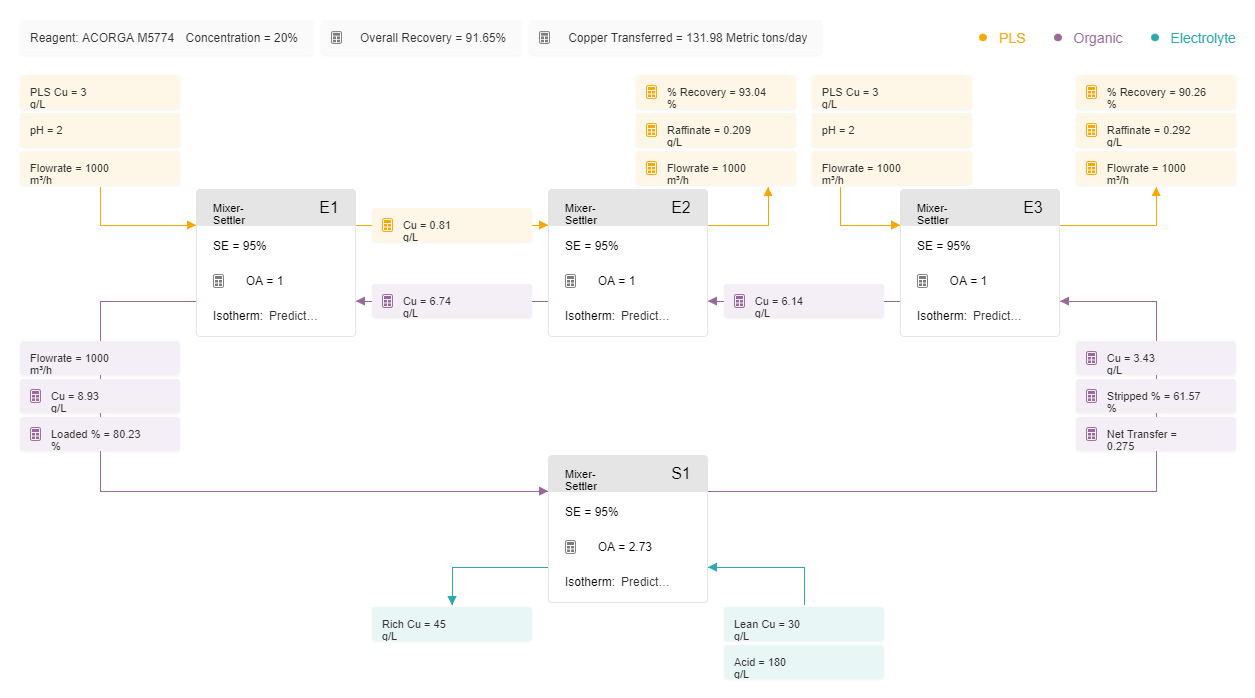
- 1+2+1 series parallel (3 extract stages—1 in parallel and 2 in series— followed by 1 strip stage):
Circuit configurations vary depending on the needs of the operation. If more than one extract or strip stage is used, the organic stream, PLS, and electrolyte may be operated in series or parallel. Operators can also consider options such as splitting the streams to redistribute flow or adding streams to enhance recovery or production. Syensqo can assist engineering houses and customers in choosing the appropriate configuration and design conditions to meet operational targets using Syensqo's proprietary solvent extraction modeling software (MINCHEM). Click for additional details of Syensqo's Service Offerings and MINCHEM Software.
Finally, one or more wash or scrub stages may be added if the PLS contains high concentrations of impurities such as chloride, manganese, nitrate, or iron, as they could negatively impact the overall process.
Wash stages may also be used to selectively scrub the organic to remove any co-extracted impurities from the organic phase. In these cases, acid or metal salts are added to the wash solution to strip the impurities from the organic or to load additional amounts of the desired metal onto the organic, "crowding" the impurities off. Although costly, this step is occasionally required, especially when the chosen reagent does not have the desired selectivity.
Over recent years a number of patents have been granted and new patent applications submitted which may influence the rights of engineering houses and operators to use certain designs. Proper due diligence is required to not only understand the real benefits of one configuration/extractant combination over another, but also to understand the long term commercial implications of issued and potential patents. As in most situations, the final decision for configuration and extractant is a combination of many factors. The important point is that there are always many options available to a plant to meet new and changing operational challenges.