
Modern commercial Cu SX reagents are based on hydroxyoximes. Their chemical structure is shown below.
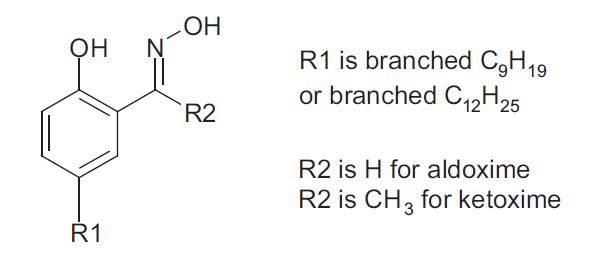
ICI, in a business unit acquired by Syensqo, developed and patented 2-hydroxy 5-nonylsalicylaldoxime (the C9 aldoxime). Today, this is the world's most widely used reagent for copper solvent extraction. The other commonly used oxime is the C9 ketoxime, which was developed by Shell Chemicals and was sold as SME 529. A dodecyl hydroxyl benzaldoxime (C12 version of the aldoxime) was used commercially in the 1980's, but as of the late 1990's had been essentially replaced by C9 aldoxime.
Each of these oximes forms a bidentate complex with divalent copper (Cu2+) ions according to the reversible reaction:
CuSO4 + 2LH ⇄ L2Cu + H2SO4
Where LH is the uncomplexed oxime and CuL2 is the copper-loaded oxime.
The distribution of atoms in the oxime is such that the oxime forms a "square planar" complex with copper. The square planar complex is stabilized by hydrogen bonds between the oxime and phenol. Extraction of copper into the organic phase can be visualized as follows.
