In the hydrometallurgical processing of copper, there are three basic interconnecting process loops: Leaching (L), solvent extraction (SX), and electrowinning (EW). A general schematic is shown below:
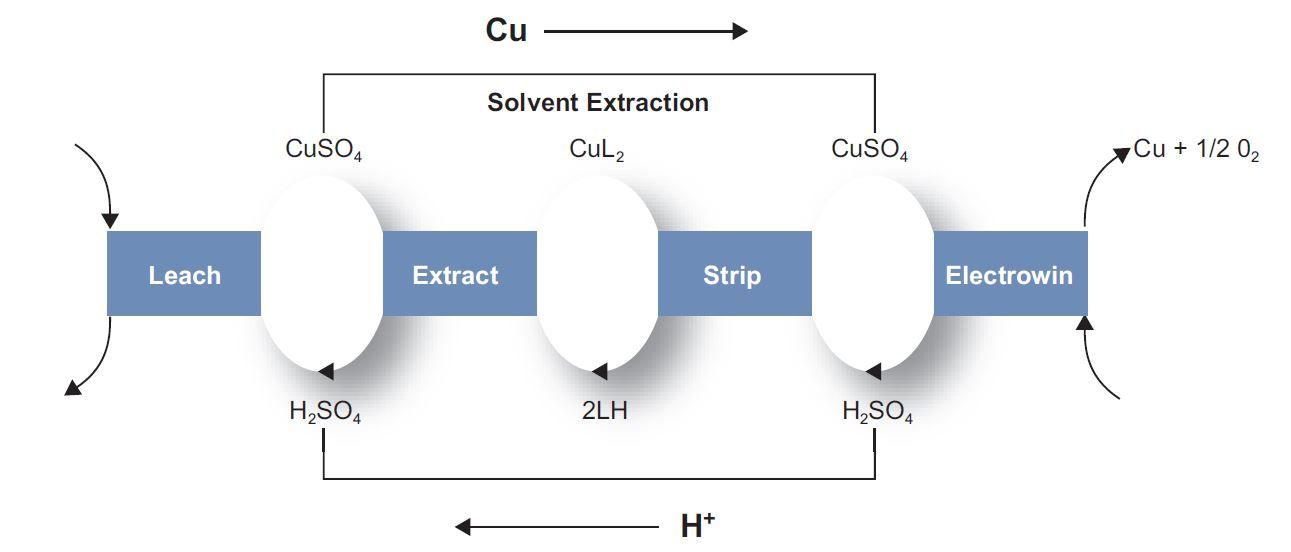
The chemical equilibrium through all three stages can be given by:
Leach | CuO + H2SO4 → CuSO4 + H2O |
Extraction | CuSO4 + 2LHorg → [CuL2]org + H2SO4
|
Stripping | [CuL2]org + H2SO4 → CuSO4 + 2LHorg |
Electrowinning | CuSO4 + H2O → Cu + 1/2 O2 + H2SO4 |
Overall | CuO → Cu + 1/2 O2 |
The subscript org indicates the chemical species is in the organic or diluent phase.
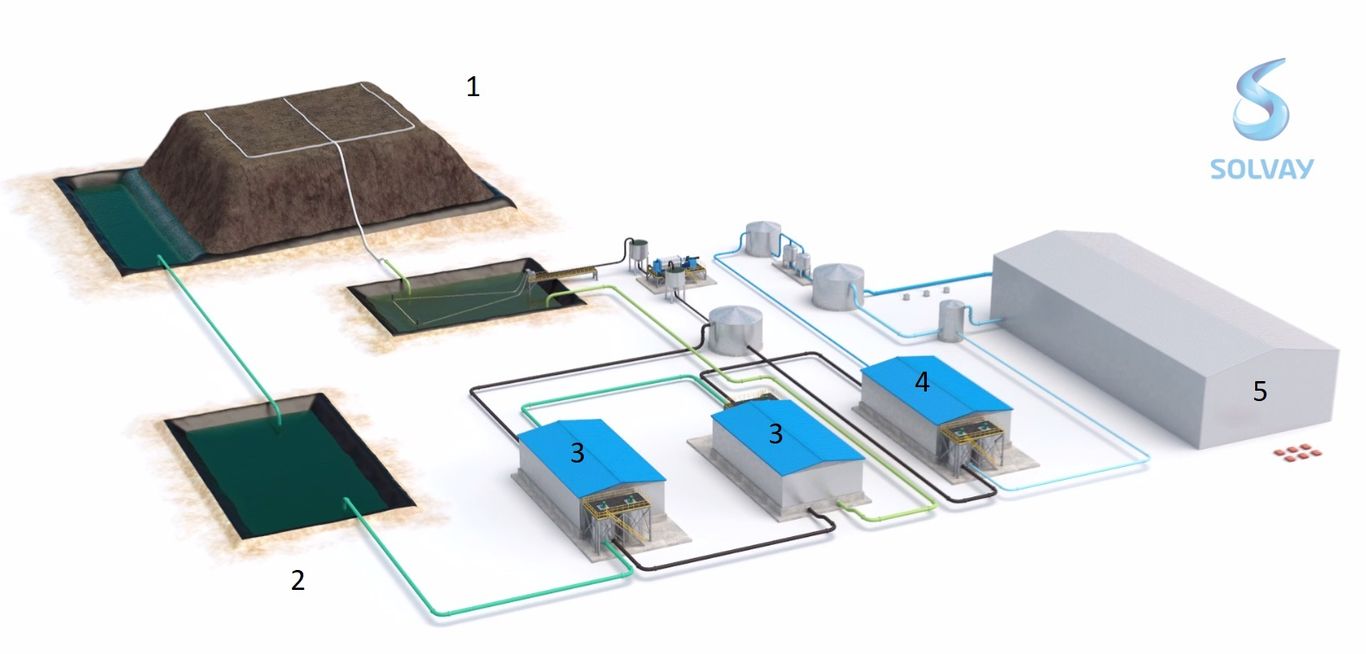
A simple heap leach SX-EW circuit is illustrated. The figure shows the leaching of metals from an ore heap (1), producing a mixed metal stream or Pregnant Leach Solution (PLS) (2), followed by extraction of copper (3), stripping of copper (4), and electrowinning (5).
Leaching
Metal is first put into solution via one of several leaching methods depending on the type of mineral/feedstock and the needs of the operation. For example, a normal copper oxide feedstock is likely to be subjected to heap or agitation leaching, whereas a copper sulfide feedstock is usually leached via pressure or bio leaching.

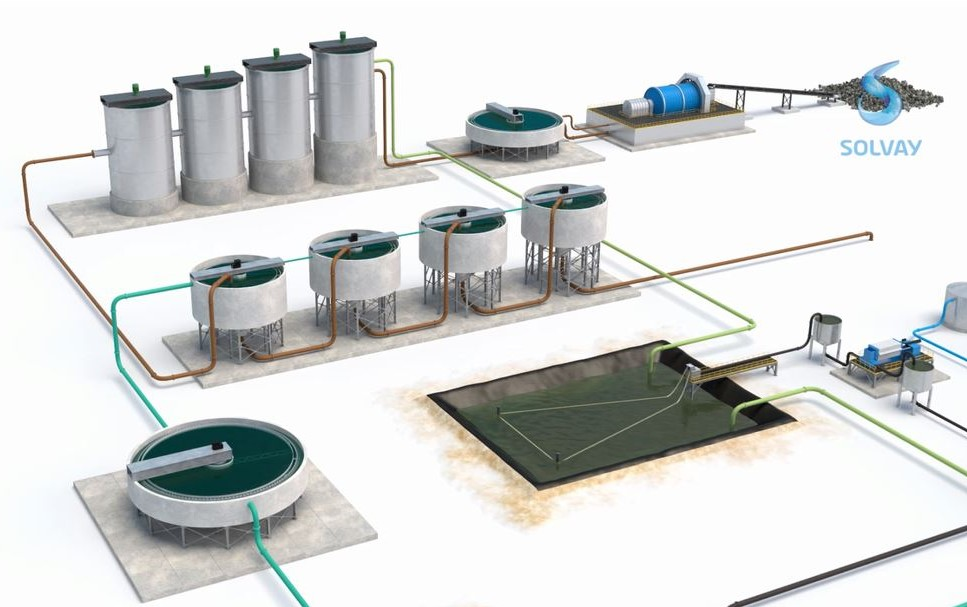
The leaching route varies for different copper minerals. For non-sulfide minerals, leaching takes place via reaction with sulfuric acid as described by the equation:
CuO + H2SO4 → CuSO4 + H2O
Leaching of sulfide minerals requires an oxidant such as Fe3+ in addition to sulfuric acid. Typical reactions are:
CuS + 8Fe3+ + 12SO42+ 4H2O → Cu2+ + 8Fe2+ + 9(SO4)2+ 4H2SO4
1/2O2 + 2Fe2+ + 2(SO4)2+ H2SO4 → 2Fe3+ + 3(SO4)2+ H2O
In both cases, many metals are dissolved along with copper into the leach solution. The solution must therefore be purified (and often concentrated) before electrowinning.
Solvent Extraction
Solvent extraction in its simplest form is a two-step process:
Extraction
Copper is selectively extracted from the leach solution into an immiscible organic phase containing a copper-specific extractant. The copper depleted aqueous is acidified by the extraction process and is returned to the leach feedstock to dissolve more metal.
Stripping
Copper is transferred from the loaded organic to a strongly acidic aqueous phase called the spent or lean electrolyte. The electrolyte, enriched in copper and called the rich or advance electrolyte, is advanced to the tankhouse for electrowinning (cathodic deposition).
The reversible reaction (extraction and stripping) is:
CuSO4 + 2LH ⇄ L2Cu + H2SO4
- Copper extraction and stripping is often referred to as working via a "pH swing" because:
- Acid is generated during extraction (reaction proceeds left to right)
- Acid is consumed during strip (reaction proceeds right to left)
Electrowinning

The rich electrolyte is transferred to the tankhouse where the copper in solution is reduced to copper metal (cathodic reaction) through an electrolytic process. The anodic decomposition of water produces hydronium ions and oxygen. Typical copper cathode purity by L-SX-EW is greater than 99.99%.
It should also be noted that copper sulfate crystallization can also be used instead of electrowinning as the final Cu production method.