
Executive Summary
Oxide copper ores is a term used for ores in which significant amounts of non-sulfide copper minerals occur. Whether these ores are treated by flotation or leaching is dictated largely by its mineralogy, namely, the amount of oxide copper and the nature of the oxide copper minerals.
Recoveries by flotation in these ores is typically low given that these minerals are naturally hydrophilic. In flotation, these oxide copper minerals can be recovered by first sulfidizing these minerals with a sulfidizing agent such as sodium hydrosulfide, followed by hydrophobization through collector adsorption and subsequent flotation by normal means.
Some of these minerals, however, do not respond either based on flotation conditions or by nature (e.g. chryscolla in the latter case), in which case use of alkyl hydroxamates may prove effective. Syensqo offers a line of collectors specifically designed for this application. The following details many aspects of these ores and methods used to treat them.
General Comments/Major Considerations
Terminology
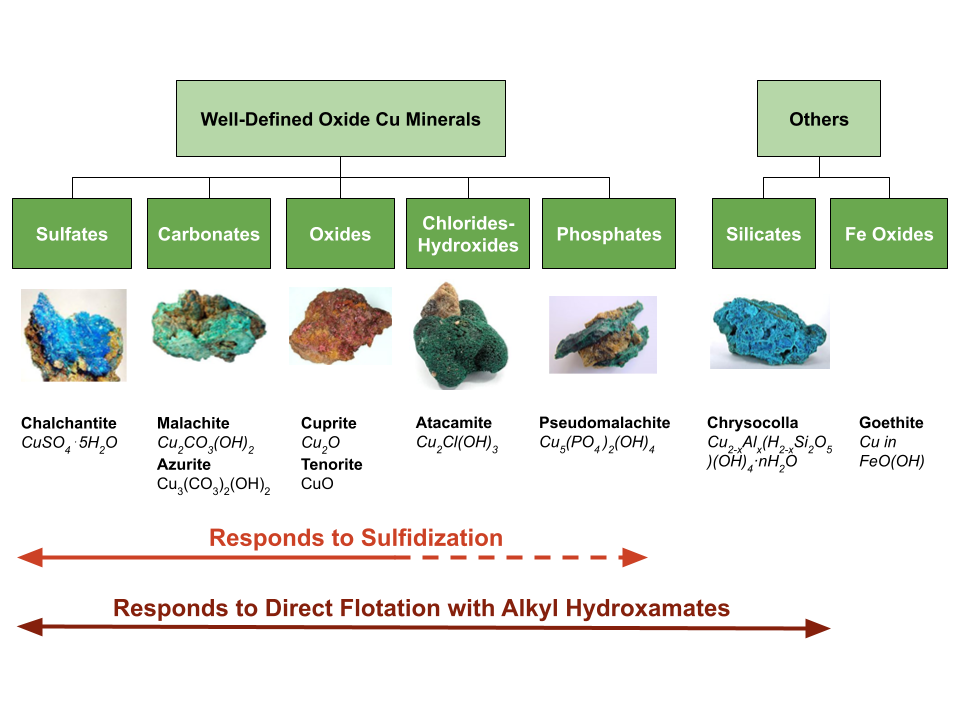
“Oxide copper” is a general term used to describe non-sulfide copper minerals found in the oxidized zones of copper deposits. These non-sulfide copper minerals include malachite Cu2CO3(OH)2, pseudo-malachite Cu5(PO4)2(OH)4, azurite Cu3(CO3)2(OH)2, , cuprite Cu2O, atacamite Cu2Cl(OH)3, paratacamite Cu2(OH)3Cl, tenorite CuO, and native Cu. All of these minerals are referred to as “well-defined oxide copper minerals”.
Chrysocolla [Cu2-xAlx(H2-xSi2O5)(OH)4·nH2O], where (x<1), is a mineral with variable composition and may be identified as one of the “not well defined” species, as is Cu-containing goethite.
Other terms used in the industry to describe “oxide copper” minerals are “Acid Soluble copper” (or AS Cu), “Non-Sulfide copper” (NS Cu), and “oxidized” copper (ores or minerals). All of the terms are rather vague and none of them clearly defines the various copper species present in the ore. These terms are often used interchangeably, but preference is given to AS Cu because the chemical assays obtained for “oxide copper” are based on acid digestion of the ore.
Range of Mineralogical Composition
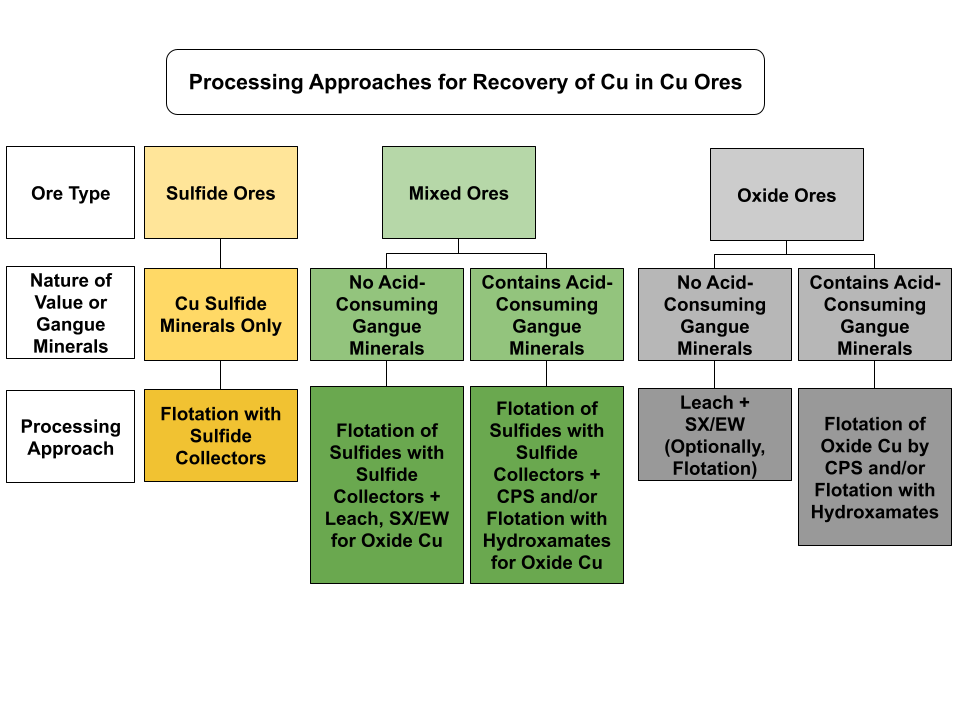
Oxide Cu ores can span a range of mineralogical compositions: strictly oxide Cu ores which contain little to no sulfides, mixed sulfide-oxide Cu ores, tarnished Cu ores and strictly sulfide Cu ores with oxide Cu content that bears no impact on overall recovery (in the latter case, oxide Cu may be < 10% of the total Cu head assay). On the one end, ores that contain only oxide Cu minerals with little to no sulfides as well as no acid-consuming gangue minerals are typically treated by leaching followed by electrowinning and are not considered herein. We will only concern ourselves with mixed sulfide / oxide Cu ores which contain a significant amount of recoverable, acid soluble Cu. Mixed sulfide / oxide Cu minerals that don’t contain acid-consuming gangue minerals can also be treated by leaching/electrowinning after flotation of sulfides has been carried out. However, those that do contain acid-consuming gangue minerals need to be processed by flotation of sulfides and oxide Cu minerals, which is the subject of our discussion. Tarnished ores will also be discussed in our section titled AERO® MX-3710 series. Note that most Cu mines encounter all of these ore types. Figure 1 is a summary of the processing approaches taken based on the nature of the Cu ores in question.
Factors Considered in Processing
The main consideration when treating these mixed sulfide / oxide Cu ores is to clearly define the mineralogy of the ore or set of ores to be treated. This is absolutely critical in order to determine how much or even whether Cu recovery may be improved by chemical means, more specifically, by flotation of oxide Cu minerals. Factors such as the nature of Cu species present, their relative amount, locking of minerals, liberation, and grain size, among other things are important in determining the approach to take when processing the ore. Sulfides are floated first, as would be the case of a strictly Cu sulfide ore, followed by flotation of oxide Cu minerals. Oxide Cu minerals are then activated by sulfidization with a sulfidizing agent such as sodium hydrosulfide (NaHS), and subsequent flotation using strong thiol collectors. However, not all oxide Cu minerals respond well to sulfidization. For example, among the above-mentioned minerals, malachite, azurite, cuprite, and tenorite respond readily to sulfidization, pseudomalachite and atacamite will respond only when aquatic chemistry is favorable, and chrysocolla will not respond to sulfidization. The latter minerals can be instead floated by the use of alkyl hydroxamates collectors such as Syensqo's new AERO® OX-100 series.
Furthermore, Cu may be present in Cu-bearing goethite (limonite) as well as within the lattices of Cu-bearing silicates such as biotite or chlorite, or even in finely disseminated Cu minerals locked in silicate matrices. These species are generally deemed partially or fully unrecoverable by flotation depending on surface Cu exposure or concentration, but will frequently report as AS Cu. For sulfidization, pH is in the range of 8.5-10.5 conditions under which the sulfidizing agent can be dosed. Successful sulfidization will depend on careful control of sulfidizing agent dosage and monitoring of the sulfide ion concentration by use of a sulfide ion selective electrode (i.e. Ag/Ag2S) (next section). Figure 2 gives an overview of the common oxide Cu minerals classes as well as their amenability to sulfidization and direct flotation with alkyl hydroxamates.
Other important considerations are the presence of problematic non-sulfide gangue minerals as well as overfrothing of mineralogical or reagent sources. Both of these issues require the use of modifier reagents. Problematic gangue can fall into three main groups: Fe oxide gangue, carbonate gangue and slime-forming gangue. Depending on the specific mineral species that are present, the grain size of the gangue particles can be coarse or fine, with fine particles observed to be more problematic. These can consume reagents or coat value minerals leading to low recoveries and grades. Carbonate gangue can consist of calcite or dolomite which impact recoveries through the pulp phase by precipitation of species released from these minerals onto value mineral surfaces. Slimes-forming minerals such as sericite, swelling clays or serpentines can also be problematic. These can impact flotation either through increases in pulp viscosity or coating of value minerals. For all these, use of Syensqo's Cyquest modifiers is recommended as discussed later. Care must be taken in applying modifiers as these may result in depression of oxide Cu minerals or of, say, silicate minerals containing Cu with a loss in recovery, therefore one must understand the deportment of Cu prior to testing these ores as stressed above.
Challenges Faced
Oxide Cu ores face many processing challenges as listed in the following:
- Variability in the type and concentration of oxide Cu minerals, all of which respond differently to the various treatment options. In particular, the optimal dosage of sulfidization reagents may be vastly different for each mineral rendering the selection of dosage difficult.
- Variability in oxide Cu content.
- Presence of unrecoverable Cu within Fe oxide/hydroxide- and silicate minerals.
- Lack of active strategies for managing oxide Cu, more specifically, the absence of live mineralogy options to develop the active oxide Cu management strategy.
- Inability to quantify the onset of problematic gangue minerals and ready availability of treatment options.
- Insufficient conditioning time available at the desired addition points to enable collector adsorption.
- Overfrothing due to gangue minerals or reagents used.
Traditional Strategies/Syensqo Recommendations
Flotation by Sulfidization
Oxide copper minerals generally do not respond well to traditional methods of concentration using known copper sulfide collectors. Their recovery in a froth flotation circuit requires special treatment. The traditional method involves sulfidization of oxide Cu minerals (e.g. at -500 to -600 mV vs. a combination Sulfide Ion Electrode) using sodium sulfide (Na2S), sodium hydrosulfide (NaHS), or ammonium sulfide ((NH4)2S), followed by flotation using xanthate or other sulfide collectors6,10. In the years before 1978, sulfidization was practiced by slug addition of the sulfidizing agent as were other reagents such as collectors, frothers and depressants together with manual regulation3; this approach, however, would lead to variable performance. In 1978, Jones and Woodcock developed the Controlled Potential Sulfidization (CPS) technique5 which came to be known as a more efficient way of carrying out sulfidization. CPS consists in careful addition of the sulfidization agent, typically in stages, while simultaneously monitoring the potential as given by a sulfide ion selective electrode (see Technical Note), providing more consistent results and typically requiring less dosage of sulfidizing agent2.
Technical note. Sulfide Ion Selective Electrode
In sulfidization, it is important to monitor the potential using a sulfide ion selective electrode (ISE). These are typically made from silver coated with silver sulfide, usually written as Ag/Ag2S (analogous to Ag/AgCl). This electrode, when placed in a solution containing sulfide ion, will then establish a rapid dynamic equilibrium with the same per:
2Ag0 + S2- ↔ Ag2S + 2e-
and setup a potential as given by the Nernst equation:
Es = E0 + 0.0295*ln(1/[S2-])
Note that the reading of the sulfide ISE (in mV vs. Ag/AgCl for a combination sulfide ISE) relates directly and exclusively to the concentration of sulfide ions in the pulp. By contrast, a platinum (Pt)/Ag/AgCl combination electrode will report the potential of the pulp based on all redox couples present. Therefore, given that the ISE closely monitors the concentration of sulfide ion it allows for better control of dosing during sulfidization. Therefore, we strongly recommend the use of a sulfide ISE when carrying out sulfidization.
Care should be taken to constantly calibrate sulfide ion selective electrodes, for example by checking that the potential of the electrode is approximately -700 mV (vs. Ag/AgCl) when placed in a saturated Na2S solution. Maintenance of the electrodes is also key to obtaining consistent and reliable results, given that they will tend to foul when submerged in ore pulp, and thus polishing with a 1-2 micron polishing cloth is encouraged. These and other procedures are typically provided by electrode manufacturers.
Sulfidizing agents are therefore, more often than not, stage-added for both efficacy and control. The use of NaSH will reduce excessive alkalinity, which Na2S can cause and thus, NaSH is normally preferred, given that a pH greater than 10.5 can adversely affect copper oxide mineral recovery.
The following are factors to consider when carrying out sulfidization:
a) Controlling the dosage of the sulfidizing agent is key. For example, an excess causes depression of both sulfide and oxide minerals, and an insufficient amount produces poor recoveries; Figure 3 illustrates these effects schematically. When underdosed, oxide Cu minerals are not effectively sulfidized and when potential rises in flotation (as air is introduced, which oxidizes the NaHS or Na2S) the froth is barren and poorly-mineralized; on the other hand, when overdosed, excess sulfidizing agent can swamp the surfaces of both oxide and sulfide minerals and result in their depression. Furthermore, reaching the flotation domain may be delayed, resulting again in a barren or unmineralized froth. Finally, the correct dosage would place the Es (ISE potential) in the right domain for sulfidization of the specific oxide Cu species present in the ore and effective adsorption of sulfide collector thus occurs.
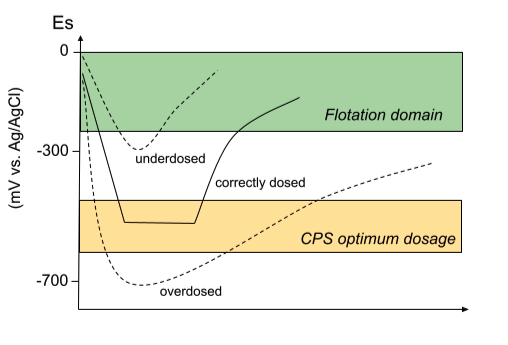
b) Different oxide minerals respond differently to sulfidization. This phenomenon is well-documented, some oxide copper minerals will float within certain limits of pulp redox potentials10, 11, 1, 4. These limits may be broad or narrow and slightly different for each oxide mineral, i.e. the CPS optimum dosage regime of Figure 1 varies for certain oxide Cu minerals. For example, malachite is sulfidized at Es of -500 to -400 mV at pH 9, requiring relatively short conditioning times, whereas other oxide copper minerals are sulfidized in the -600 to -500 mV range and require longer conditioning time; therefore, if applied blindly without consideration of mineralogy, sulfidization will simply fail to provide acceptable oxide copper recovery. For an ore containing several oxide copper minerals, it is common to have varying froth mineralization in different sections of the flotation circuit as the pulp potential changes. Chrysocolla is generally found to respond poorly to sulfidization-flotation, however, Syensqo offers AERO® OX-100 and AERO® OX-101 for its flotation with or without sulfidization. Many of the collectors used for copper sulfide flotation are also applicable for the flotation of sulfidized copper oxide minerals. Some collectors have been found to be particularly effective for sulfidized oxides. Examples of these include AERO® 407, AERO® 412, AERO® 3739, AERO® 3473, and AERO® 7152 often in combination with a small amount of xanthate.
The decision to recover oxide copper minerals from an ore depends on whether the ore contains sufficient oxide copper to be economically viable and whether such oxide copper is in a form that is amenable to flotation. It is often assumed that sulfidization-flotation is the preferred method for oxide copper recovery, but this is not necessarily valid until other options have been evaluated. For minerals that respond poorly to sulfidization, and consequently to flotation by use of thiol collectors, a family of collectors known as alkyl hydroxamates have been proven effective for their recovery as discussed in the next section.
Use of Alkyl Hydroxamates
A wide variety of collectors has been tested in the laboratory for oxide copper flotation without sulfidization. These include a large number of organic complexing agents, fatty acids, fatty amines, and petroleum sulfonates8, 9, 4. Except for a very limited use of fatty acids (which are quite non-selective) none of the proposed reagents has been used in an operating plant, because of high cost, consumption, and inadequate performance. Alkyl hydroxamates, on the other hand, are among the very few collectors that have shown significant promise. Syensqo has a long history in the design and manufacture of hydroxamate reagents, starting with the AERO® 6493 and AERO® 6494 collectors, first introduced in 1987.
Our new and improved line of alkyl hydroxamates are marketed under the trade name AERO® OX-100 series. Extensive laboratory studies and plant experience on a wide variety of oxide and mixed sulfide-oxide ores from around the world have shown that well defined oxide copper minerals such as malachite, azurite, cuprite, tenorite, pseudomalachite, atacamite, etc., are floated by the AERO® OX-100 family of products under the right conditions with or without sulfidization. For some ore types with favorable aquatic chemistry characteristics, high Cu containing chrysocolla was also shown to respond to AERO® OX-100. Certain copper occurrences in the ore, for example copper-containing goethite, are not amenable to flotation and they will not be recovered by AERO® OX-100 collectors. Knowledge of the Cu bearing species in oxide or mixed sulfide-oxide ores is thus critical to determining the amenability of recovery improvement with OX-100. Even if a species such as Cu-containing goethite were made to float, they would produce a very low-grade concentrate, which may not be a desired product (direct leaching is perhaps better in such cases). Experience has shown that any lack of performance with AERO® OX-100 promoter is usually attributed to mineralogical constraints in the ore. A microscopical examination verified by microprobe work, is strongly recommended before embarking on any flotation testing program. Relying solely on chemical assays of AS Cu will lead to erroneous conclusions and will prevent a meaningful cost-benefit assessment of AS Cu recovery by flotation. Due to similar reflective light microscopy characteristics, goethite and Cu-bearing goethite can easily be misidentified as cuprite by the untrained eye. Cu-bearing goethite will also report as acid soluble copper in chemical analyses. Misidentification of Cu-bearing goethite as cuprite will lead to the erroneous conclusion that cuprite is not recovered by alkyl hydroxamates7.
The AERO® OX-100 family of products should be added “neat” or “as-is”. At temperatures below 20oC , this collector may begin to solidify and it may be necessary to warm it slightly. For laboratory tests, AERO® OX-100 can be added to the float cell, either in the rougher stage along with the sulfide collector(s) and/or frother, or to the scavenger stage. The recommended conditioning time is 3 minutes. For plant evaluation, AERO® OX-100 can be added, either to the sump pumps or to the bottom of conditioning tanks (along with sulfide collectors, if this is the case), or to the scavenger circuit with the idea to maximize conditioning time. Appropriate addition points will have to be determined in the individual plants. The frother dosage and froth depth may need adjustment because AERO® OX-100 may have a slight tendency to enhance frothing on certain ore types. Addition of AERO® OX-100 promoter to the grinding mill is generally not recommended, in view of the fact that there is an iron-rich environment in the mill, which may cause loss of hydroxamates via complexation with iron species. With some ores, the hydroxamates will work better with sulfidization prior to the addition of hydroxamate, so test programs should include dosing AERO® OX-100 with low doses and high doses of NaHS/Na2S, as well as without sulfdidizing reagents. Testing various orders of addition is also recommended (for example, addition of AERO® OX-100 post sulfidization as well as pre-sulfidization).
Management of Gangue Minerals
Gangue species that readily generate slimes, for example clays, sericite, limonite, etc., may interfere with oxide copper flotation with hydroxamate and cause excessive frothing. One obvious solution would be to include a desliming step. If this is not feasible, then a dispersant such as sodium silicate, CYQUEST® 3223 or CYQUEST® 40E antiprecipitant may be necessary. These can be added either to the mill or to the flotation bank. They can also be stage-added. Typical dosages are 200-500 g/t for sodium silicate and 50-120 g/t for CYQUEST® 3223 antiprecipitant. Dispersant dosage must be selected carefully, because an excess of dispersant may hinder or even depress oxide copper flotation. Soda ash can be used as a dispersant and pH modifier in non-lime circuits. It is important to note, however, that oxide copper minerals slime easily, given that they are soft and ground fine, therefore, any desliming step may result in copper losses in the slimes fraction.
If the ore contains large amounts of pyrite or pyrrhotite, they may be depressed using sodium cyanide, sodium metabisulfite, SO2, or a combination of these. These depressants should be added prior to hydroxamate addition. Typical starting dosages are 25-100 g/t sodium cyanide, 100-400 g/t for sodium metabisulfite, and 500-1000 g/t for SO2. Again, the dosage of these depressants must be evaluated carefully because they can hinder oxide copper flotation.
Froth Characteristics
Observing the froth character associated with the use of AERO® OX-100 promoter is very important to assess its function. An excessive froth is indicative of one or more of the following:
- The dosage of the hydroxamate is too high.
- The ore has problematic gangue minerals, and use of a modifier is required.
- The ore has activated pyrite or pyrrhotite.
- The ore has large amounts of goethite (limonite), hematite, or magnetite.
- Insufficient conditioning time or complex aquatic chemistry issues has/have led to the adsorption of hydroxamic acid on the liquid air interface. In this case, it may be useful to explore both longer conditioning times, as well as flotation at slightly elevated temperatures.
If the froth has a tendency to flatten and additional frother does not help, it may be indicative of a more fundamental problem related to the adsorption of hydroxamate on undesired minerals.
Operating Range and Dosage
Optimum pH range for oxide mineral flotation with AERO® OX-100 collectors is 8.0-10.2. If a copper circuit is operating at pH values much greater than 10.5, this may pose a problem for effective use of hydroxamate. In such cases, addition of hydroxamate to the scavengers would be preferable, since the pH of the pulp in the scavengers would be lower than that in the rougher. Minor pH adjustment in the scavenger circuit may be possible, but pyrite flotation may be enhanced at lower pH values if xanthate is the collector. Alternatively, the entire circuit can be run at a lower pH by using a selective sulfide collector such as AERO® 5100 or AERO® XD-5002 promoters, and related collectors. This will not only be beneficial to the performance of hydroxamates, but will also result in savings in lime cost.
Dosage requirements will depend on AS Cu grade, value mineralogy, gangue mineralogy and process water chemistry. For example, ore with 0.2% AS Cu may require as little as 20-30 g/t of AERO® OX-100, whereas an ore with 2% AS Cu may require 100-500 g/t. Ores with large amounts of difficult-to-treat minerals like Chrysocolla, or problematic gangue mineralogy like calcite, dolomite, goethite, hematite, magetite, etc., may require even higher dosages. Note that it is typical to see large improvements even at low dosages, for example, in a multiple stage addition, one addition of 100 g/t may lead to a recovery in the order of 5%, a second addition would result in a further 5% recovery improvement and yet a third yield another 5% gain which is typical. The optimum dosage will depend on the oxide content of the ore, the nature and extent of iron-containing gangue and silicates, and the amount of pyrite or pyrrhotite present.
Leach-Precipitation-Flotation
In addition to sulfidization-flotation and alkyl hydroxamate flotation for oxide mineral recovery, there is the LPF process (Leach-Precipitation-Flotation). The ore is leached with sulfuric acid (which will also dissolve chrysocolla, if present) and the copper in solution is precipitated onto iron powder. The precipitated copper (and copper sulfide minerals, if present) is then floated in acid circuit. Perhaps the best collector for this application is AERO® MX-3048D promoter, which has been used commercially at pH 1.5. AERO® 6697 promoter has also been used in commercial operations.
Metallic Copper Flotation
Metallic copper, if present in the ore, responds readily to flotation, preferably in a low pH circuit. The most effective collector for recovery of metallic copper is AERO® 7152 promoter in conjunction with a frother like OREPREP® F-507. AERO® 31, AERO® 7310, AERO® 404 and AERO® 407 promoters have also been used commercially with success.
References
- Castro, S., Goldfarb, J. and Laskowski, J.S. Sulphidizing reactions in the flotation of oxidized copper minerals, I. Chemical factors in the sulphidization of copper oxide." International Journal of Mineral Processing 1974, 1(2): 141-149.
- Corin, K.C., Kalichini, M., O'Connor, C.T., Simukanga, S. The recovery of oxide copper minerals from a complex copper ore by sulphidisation. Minerals Engineering 2017, 102:15-17.
- D.W. Clark, A.J.H. Newell, G.F. Chilman, P.G. Capps, Improving flotation recovery of copper sulphides by nitrogen gas and sulphidisation conditioning. Minerals Engineering, 2000, 13(12): 1197-1206.
- Deng, T., and Chen, J.. "Treatment of oxidized copper ores with emphasis on refractory ores." Mineral Procesing and Extractive Metallurgy Review 1991, 7(3-4): 175-207.
- Jones, M.H. and Woodcock, J.T. Optimisation and control of laboratory sulphidisation of oxidised copper ores with an ion selective electrode. Proceedings of Australasian Institute of Mining and Metallurgy 1978, 266:11-19.
- Jones, M. H., Wong, K.Y., and Woodcock, J. T. Controlled-potential sulphidization and rougher-cleaner flotation of an oxide-sulphide copper ore. Melbourne, Congress/Australasian Institute of Mining and Metallurgy, 1986.
- Lee, J., Nagaraj, D.R., and Coe, J. Practical aspects of oxide copper recovery with alkyl hydroxamates. Minerals Engineering 1998, 11(10):929-939.
- Nagaraj, D. R. and Somasundaran, P. Chelating Agents as Collectors in Flotation: Oxime - Copper Minerals Systems. Mining Engineering 1981, pp.1351-57.
- Nagaraj, D. R. The chemistry and application of chelating or complexing agents in mineral separations, Chapter in Reagents in Mineral Technology. Editors: Somasundaran, P. and Moudgil, B.M., Marcel Dekker, New York, 1987 Chapter 9: 257-334.
- Nagaraj, D.R. and Gorken, A. Potential controlled flotation and depression of copper sulfides and oxides using hydrosulfide in non-xanthate systems. Canadian Metallurgical Quarterly 1989, 30(2):79-86.
- Soto, H., and J. Laskowski. "Redox conditions in the flotation of malachite with sulphidizing agent." Trans. Inst. Min. Metall. C Miner. Process., Extract. Metall 1973, 82: C153-C157.