
Executive Summary
Improving the recovery of fine particles has been a longstanding challenge in flotation for many years. It is recognized that a low rate of successful bubble-particle interactions is responsible for low flotation kinetics and consequently, recovery. The poor interactions between bubbles and particles can be related to the low inertia possessed by particles approaching sizes in the order of around 10 microns. In addition, the poor bubble-particle contact can be exacerbated by unfavorable surface chemistry conditions of the particles, for example, due to oxidation and/or presence of intrinsic and extrinsic hydrophilic species at the surface. Many have been the approaches taken, both chemical and physical, in order to improve flotation kinetics in this small particle size regime. Chemical strategies include enlargement of particle sizes in its many forms (flocculation, coagulation, etc.), carrier flotation, use of extenders, to name a few. Physical means include increasing the specific energy input into the cell such that increased bubble-particle collisions result in greater flotation kinetics.
Another physical solution takes advantage of cavitation in order to promote nucleation of gas at the particle surface in the form of microbubbles which in turn interact better with the bubbles present in the cell from the normally dispersed air. The cited examples only represent a small set of the largely diverse ways to tackle the recovery of fines. In the following discussion the main ideas of these chemical and physical approaches are presented together with recommendations of Syensqo reagents that have been proven to work under the different conditions for the recovery of value fines.
General Comments / Majors Considerations
Achieving the desired recovery of value fine particles and avoiding the recovery of unwanted fine particles has been an ever-present issue in flotation of both sulfide and non-sulfide ores20, 1, 9, 3. Generation of fine particles is normally a result of overgrinding or regrinding of soft- and/or finely disseminated ores. The presence of fines in flotation leads to multiple problems that can range from loss of values to tailings streams, to dilution of concentrate grade by fine gangue, adsorption of reagents (leading to large dosage requirements or inefficacy), modification of pulp rheology, and froth stabilization or destabilization.
Fines that report to concentrates can do so by way of true flotation, carried by other (larger) particles, by entrainment, and/or entrapment. True flotation refers to those particles that possess enough hydrophobicity to adhere to air bubbles; the hydrophobicity in turn can be natural as in the case of talc, intentionally caused by the addition of selective collectors or unintentionally caused by non-selective collectors. The transport of fines by other particles into the froth can occur by heterocoagulation, by means of so-called “slimes coating” of values or other gangue, or it can be a result of piggy-backing of value fines on larger value particles by deliberate hydrophobization of the latter through the use of collectors, oils or a combination of both. Entrainment is the result of fine particles being carried in the wake of bubbles or otherwise in the aqueous films between bubble aggregates, a process that correlates directly with the amount of water that reports to the froth. Entrapment on the other hand refers to the carrying of fine gangue minerals by bubbles and bubble aggregates, however, in contrast to entrainment, this happens typically when fines themselves form higher structures and are carried as such into the froth. Our research has demonstrated a clear example of this mechanism, where reporting of chrysotile (a serpentine mineral) to the concentrate is due to the formation by the same of large fibrous structures, which in turn are carried as a network by bubble aggregates into the froth phase12, 13. These large mineral structures, when transported to the froth, will interfere with proper drainage of hydrophilic particles that would otherwise drop back into the pulp.
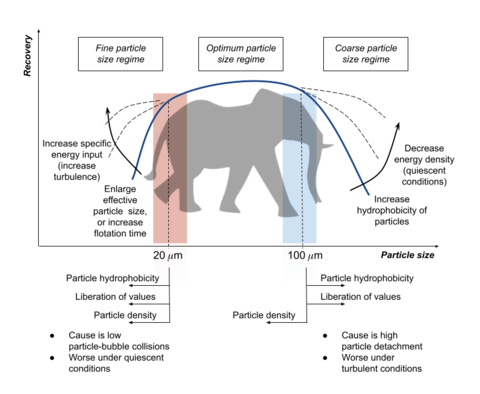
In fact, it is well-known that in conventional flotation cells there are limits to how small particles can be recovered by true flotation. Below this limiting size there is a drop-off in particle recovery. The same can be said of coarse particles that similarly have a limit in size above which their recovery falls significantly. These two phenomena result in the definition of a so-called “elephant curve” (particle recovery vs. particle size) as shown in Figure 18. The specific size at which fine value particles are poorly recovered is conditional and thus will depend on both chemical and physical factors as well as intrinsic properties of the ore in question but falls roughly between 5 and 20 microns. The accepted mechanism for poor fine value recovery is low effective collisions between particles and bubbles within the pulp. A fine particle possesses low momentum and therefore is often not able to penetrate the film of water between it and an approaching bubble.
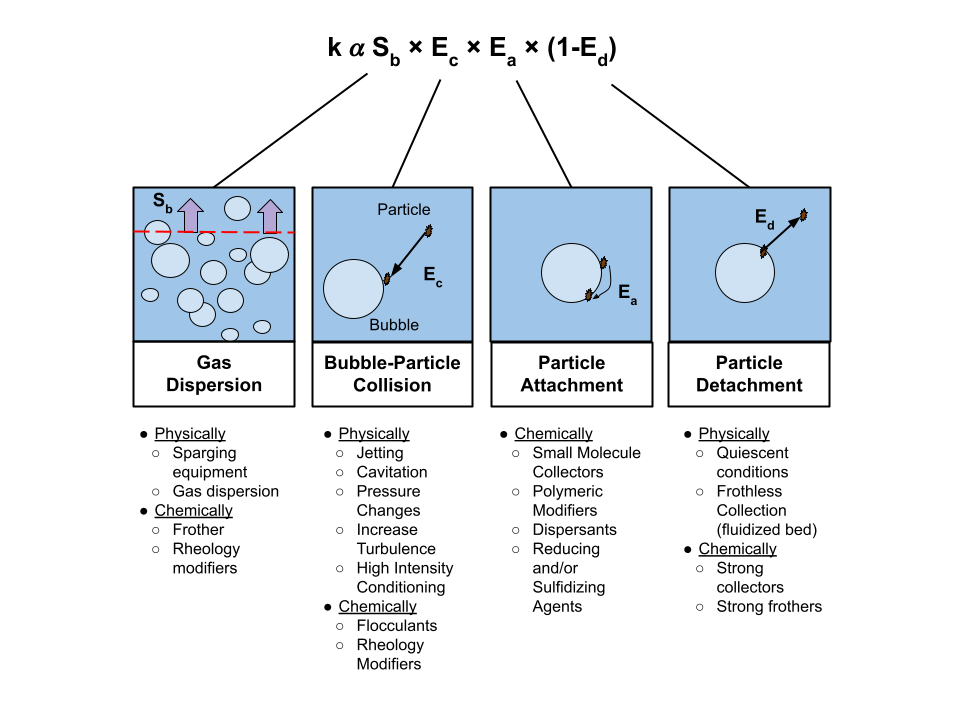
As shown in equation 1, the rate of flotation, k, of a given class of particles is known to depend on both gas dispersion (as given by the bubble surface area flux, Sb) as well as on probabilistic sub-processes that together make up the efficiency of particle collection by bubbles, Ecoll. Ecoll is comprised of the efficiency of bubble-particle collisions, Ec, the efficiency of particle attachment, Ea, and the so-called stability of the particle-bubble interaction, (1-Ed), where Ed is the efficiency of particle detachment from a bubble. These subprocesses are illustrated in Figure 2.

Therefore, in order to increase the rate of flotation of a given class of particles one needs to increase the contribution of either of the terms on the right hand side of equation 1. In the case of fine particles, the more relevant terms are the bubble surface area flux (Sb) and the efficiency of bubble-particle collisions (Ec). Thus, methods currently used seek to improve the recovery of fine particles by increasing the prominence of these two values: physically, through the use of new equipment and ways of contacting particles and bubbles in which high shear/high intensity agitation is used to promote particle-bubble collisions; as well as, chemically, through enlargement of the particle’s effective size by the use of, say, flocculants and/or through hydrophobization of particles by selective collectors (in the latter case, hydrophobization combined with high shear or intense conditioning is ideal).
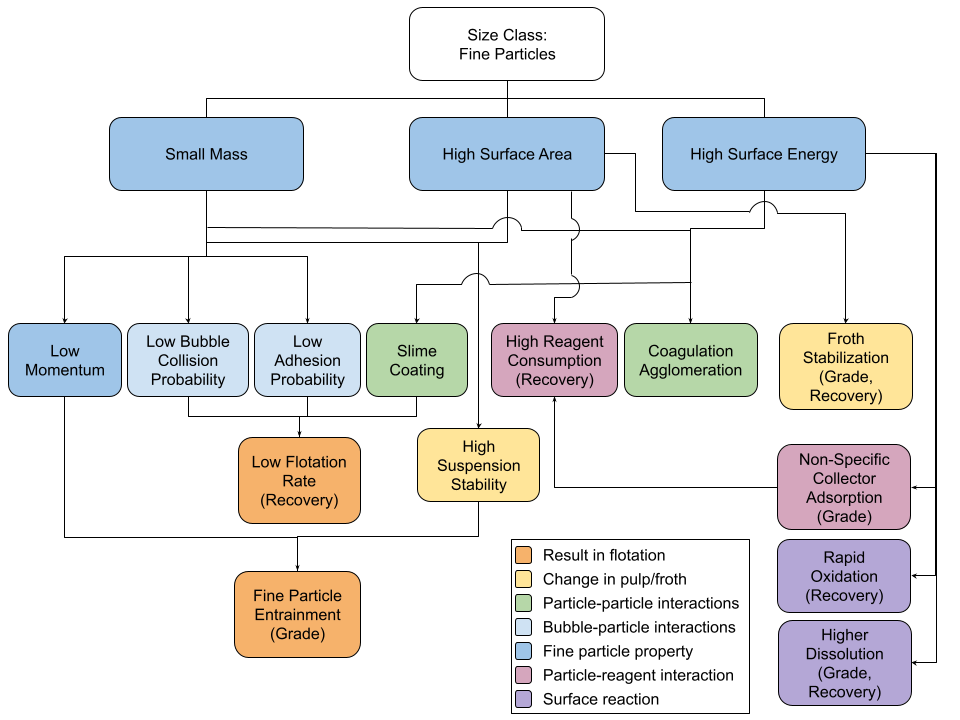
Fine gangue particles also lead to many issues that impact both value recovery and grade. Due to their small mass and low hydrophobicity, fine gangue particles will travel in the wake of bubbles and thus report to the froth by entrainment. This process in turn leads to downgrading of flotation concentrates. In like manner, some fine particles can aggregate to form higher structures thus increasing pulp and froth viscosity. The increased viscosity negatively affects gas dispersion and bubble-particle collisions leading to decreased flotation rates and recoveries. As mentioned previously, fine particles are also able to adhere to value particles by way of heterocoagulation, in which gangue and values have opposite charge and, as a consequence, value particles are rendered slow-floating. Due to the high surface area of fine particles, they are able to adsorb large quantities of reagent specifically or non-specifically resulting in large reagent dosages which, in turn, can result in other unwanted effects such as overfrothing, for example. These and other characteristics and processing impacts of fine particles are summarized in Figure 3.
Challenges Faced
The following is a list of the challenges faced when dealing with fine particles (both value and gangue):
- Fine value particles are locked in gangue and cannot be liberated without causing issues with fine gangue (e.g. clay) or overgrinding to ultrafine value particles.
- Difficulty in cleaning concentrates consisting of fine value and fine gangue particles.
- Poor cell hydrodynamics that lead to low bubble-particle collisions. This is due to the need of plants to run at ever higher throughputs because of the low value grades of ores processed, larger and larger cells are being used (e.g. 300-600 m3), which in turn distribute the energy input in a larger volume thus leading to insufficient energy for effective fine particle-bubble interactions. Therefore, for improved fine particle recovery, high specific energy input is required8.
- Under-dimensioned cells and cell banks that lack the long residence time required to float fine values.
- Loss of values to tailings as fine particles.
- Generation of large amounts of fine and ultrafine particles from overgrinding of soft and/or finely disseminated ores.
- Recovery of fine gangue is recovered by entrainment and dilutes concentrate grade.
- Large reagent consumption due to the high surface area of fine particles.
- Modification of pulp rheology due to fine particles forming higher structures (for example certain clay minerals).
- Stabilization of froth by fine particles resulting in overfrothing or persistent froth downstream. In turn, these conditions place constraints on increases in plant throughput or flotation efficiency.
Traditional Strategies / Syensqo Recommendations
Fine value particles
Bubble dispersion can be improved by modifying the manner in which gas is introduced into the pulp through changes in the flotation cell and its components (gas spargers, stators, etc.) and/or through the use of reagents such as frothers that allow attainment of optimum bubble sizes. Note that although small bubble size is usually sought, in a conventional flotation cell, there is a compromise between small, numerous bubbles and their low lifting force and low rising velocity which tends to be lower the smaller the bubble. In addition, they lead to higher recovery of water and, by association, to fine gangue particles carried over by entrainment3.
Increase of fine particle hydrophobicity normally results in relatively modest improvements in flotation rates or recovery of fine particles as such. However, hydrophobization of fine particles is more difficult due to the fact that fine particles are more prone to oxidation and are influenced in a more pronounced way by slime coating as compared to coarse particles. Slimes coating and oxidation of fine particles happens from exposure to slimes during grinding or from prolonged contact in tailings ponds. This latter point is important when values are sought to be recovered from tailings waste. One way to reverse the effect of oxidation mechanically is by attrition or even sonication, however, attrition implies potentially generating even finer particles, although some novel flotation technologies make use of this effect as part of the dominating mechanisms for enhanced fines recoveries as will be discussed later. Another way is by sonication of the pulp, although this approach is somewhat impractical. A more fruitful strategy is to address the issue chemically by the use of reducing agents (e.g. NaHS) to reverse oxidation (i.e. by reduction and sulfidization) and dispersants to deal with slime coatings (e.g. use of sodium hexametaphosphate or sodium silicate).
Increasing the effective size of the particles is another way by which the recovery of value fines can be enhanced. In fact, it is established in the literature as well as in industrial practice that agglomerating fines into larger, floatable aggregates is the most effective and practical pathway for fine particle flotation19, 7, 17. Enlargement of fines into floatable aggregates has been demonstrated in the literature for coal, non-sulfide ores and sulfide ores. Aggregation of fine particles can be achieved through coagulation, polymeric flocculation, or hydrophobic flocculation. Except for coagulation, agglomeration will be used herein as a catch-all phrase for any approach to fine particle aggregation that exploits hydrophobic surface chemistry phenomena (this includes terms already mentioned like polymeric flocculation and hydrophobic flocculation, but includes others such as carrier flotation, floc-flotation, shear flocculation, emulsion flotation, etc.). All these terms pretty much describe similar phenomena and are a result of varying nomenclature used in the literature, although, if anything, they may be differentiated on the basis of some operational details.
Coagulation is carried out by adding electrolyte which will decrease the electrostatic repulsion between charged particles. Coagulation is also tied to pH where it has been observed that maximum aggregation of sulfides generally occurs around the isoelectric point of a particle3. One issue with this technique is that it can also cause heterocoagulation, i.e. the joining of particles of different charge including undesired interactions like those of value and gangue minerals. One way suggested to reverse this effect is through dispersion processing of the ore prior to flocculation by other means17. The dispersion can be achieved by the use of dispersants, preferably at the grinding stage. In general, however, coagulation alone is considered a non-specific technique and because specificity is paramount in flotation, this approach is rarely or never practiced in flotation. Flocculation by polymers can be achieved by the selective adsorption of functionalized polymers onto the fine particles of interest. The polymers then serve as bridges between particles and cause their agglomeration into larger aggregates. On the other hand, hydrophobic flocculation works in a slightly different manner, whereby a non-polar oil is used as a so-called “extender” in which said oil interacts with the adsorbed layer of collector at the surface of a targeted mineral, effectively enhancing the particle’s hydrophobicity and promoting aggregation between particles. This aggregation occurs due to capillary effects from adsorbed oils or collectors. An example of this effect was shown for a Cu-Pb-Zn ore from Rey de Plata in which, due to their excellent selectivity for galena and chalcopyrite against zinc and iron sulfides, AEROPHINE® 3418A and AEROFLOAT® 241 were used as the collectors, kerosene as the extender oil, and zinc sulfate (ZnSO4), sodium sulfite (Na2SO3) and sodium cyanide (NaCN) were added as depressants for sphalerite and pyrite16.
Air bubbles can also play the role of hydrophobic entity at the surface through fine air “microbubbles” in the range of tens of nanometers to 10 microns that can form at hydrophobic sites on the particle surface. This process can be spontaneous by adsorption and nucleation of dissolved air molecules at the surface or intentionally by lowering the pressure of the water (through cavitation or otherwise). The particles then aggregate with each other or to larger bubbles in the pulp through these nascent bubbles at their surface. The capillary forces that are responsible for these aggregation phenomena are large and in fact practically irreversible in such a way that aggregates keep their integrity under high shear or turbulent conditions. These aggregates then behave as would particles of larger size and as a result are able to collide with bubbles given their increased inertia. In conventional flotation, the main drawback of flocculation in general is that there is entrapment of gangue by the particle aggregates (and concomitant water) and therefore, concentrate grade tends to suffer as a consequence.
Despite there being a thermodynamic (i.e. energetically favorable) driving force for aggregation of hydrophobic particles, there is always a kinetic barrier to overcome for this aggregation to occur. One consequence of this is that the hydrophobic solids need to be present in great numbers for chances of aggregation to be significant (e.g. by operating at high solids). However, for a fixed amount of solids, it is well known that, in order to increase the rate of aggregation, large amounts of kinetic energy in the form of high shear are helpful. This is the basis of techniques such as high intensity conditioning, in which aggregation of fine hydrophobic (or paramagnetic/ferromagnetic) particles is promoted by increasing the rate of agitation in the cell4, 5, 10, 21 or otherwise increasing the energy per unit volume imparted to the pulp. This also helps in cleaning particle surfaces through mutual attrition, thus renewing oxidized or tarnished surfaces. One example of hydrophobic aggregation of fines plus increased kinetic energy through mechanical agitation was that of recovering Ag fines in the form of argentite in which AEROPHINE® 3418A was used as the selective collector and kerosene as the extender oil2. Similar examples of agglomeration of molybdenite fines by use of kerosene and intense agitation can be found in the literature18, 22.
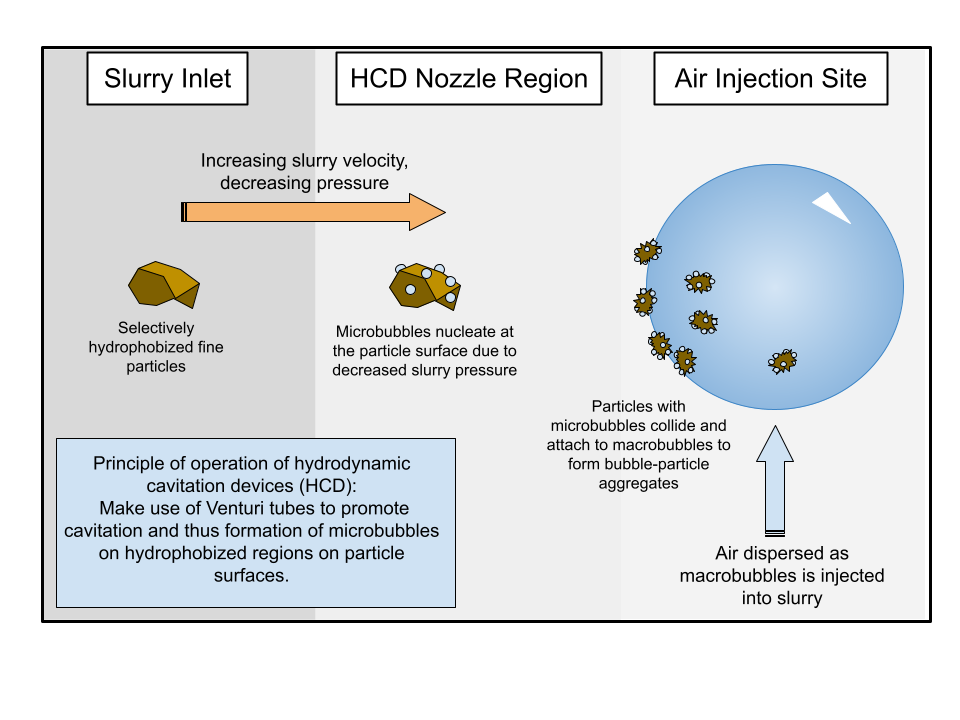
Newly available flotation equipment has sought to improve the rate of flotation of fine particles by addressing all of the challenges associated with their recovery. For example, the low probability of bubble-particle collisions is improved by contacting the flotation gas and the pulp in regions of high shear; examples include Prof. Jameson’s Concorde cell6, the StackCellTM by Eriez8, just to name a few*. In addition, the high turbulence of the slurry-air contact regions also promote cleaning of fine particle surfaces as well as agglomeration between particles. Other technologies make use not only of higher shear conditions but also of deliberately exploiting changes in cell pressure to promote formation of bubbles from the surface of fine particles as discussed earlier, the slurry is then contacted with dispersed air introduced into the flow cell at high pressures thus leading to intimate contact of these macrobubbles and the microbubbles generated on the particles themselves. Of course, selectively hydrophobizing the particles ahead of time is required for optimum performance as hydrophobic sites on the surface serve as gas nucleation sites for microbubble growth. Figure 4 shows conceptually how this process works. Examples of these so-called hydrodynamic cavitation devices include Eriez’s CavTube11 and GoldOre’s Mach reactor14.
One of the main reasons for flotation of fines through agglomeration hasn’t been widespread is that little effort has been made to combine reagent and equipment solutions, i.e. chemistry and physics, to work together for effective recovery of value mineral fines.
Fine gangue particles
Just as important as managing recovery of fine value particles is also the rejection (or negligible recovery) of fine gangue particles. As was discussed earlier, due to either large quantities in the ore or their low density, or both, fine gangue particles will tend to report to the concentrate by entrainment. This problem can be exacerbated by the wrong choice of frother or if the presence of fine gangue itself results in increased stability and persistence of the froth. Increased stability in the froth may be due to hydrophobic fine gangue minerals attaching to bubbles impacting directly the elasticity and strength of the bubbles themselves, or it can be due to hydrophilic fine gangue that increases the viscosity of the fluid between bubbles and thus retards water drainage. For the former case, fine hydrophobic gangue (e.g. talc), traditionally carboxymethyl cellulose is used for its depression; as an alternative, Syensqo recommends the use of a depressant such as AERO® 8860GL. For the latter case, fine hydrophilic gangue (e.g. kaolinite), Syensqo offers our line of froth modifier OREPREP® D-202HMW that has demonstrated exclusion of water from the froth phase and consequently of gangue that comes by entrainment. Of course, one way to deal with entrained hydrophilic gangue operationally is by cleaning in a column cell whereby there is a deep froth and which includes wash water, both of which promote good separation between gangue and values as well as enhanced drainage of the froth. Ultrafine gangue can also adsorb onto the surfaces of value particles, thereby slowing down the kinetics of flotation or even resulting in their depression. The mechanism of adsorption is typically electrostatic in nature and therefore dispersion or coagulation are good strategies to adopt as a remedy to sliming issues. Use of Syensqo's CYQUEST® 3223, CYQUEST® 40E or CYQUEST® 4000 is recommended for dispersion (choice depends on pH and presence of Ca2+ or Mg2+ ions in solution); CYFLOC® C-592 added to the grind is our recommendation for coagulation of delaminated clay or silicate minerals. Naturally, sodium silicate can also be an option as dispersant where applicable. Operationally, one can also mitigate sliming by desliming the pulp prior to flotation, this can be achieved with large clusters of small hydrocyclones, an approach that is taken, for example, by the large nickel sulfide operation at Mt. Keith in Western Australia15. Lastly, fine gangue minerals can be transported to the froth by entrapment, i.e. carried on top of bubbles or bubble aggregates to the froth. This phenomenon occurs due to the formation of higher structures from fine particles, an example of which is chrysotile, a serpentine mineral that forms large fibers (asbestos). Unfortunately, neither depression nor dispersion are able to help in these cases, except for maybe preventing delamination during grinding. Our group has published on this topic12, 13.
*Syensqo does not seek to promote any particular technology over another and any mention (or exclusion) of proprietary technology including equipment or reagents not from Syensqo is made (or not) solely with the purpose of illustrating or supporting our discussion of the subject matter at hand.
References
- Ansari MI. Fine particle processing-A difficult problem for mineral engineers.
- Espinoza-Ortega, O., Song, S., Lopez-Valdivieso, A., Galindo-Murillo, F., Reyes-Bahena, J.L. Regrinding and floc-flotation of silver sulphide scavenger concentrate. Mineral Processing and Extractive Metallurgy. 2003, 112(2):90-4.
- Farrokhpay, S., Filippov, L., Fornasiero, D. Flotation of fine particles: A review. Mineral Processing and Extractive Metallurgy Review 2021, 42(7):473-83.
- Holder, R. K. Improvement in Copper and Silver Flotation at Hellyer Using High Energy Conditioning. 5th Mill Operators conference, 1994. Roxby Downs; Australia, Australasian Institute of Mining and Metallurgy: 153-160.
- Hussey, L., Thanasekara, H., and Kohmuench, J. The Application of High Intensity Flotation Technology at Mt Keith Nickel Concentrator. MetPlant 2017: Metallurgical Plant Design and Operating Strategies – World’s Best Practice. Perth WA: 259-278.
- Jameson, G.J. New directions in flotation machine design. Minerals Engineering, 2010, 23(11–13):835-841.
- Lu, S. and Song, S. Hydrophobic interaction in flocculation and flotation 1. Hydrophobic flocculation of fine mineral particles in aqueous solution." Colloids and Surfaces 1991, 57(1): 49-60.
- Mankosa, M.J., Kohmuench, J.N., Christodoulou, L., Yan, E.S. Improving fine particle flotation using the StackCell™ (raising the tail of the elephant curve), Minerals Engineering. 2018, 121:83-89.
Doi: https://doi.org/10.1016/j.mineng.2018.03.012. - Miettinen, T., Ralston, J., Fornasiero, D. The limits of fine particle flotation. Minerals Engineering 2010, 23(5):420-37.
- Musuku, B., Muzinda, I., Lumsden, B. Cu–Ni processing improvements at First Quantum’s Kevitsa mine. Minerals Engineering. 2016, 88: 9-17.
- Oliveira, H., Azevedo, A., Rubio, J. Nanobubbles generation in a high-rate hydrodynamic cavitation tube. Minerals Engineering. 2018, 116:32-4.
- Patra, P., Bhambhani, T., Vasudevan, M., Nagaraj, D.R., Somasundaran, P.. Transport of fibrous gangue mineral networks to froth by bubbles in flotation separation. International Journal of Mineral Processing 2012, 104:45-8.
- Patra P., Bhambani, T., Nagaraj, D.R., Somasundaran P. Dissolution of serpentine fibers under acidic flotation conditions reduces inter-fiber friction and alleviates impact of pulp rheological behavior on Ni ore beneficiation. Colloids and Surfaces A: Physicochemical and Engineering Aspects 2014 Oct 5;459:11-3.
- Ross, V., Singh, A., Pillay, K. Improved flotation of PGM tailings with a high-shear hydrodynamic cavitation device. Minerals Engineering, 2019, 137:133-139.
Doi: https://doi.org/10.1016/j.mineng.2019.04.005. - Senior, G.D., Thomas, S.A. Development and implementation of a new flowsheet for the flotation of low grade nickel ore. International Journal of Mineral Processing 2005, 78: 49-61.
- Song, S., Lopez-Valdivieso, A., Reyes-Bahena, J. L.and Lara-Valenzuela, C. Floc flotation of galena and sphalerite fines. Minerals Engineering 2001, 14(1): 87-98.
- Song, S. and Lopez-Valdivieso, A. Parametric aspect of hydrophobic flocculation technology. Mineral Processing and Extractive Metallurgy Review 2002, 23(2): 101-127.
- Song, S., Zhang, X., Yang, B. and Lopez-Mendoza, A. Flotation of molybdenite fines as hydrophobic agglomerates. Separation and Purification Technology 2012, 98: 451-455.
- Subrahmanyam, T. V. and Forssberg, K. S. E.. Fine particles processing: shear-flocculation and carrier flotation — a review. International Journal of Mineral Processing 1990, 30(3): 265-286.
- Trahar, W.J. A rational interpretation of the role of particle size in flotation. International Journal of Mineral Processing 1981, 8: 289-327.
- Valderrama, L. and Rubio, J. High intensity conditioning and the carrier flotation of gold fine particles. International Journal of Mineral Processing 1998, 52(4): 273-285.
- Yang, B., Song, S. and Lopez-Valdivieso, A.. Kinetics of hydrophobic agglomeration of molybdenite fines in aqueous suspensions. Physicochemical Problems of Mineral Processing 2015, 51(1): 181-189.
- Wang, B. and Peng, Y. The effect of saline water on mineral flotation - a critical review. Minerals Engineering 2014, 66-68:13-14.