
General Comments / Major Considerations
Molybdenum is found in nature in very small amounts, most commonly in low-grade, highly disseminated porphyry ores where it principally occurs as molybdenite (MoS2) and is recovered either as the predominant metal in quartz-porphyry ores or as a by-product in porphyry Cu ores. Molybdenum-copper porphyries are typically large in volume and account for more than 95% of the known molybdenum sources in the world8. The Mo grade in these Cu-Mo porphyries generally varies between 0.005% and 0.1% which makes flotation the only economically feasible process for recovering molybdenite from the other sulfide minerals, including pyrite as well as nonsulfide gangue minerals.
The typical flotation process for producing Cu and Mo concentrates from Cu-Mo ores involves two stages. In the first stage, the Cu-Mo ore is processed to produce a bulk Cu-Mo concentrate containing copper and molybdenum values. The bulk concentrate typically contains a range of other minerals including pyrite, galena, and As minerals as well as nonsulfide gangue minerals. This bulk concentrate is then processed in the second Cu-Mo separation stage to produce separate Cu and Mo concentrates by depressing the Cu minerals using and selectively floating molybdenite. The depressants used in the separation stage are also able to depress Fe, Pb and As minerals, which facilitates production of a high grade Mo concentrate with minimal penalty elements. A basic Cu-Mo separation scheme is presented in Figure 1 below.
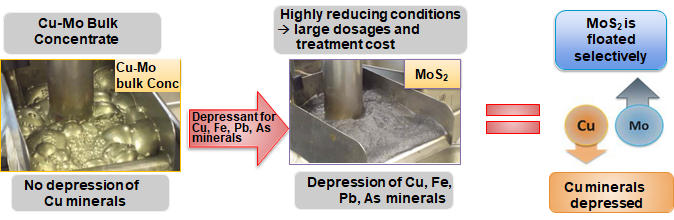
Figure 2 below shows a more detailed, yet simplified plant flowsheet of the Cu-Mo bulk flotation and Cu-Mo separation schemes, along with addition points of typical reagents (bulk flotation collectors and Cu sulfide depressants). Cu and Mo sulfide collectors, which are typically thiol and nonpolar hydrocarbon oils respectively, are utilized in the bulk Cu-Mo circuit to maximize recoveries. Attempts are made to minimize pyrite flotation into the Cu-Mo bulk concentrate by using lime at high pH in the bulk flotation cleaners. However, a small amount of pyrite invariably reports to the Cu-Mo bulk concentrate. The Cu-Mo bulk concentrate is often rich in Cu (>21%) but the Mo content, which is typically ~0.3 - 2%, must be upgraded further to produce a saleable final Mo concentrate. This is done in the Cu-Mo separation circuit, also colloquially called the “Moly plant”, through a selective process that involves addition of depressants to modify the hydrophobic copper minerals and pyrite, making them hydrophilic and depressing their flotation. The traditional, most commonly used Cu sulfide depressants work by desorbing or destabilizing the previously added Cu sulfide collectors. A few plants pretreat the bulk Cu-Mo concentrate by steaming to ~75 °C, acid conditioning, or aging/air oxidation in thickeners and tanks with the understanding that such methods aid collector desorption and/or decomposition. However, these practices are not widespread. Molybdenite, due to its inherent hydrophobic structure, floats strongly in the presence of the Cu sulfide depressants.
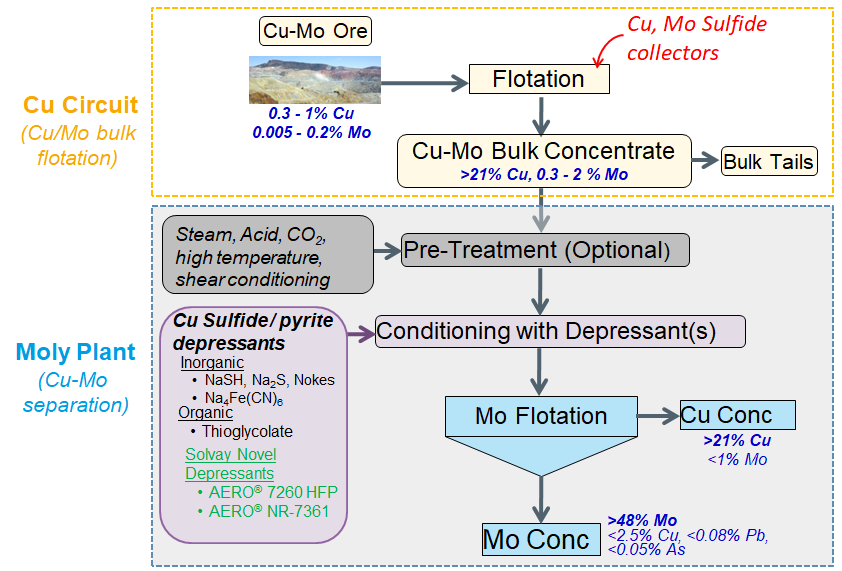
The rougher stage of the Cu-Mo separation stage produces the final Cu concentrate (depressed tailings stream) and a molybdenum rougher concentrate which is then upgraded in several stages to produce the final Mo concentrate. The main objective in the rougher stage is to maximize Mo recovery and depress as much Cu sulfides and pyrite as possible while the main objective in the cleaners is to upgrade the Mo rougher concentrate to target specifications. The final Cu concentrate can range in Cu grade from 21% if the Cu sulfide is predominantly chalcopyrite to >40% if the predominant Cu sulfides are the high Cu containing sulfides such as chalcocite. Target Mo grade in the final Mo concentrate is often >48% though some plants produce different lower grade concentrates depending on the smelter contracts. The content of Cu in the final Mo concentrate is often in the range of 0.8 - 2.5% though some plants have lower specifications (e.g. 0.45%) while some can afford to have higher amounts of Cu in the final Mo concentrate (e.g. 2.5-3.5%). In the latter case, it is common for the final Mo concentrate to be subjected to a ferric chloride leach (or sometimes a cyanide leach) to recover the copper. Some plants have specifications on the penalty element content (Pb, As) in the final Mo concentrate. The limits are dependent on the smelter contract. Typical targets are <0.08% Pb, <0.05% As.
The majority of the plants use inorganic, redox-active depressants such as sodium hydrosulfide, (NaSH) or sodium sulfide (Na2S). NaSH and Na2S are the same in function, efficiency and selectivity when compared on HS- or S2- (active ions) equivalence. These active ions are quite unique in that they are both strong reducing agents and lattice ions.
The following are the main requirements and considerations for effective depressants in Cu-Mo separation:
- Inorganic depressants such as NaSH or Na2S must destabilize and remove the previously adsorbed collector coating on Cu sulfides by controlling the pulp redox potential. The desorbed collector must not re-adsorb on the Cu sulfides. This is achieved in practice by maintaining highly reducing pulp potentials, typically in the range of -450 mV to -600 mV (measured against a Ag/AgCl reference) using high NaSH dosages. Being lattice ions, HS- from NaSH can also specifically adsorb on Cu sulfides and “swamp” the mineral surfaces with hydrophilic products.The activity of HS- in the pulp can be measured through the Oxidation Reduction Potential (ORP), which is synonymous with pulp potential, pulp redox potential or Ep. Thus, ORP measurement is an important dosage control strategy for NaSH application in the plant.
- Other types of depressants such as small organic or polymeric molecules must adsorb on the hydrophobic Cu sulfides (and pyrite) through some mechanism such as complexation in such quantities so as to create sufficient hydrophilic regions on the particles to prevent attachment to air bubbles.
- The depressants must also efficiently depress lead and arsenic containing minerals since Pb and As are considered penalty elements if present above specified concentrations in the final Mo concentrate.
- An important requirement is for the depressants to be very selective, i.e., they must only adsorb on Cu sulfides and pyrite without negatively impacting Mo flotation recovery and kinetics.
- Frothing properties of the depressants must not interfere with effective rejection of non sulfide gangue minerals which is required to produce a high grade Mo concentrate. The frothing properties must also not increase entrainment of Cu sulfides or pyrite into the Mo concentrate.
NaSH, being a redox-active reagent and a strong reducing agent, has significant impact when added to the flotation pulp. It hydrolyses and dissociates in solution which releases a large concentration of the active HS- ions into the pulp via the equation below. As well, the high concentration of OH- ions relative to the H+ concentration results in a very alkaline pulp, typically above pH 11.

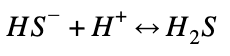
Maintaining a highly alkaline pulp is required to avoid formation of toxic H2S gas which can occur via the equation below at low pH (higher H+ concentrations).
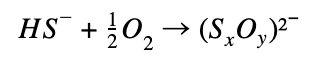
The HS- ions can also react with oxygen according to the equation below to produce various sulfoxy compounds [(SxOy)2-] that could negatively impact the Cu-Mo separation process.
The NaSH dosage requirements are quite variable across plants globally. Even in the same plant, NaSH dosages are often found to vary significantly. In general, the dosage is influenced by many factors. Often, a careful diagnosis of the process is required to pinpoint factors causing variation in the NaSH dosage. The most important factors driving NaSH dosage variability are:
- Mineralogy: Cu sulfide mineralogy as well as the amount of pyrite in the bulk Cu/Mo concentrate appear to be the most important factors. Castro3 noted that ores with secondary Cu minerals such as chalcocite and bornite tend to consume larger amounts of NaSH. Arinaitwe and Nagaraj1 tested a range of Cu/Mo bulk concentrates from one plant and concluded that the observed swings in NaSH performance were likely related to variations in mineralogical composition, feed grade, liberation, and oxidation of the concentrates. Oxidation becomes particularly important when chalcopyrite is the predominant Cu sulfide. The unique oxidation of chalcopyrite produces surfaces that tend to be sulfur-rich or metal-deficient and therefore very hydrophobic. Such surfaces are difficult to depress in Cu-Mo separation. High NaSH dosages and very long conditioning times would be required to restore hydrophilicity.
- Type of flotation gas, air flowrate and type of equipment: As mentioned above, high dosages are required when air is the flotation gas compared to N2. High air flowrates often result in higher dosages. In the cleaners where columns are typically used instead of mechanical cells, the amount of NaSH per tonne of Cu required to meet the set Cu content specification in the final Mo concentrate is typically high due to the higher NaSH at the high gas holdups in columns.
- Type of reagent scheme used in the bulk Cu-Mo flotation stage. Better Cu-Mo separation and a high quality final Mo concentrate is achieved with a selective reagent scheme type of reagent scheme used in the bulk Cu-Mo flotation stage.
- Plant water chemistry: Presence of high levels of Mg2+ and/or Ca2+ can lead to higher NaSH dosages.
The operating pH for Cu-Mo plants ranges from ~5.5 - 12, depending on factors such as mineralogy, water quality, bulk circuit operation, and cleaning capacity. However, the majority of the plants operate at high pH for safety reasons in order to avoid H2S generation or to sufficiently depress pyrite if it occurs in the bulk concentration in large amounts. Plants that operate at lower pH utilize CO2 or sulfuric acid to drop the pH of the bulk Cu-Mo concentrate.
Challenges Faced
NaSH has been the main Cu sulfide depressant used extensively in Cu-Mo separations for many decades. Although NaSH is an excellent Cu sulfide depressant, it possesses a number of serious problems and shortcomings accompanying its use. The challenges associated with use of NaSH can be grouped into four categories:
High treatment cost
For plants using air as the flotation gas, most of the NaSH added is wasted through air oxidation thus an excess amount has to continuously be added down the flotation bank in order to maintain sustainable depression of Cu sulfides and pyrite. The high overall dosages – typically in the range of 5kg to 30kg of NaSH per tonne of the Cu-Mo bulk concentrate – translate into high treatment cost. In some operations, the NaSH treatment cost can be as high as 30$/t.
Performance deficiencies in certain ore systems
The mineralogy of Cu-Mo concentrates can be quite variable, with some concentrates containing predominantly chalcopyrite, but others containing varying amounts of secondary copper minerals. Chalcopyrite is typically easy to depress except in certain cases when it gets oxidized and becomes highly hydrophobic (and therefore difficult to depress) likely due to the formation of elemental sulfur-like, metal deficient surfaces. On the other hand, secondary Cu minerals can sometimes prove more problematic to depress using NaSH, particularly if their relative proportions vary considerably. Pyrite can also be present in the bulk concentrate in high amounts particularly when it is activated by Cu ions which makes it very floatable in the presence of Cu sulfide collectors. Cu-activated pyrite is particularly difficult to depress even with very large NaSH dosages.
Safety hazards
Although NaSH is an excellent Cu sulfide depressant, it has the potential to generate high concentrations of hydrogen sulfide (H2S), which is a toxic, flammable, hazardous, and smelly gas; therefore, NaSH poses several SHE issues to the plant especially since it is used and handled daily in very large amounts. The amount of H2S produced from NaSH in solution increases as pH decreases, with a significant increase happening at pH below 8. Thus, NaSH cannot be used safely over a wide range of pH values, but instead must be used at high pH values, preferably above pH 10.5. Even at high pH, special (and costly) safety procedures are often required to avoid toxic H2S gas. A few plants, as mentioned above, condition the bulk concentrate with sulfuric acid to drop the pH to ~6 before adding NaSH. This creates a real risk for generating high concentrations of H2S. Additionally, there is the danger of stench and constant exposure of S compounds to plant personnel and to communities around the plants.
Logistical issues
The large dosages required for efficient performance (typically 20-40 tons per day of a 40% NaSH solution) present challenges in logistics and transportation of large amounts of the chemical to the plant site. This entails several truck loads or train cars per week. This is a major problem for flotation plants both in urban and remote areas. Some plants receive NaSH in flake form requiring solutions to be prepared daily and thus exposing operators to additional hazards. For plants located in colder regions, the volume of NaSH solutions handled in the plant increases in the winter seasons since very low NaSH solution concentrations, typically ~5-10 wt%, are required to avoid crystallization at low temperatures.
Given these challenges, industry is always seeking safer depressants that substantially reduce and/or completely eliminate the consumption of NaSH and provide better and consistent performance.
Traditional Strategies / Syensqo Recommendations
There are two main strategies for reducing NaSH consumption in the plant: non-chemical means and chemical technologies. Current non-chemical strategies include: a) switching from air to nitrogen thereby preventing NaSH oxidation and, b) use of “inert gas” option. The nitrogen option requires installation of a nitrogen plant which can require significant capital expenditure and the associated OPEX for maintaining the plant. Also, use of nitrogen does not eliminate the hazards associated with NaSH nor does it overcome the performance swings when using NaSH.
The “inert gas” option involves recirculation of the same flotation gas (typically air), so that oxygen depletes through contact with the sulfide minerals in the slurry. The use of “oxygen depleted gas” would then be expected to result in NaSH consumption equivalent to or close to the NaSH consumption when using nitrogen, though in our experience, this is not the case in practice. This strategy requires use of enclosed/sealed flotation cells and additional auxiliary equipment to manage H2S gas that can build up in the sealed cells and become a serious safety hazard. Our experience of plants operating with inert gas and enclosed/sealed flotation cells is that access to the cells is restricted to a very small opening which makes it difficult for operators to control the circuit. The efficiency of the “inert gas” system (in terms of NaSH reduction) is also fairly low since the relatively small amount of oxygen contained in the inert gas (in addition to dissolved oxygen) can have a significant influence on NaSH oxidation.
Even with the above non-chemical strategies, sustainability is at the forefront of Cu-Mo operations which are continually looking for other solutions to reduce hazards associated with NaSH usage. The operations are also looking for chemical solutions that can improve the efficiency of the separation and reduce the high treatment cost from high NaSH consumption.
A number of chemicals and strategies have been tested at lab and plant scale since the 1980s to replace NaSH. These include Nokes, disodium carboxymethyl trithiocarbonate9, sodium thioglycolate, sodium ferrocyanide, plasma treatment of chalcopyrite6, oxidation of chalcopyrite with H2O25. Only a handful of these chemical technologies, such as Nokes, disodium carboxymethyl trithiocarbonate, sodium thioglycolate, and sodium ferrocyanide, have been used in some plants intermittently. Nokes is made from the reaction of P2S5 and NaOH to form various thiophosphates and Na2S which gives it both complexing and reducing properties3. However, its reducing ability is much weaker than that of NaSH, thus it is used in a few plants typically in combination with NaSH. Sodium ferrocyanide (Na4[Fe(CN)6]) was first tested in Cu-Mo separation in the 1950s and in subsequent years, and found to be effective for secondary Cu minerals10, 11. It worked well under relatively oxidizing conditions and lower pH values (~pH 6-8), sometimes in combination with NaCN and ZnSO4. More recently, it was used in a few plants in combination with CuSO4 at pH ~6-7 but performance was not robust under varying ore conditions. Another issue with the usage of sodium ferrocyanide at lower pH is potential generation of hazardous hydrogen cyanide gas. Usage of sodium thioglycolate has been limited to only a few plants due to its poor dosage efficiently (it oxidizes under air conditions just like NaSH) as well as variable performance when used to treat different ores.
In general, Syensqo's vast experience in Cu-Mo separation since the 1980s indicates that available chemical technologies still present several challenges including limited robustness (unsatisfactory Cu and Fe depression on certain ores or negative impact on Mo recovery), high treatment cost, handling issues including odor, and hazardous gas generation.
Syensqo has been involved in seeking safer, sustainable and cost-effective alternatives to NaSH since the early 1980s. Fundamental studies and flotation studies on various molecules and Cu-Mo bulk concentrates by Nagaraj et al.7 resulted in a better understanding of the specific requirements for an effective Cu sulfide depressant and generated mechanistic ideas about the action of different types of depressants (redox active, complexing small organic molecules, complexing polymeric molecules). It was generally established that groups such as –SH and C=S that are active towards sulfide minerals along with hydrophilic groups such as –OH, -COOH, -CONH2 would be required for non reducing organic reagents to perform as superior depressants.
Several years of research involved development of molecules targeted to suit the practical requirements of Cu-Mo separation. These efforts resulted in development of the polymeric sulfide depressant AERO® 7260 HFP in 1989. The structural features of this water-soluble polymer (a mineral-specific functional group and a hydrophilic group) were tailored to make it an effective Cu sulfide and pyrite depressant7, 2, 1, 4. It is chemically and physically stable and less hazardous than traditional depressants since it does not generate toxic gases during storage, transportation, or under process conditions.
Despite the effectiveness of AERO® 7260 HFP as an excellent Cu sulfide and pyrite depressant at very low dosages, only 1/10th to 1/30th the dosage of NaSH, it requires the use of a reduced amount of NaSH, and it is thus a partial replacement for NaSH. AERO® 7260 HFP, on its own, performs well as a Cu sulfide and pyrite depressant even without the need to desorb the collector from the mineral surface. However, Mo selectivity is lost at the dosage required to achieve acceptable Cu sulfide and pyrite depression. Lab and plant experience have demonstrated that the right balance of depressant activity and selectivity can be obtained by modulating the dosage of AERO® 7260 HFP and using a small amount of NaSH. Since its introduction, it has been in commercial use globally in Cu-Mo plants for a range of purposes including the following:
- NaSH replacement: the polymer is able to replace up to 60% of NaSH using typical dosage ranges of about 100 g/t - 1000 g/t which results in significant cost savings.
- Mo grade improvement using ~50 -100 g/t in the cleaners .
- Reduction of penalty/toxic elements, arsenic and lead, in the final Mo concentrate.
- Enhancing pyrite depression in the cleaners using ~100 - 200 g/t.
In addition to the metallurgical benefits above, plants using the AERO® 7260 HFP/NaSH depressant system have reported fewer operational instabilities resulting from mineralogy and/or feed grade changes.
Syensqo has been able to build a vast knowledge base of practical aspects of the Cu-Mo separation process through various plant trials, commercialization, and optimization projects using the AERO® 7260 HFP/NaSH depressant system. Working with various global customers revealed that the operations were looking for more sustainable solutions that would completely eliminate 100% of the NaSH. This motivated Syensqo to start a large R&D program with an ambitious goal of developing an improved, safer and sustainable alternative to NaSH. A major requirement of the development process was to tailor the new molecule to suit the practical requirements of Cu-Mo operations. Specifically, we set out to answer three questions in order to address the limitations of current alternatives:
- Can we eliminate 100% of the NaSH?
- Can we design a depressant with more dosage efficiency (i.e. lower treatment cost) than NaSH?
- Can we eliminate or minimize the negative impact on Mo flotation, i.e., by developing a product with a wider operating window?
- Can we design a depressant that is easier to apply in the plant in comparison to the NaSH/AERO® 7260 HFP depressant system?
Syensqo's latest innovation, AERO® NR-7361 depressant technology, was developed with the above questions in mind, drawing on concepts and insights from our chemistry and plant practice experience. AERO® NR-7361 is chemically stable and thus does not release hazardous gases under a wide range of storage, transport or plant process conditions. For example, it can be used under a wide pH range of ~5 - 12.5 without concern for degradation that could generate hazardous H2S or CS2. It can also be used under air conditions without impact on dosage since it does not oxidize as does NaSH. These attributes make AERO® NR-7361 a safer, practical and sustainable alternative to NaSH.
Extensive plant testing under a range of plant conditions (see Table 1) has thus far demonstrated that AERO® NR-7361 is an effective Cu and Fe sulfide depressant and replaces 60-100% of the NaSH used in Cu-Mo separation. It is significantly more selective than AERO® 7260 HFP which provides operators a wider dosage operating window to apply the product without negatively impacting Mo recovery.
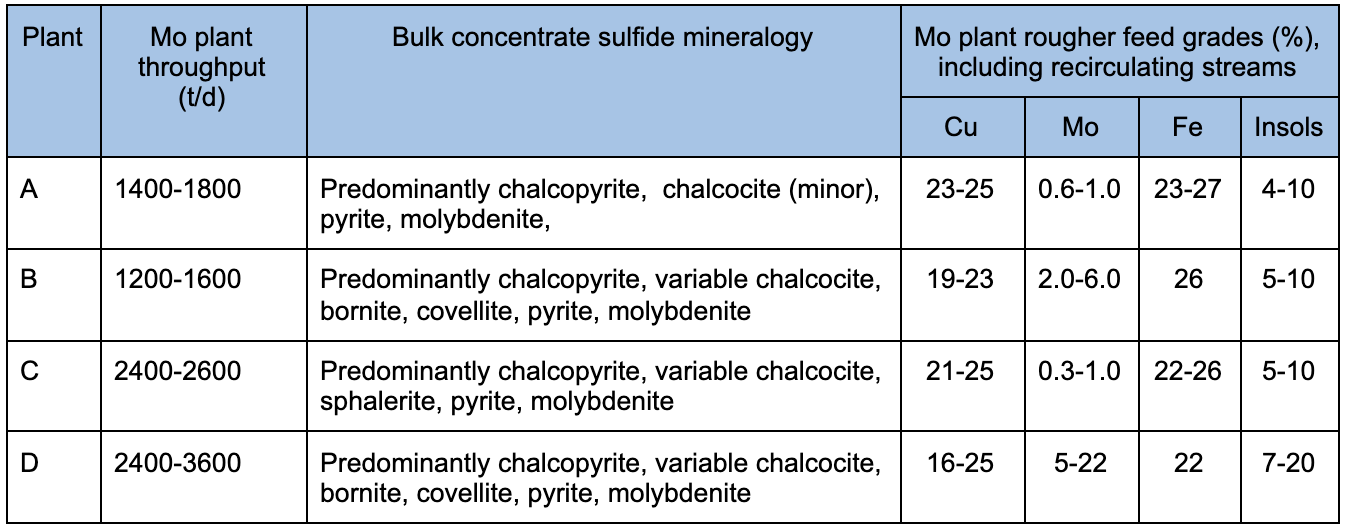
Prior to plant testing of AERO® NR-7361, Syensqo recommends a series of laboratory rougher tests using plant Cu/Mo bulk concentrates. The design and execution of a good laboratory program is essential in determining flotation conditions (e.g., conditioning time, dosage, pH) that provide optimum performance of AERO® NR-7361 with respect to certain metallurgical goals (e.g., rougher and cleaner metal recoveries and grades, dosage-effectiveness vs. NaSH). Two or three rounds of laboratory testing are usually recommended to cover the wide range of ore types and mineralogies and operating conditions (e.g. % solids) that are typically treated in the Mo plant.
In addition to rougher tests, rougher-cleaner, open circuit tests can be performed to determine the upgrading potential of AERO® NR-7361 in the cleaners. Two cleaning stages are typically appropriate, though more stages can be conducted to generate a final high grade Mo concentrate (>48% Mo).
Syensqo technical experts in Cu-Mo separation are available to discuss the laboratory tests required for evaluating AERO® NR-7361 against the plant benchmarks. The key conditions that should be evaluated in the laboratory are shown in Table 2 below:
Results from the lab program are then used to guide the design and execution of a plant trial where the focus is on applying the product on a large continuous scale and optimizing conditions to meet the plant metallurgical and economic targets.
Plant trials of AERO® NR-7361 in various Cu-Mo plants and commercialization in at least 1 large Cu-Mo operation in North America have so far generated an understanding of important practical aspects that have resulted in development of general guidelines for the use of AERO® NR-7361 as a full or partial NaSH replacement. Syensqo personnel are available to discuss the implementation of specific guidelines for a particular operation. In the plants where full NaSH replacement has not been possible, we have established that the small amount of NaSH (~10-30% of the typical NaSH consumption) is required for various reasons, for example, to counteract effects of different reagents used in the Moly plant or as a co-depressant particularly in the cleaners to achieve the final Mo concentrate grade.
In addition to the safety benefits of replacing NaSH with AERO® NR-7361, lab and plant tests have shown benefits in lower reagent treatment cost due to the lower AERO® NR-7361 dosage requirements (~1 - 4 kg/ton of Mo plant rougher feed) compared to the large NaSH dosage requirements (~ 5 - 40 kg/ton of Mo plant rougher feed). The main advantage of AERO® NR-7361 which allows it to perform as well as NaSH at much lower dosage lies in its ability to efficiently adsorb on Cu sulfides and pyrite via the mineral specific functional group without the need to desorb the collector from the mineral surface. On the other hand, large NaSH dosages are often required to not only desorb the collector from the mineral surfaces but to also maintain highly reducing pulp conditions needed to prevent collector re-adsorption. Additionally, plant experience with AERO NR-7361 has also shown that it is used at a much lower dosage per unit Cu in the cleaners compared to NaSH which is often used at large dosages regardless of the relatively small amount of Cu that reports to the cleaners.
It is common practice in many Cu-Mo operations to operate the Mo plant at highly alkaline pH conditions (>pH 11) specifically for safety reasons to avoid H2S generation. The increase in pH of the Cu/Mo bulk concentrate is often a result of the NaSH addition since the NaSH solution itself is maintained at very high pH (>12) for safety reasons. AERO® NR-7361, being a stable product in a wide pH range, is well-suited for use at much lower pH conditions than NaSH. Lab and plant tests have shown good performance and lower dosage requirements in the pH range of 5.5 - 8.5 thereby providing potential savings in lime or NaOH costs for plants that use a pH modifier to maintain high pH when using NaSH for safety reasons. The benefits of AERO® NR-7361 at lower pH have particularly been obtained when the pulp is conditioned with sulfuric acid as the pH modifier.
The synergistic use of AERO® NR-7361 depressant with a Mo collector such as Syensqo's AERO® MX-2410 helps to boost Mo recovery especially under plant conditions where there is limited rougher retention time or limited flexibility in the operational parameters that can be adjusted to improve Mo recovery. The use of AERO® MX-2410 in the Mo plant provides other benefits including a reduction in frother or diesel consumption and better froth drainage which promotes rejection of insols. This is particularly beneficial for plants that require high dosages (>100 g/t) of a relatively strong frother in the Mo plant to improve froth mobility and hence Mo recovery. It should be noted that AERO® NR 7361 is also beneficial in rejecting insols both in the roughers and cleaners, thus its use with AERO® MX-2410 should be considered for plants that treat Cu-Mo bulk concentrates with high insols.
Some plants operate or desire to operate the Mo plant roughers at high % solids (e.g. >40% solids) or have an issue with slimes that may impact Mo recovery. In such cases, the use of a suitable modifier, e.g. Syensqo's Cyquest® 3223 or a similar dispersant, in conjunction with AERO® NR-7361, is required to ensure acceptable Mo recovery.
An additional metallurgical benefit that has been observed commercially in a large Cu-Mo operation in North America is efficient removal of Pb impurities from the final Mo concentrate, allowing the plant to avoid smelter penalties. Based on the good Pb depression in Cu-Mo plants, AERO® NR-7361 has recently been applied in Cu-Pb separation at very low dosages (<100 kg/t) where it exhibits greater affinity to galena than Cu minerals, thus allowing it to be used as a very selective Pb depressant compared to starch.
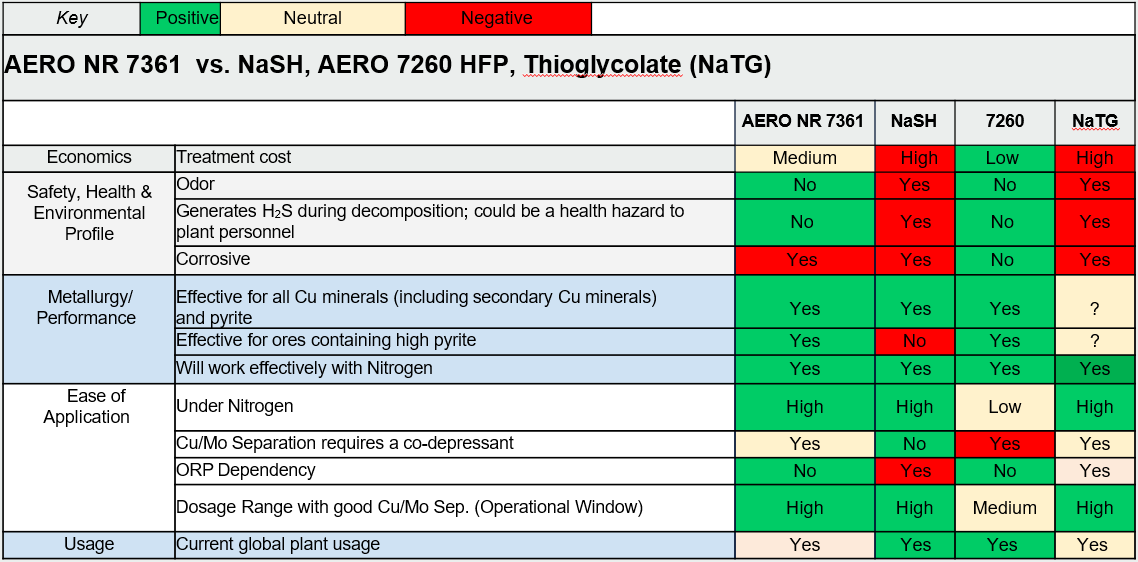
Lastly, Table 3 summarizes the safety, metallurgical and operational benefits of AERO® NR-7361 over existing technologies used in Cu-Mo separation. The comparison generally shows that Syensqo's depressants are the leading commercial sustainable technologies that can partially or fully replace NaSH.
Table 3. Benefits of AERO® NR-7361 vs. existing depressants
References
- Arinaitwe, E. and Nagaraj, D. R. 2015. Polymeric depressants as safe and efficient alternatives to NaSH in Cu-Mo separations: The role of mineralogy and flotation gas, SME Annual Meeting, Denver, CO, United States: Society for Mining, Metallurgy and Exploration.
- Bhambhani, T., Nagaraj, D. R., Gupta, P., Lawrence, A., Peart, M. and Zarate, P. 2014. Practical aspects of Cu-Mo separations and alternatives to NaSH and Nokes reagent. IMPC XXVII, Santiago, Chile.
- Castro, S., (1981), "Selective Flotation of Molybdenite: Depression Mechanisms of Chalcocite with Sodium Sulfide, Anamol-D and Nokes Reagent.", Developments in Mineral Processing 2 Part A., (Proc.Thirteenth International Mineral Processing Congress, Warsow-Poland), J. Laskowski, Ed., Elsevier, pp. 181.
- Mortensen, J., Castillo, G., and Lawrence, A. 2016. Reduction of NaSH usage in Kennecott molybdenum plant using AERO® 7260 HFP depressant, SME Annual Meeting, Phoenix, AZ, United States: Society for Mining, Metallurgy and Exploration.
- Hirajima, T.; Miki, H.; Pandhe, G.; Suyantara, W.; Matsuoka, H.; Elmahdy, A. M.; Sasaki, K.; Imaizumi, Y.; Kuroiwa, S. "Selective flotation of chalcopyrite and molybdenite with H2O2 oxidation" Minerals Engineering 2017, 100, 83.
- Hirajima, T.; Mori, M.; Ichikawa, O.; Sasaki, K.; Miki, H.; Farahat, M.; Sawada, M. "Selective flotation of chalcopyrite and molybdenite with plasma pre-treatment" Minerals Engineering 2014, 66-68, 102.
- Nagaraj, D.R., Wang, S.S., Avotins, P.V., Dowling, E. (1986) Structure-activity relationships for copper depressants, Trans. IMM, Sect C: Vol. 95, pp. 17-26.
- Sutulov, A. "Flotation Recovery of Molybdenum" Canadian Metallurgical Quarterly 1977, 16.
- Timbillah, S., et al. (2021). "Theoretical and experimental investigation of disodium carboxymethyl trithiocarbonate in Cu-Mo flotation." Minerals Engineering 169: 106943.
- Shirley, J. F. , By-Product Molybdenite Plant Design, Proc. Canadian Mineral Processors, Jan . 1981.
- Sutulov, A., Molybdenum Extractive Metallurgy, University of Concepcion, Chile, 1965