Solvent extraction (SX) plays a crucial role in the purification of essential metals such as copper (Cu), cobalt (Co), nickel (Ni), and lithium (Li). Its versatility enables the removal of metal impurities and the purification of desired metals across various stages, as demonstrated in the Cu production industry, Co/Ni separation and purification, or in the emerging field of electric vehicle (EV) battery production and recycling.
The successful design and effective operation of SX circuits, at the pilot plant or industrial scale level, rely on selecting the optimal reagent and suitable operational parameters such as number of stages, organic/aqueous ratios, reagent concentrations, etc. Additionally, precise pH control throughout the extraction, scrubbing, and stripping stages is essential to achieve desired metal recoveries and product purities. Circuit design and optimization requires extensive SX experience and laboratory and pilot-scale testing.
Syensqo's upgraded CYANEX® MINCHEM™ modeling program aids in circuit design, development, and optimization by evaluating various operational factors in fully integrated SX circuits. Its user-friendly interface facilitates efficient and quick modeling of complex SX circuits, reducing design time and costs. Syensqo’s modeling program utilizes lab generated equilibrium data for multiple metals and extractants to determine resulting metal concentrations and pH. By using the equilibrium calculations, the software takes into account metal exchange and selectivity achievable for a given circuit design, and by using standard chemical engineering calculations the program follows an iterative process to determine the circuit performance. The iterative process is completed around each extract, scrub, and strip cascades and then around the full process until an overall mass balance is achieved.
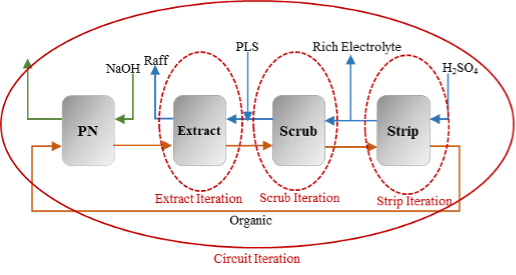
Currently, our modeling capabilities include applications using CYANEX® 272 for cobalt and related metals, CYANEX® 572 and CYANEX® 801 for rare earth elements and DEHPA® for Zn and common impurity metals. Syensqo's enhanced modeling program represents a significant advancement in SX circuit simulation.
The user inputs required for designing or optimizing an SX circuit may differ based on the project’s overall objective, but the general user inputs are summarized in Table 1.
Reagent Type | Scrub feed composition |
|---|---|
Reagent Concentration | Scrub acidity |
PLS metal composition | Strip feed composition |
PLS pH | Strip acidity |
Circuit configuration | Recovery target(s) |
Number of stages | Selectivity target(s) |
Extract, scrub and strip O/A ratio | Target(s) for final product |
% Pre-neutralization |
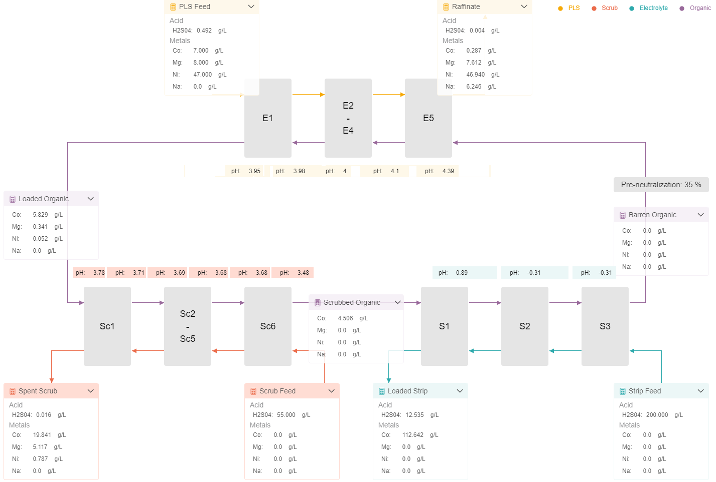
To illustrate Syensqo’s modeling capabilities, consider the simulation conducted for ‘Company A’, a high purity Co producer. The simulation was completed using a fully integrated SX circuit with pre-neutralization to assess the metal concentrations of the outlet solutions and operating parameters. The plant conditions are summarized in Table 2.
Reagent: CYANEX 272 | Scrub feed composition: No metals |
|---|---|
Reagent concentration: 25 vol% | Scrub acidity: 55 gpl H2SO4 |
PLS: 7 gpl Co, 8 gpl Mg & 47 gpl Ni | Scrub O/A: 15 |
PLS pH: 2.3 | Strip feed composition: No metals |
Circuit configuration: 5E + 6Sc + 3 S | Strip acidity: 200 gpl H2SO4 |
Extract O/A: 1.15 | Strip O/A: 25 |
% Pre-neutralization: 35% | No Mg in the Co rich electrolyte |
The steady-state results of the simulation are displayed in Figure 2. All the metal concentrations are listed in grams per liter (g/L).
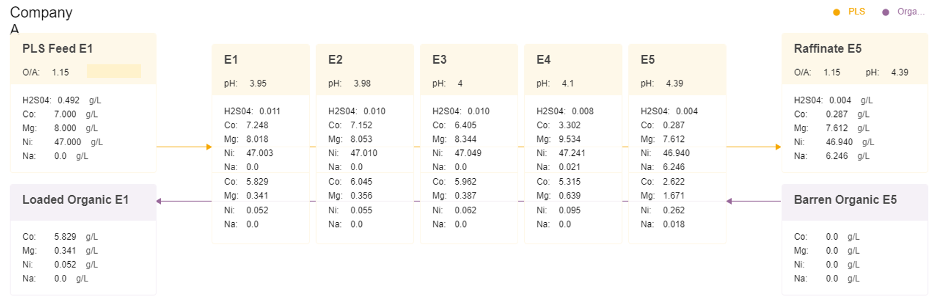
The simulation results from the extraction section indicate the Co recovery could be optimized by increasing the organic pre-neutralization or increasing the number of extract stages. The number of scrub stages is dictated by the strict Mg target in the scrubbed organic. It can be observed that 3 strip stages are sufficient to strip all the metals from the organic phase.
The aqueous and organic metal concentrations of all the inner stages of each cascade were also simulated and can be displayed. For example, Figure 3 shows the inner stages results for the extraction cascade.
Syensqo’s enhanced CYANEX MINCHEM® modeling program represents a significant advancement in SX circuit design, development and optimization, providing Syensqo customers, engineering firms and laboratories with design flexibility and significant time and cost savings. Contact your local Syensqo representative for more information of our modeling capabilities and extractants for solvent extraction design and optimization.