The objective for controlling the precipitation circuit is to maximize yield, while maintaining product soda, %-45 µm, and seed balance. Normally, the tools that you have to adjust the precipitation circuit are temperature, amount of seed, and size distribution of the seed. However, this is often not effective enough to maintain control of the product from precipitation. Crystal growth modifiers are surface active agents designed to help control the size distribution of the product from precipitation. When used in combination with the other variables for precipitation, crystal growth modifiers help maintain better control of this circuit, leading to a more consistent hydrate product. One possible mechanism by which these products work is that they control the precipitation of oxalate onto the growing gibbsite crystal, so that there is no poisoning of the crystal surface. The advantages of using crystal growth modifiers in the precipitation circuit are:
- Control or suppress nucleation (control the generation of fines)
- Enhance agglomeration (stick together small particles)
- Improve particle strength (strengthen agglomerates)
- Promote growth on large particles.
The crystal growth modifiers also can change the morphology of the sodium oxalate to give larger crystals in the shape of balls or large needles. This may be a benefit in some classification circuits, facilitating the separation of the precipitated oxalate from the alumina trihydrate.
Syensqo's crystal growth modifiers
The Syensqo products available are:
- CYQUEST® 120 processing aid
- CYQUEST® 170 processing aid
- CYQUEST® 174 processing aid
- CYQUEST® 178 processing aid
The crystal growth modifiers can be added almost anywhere in the precipitation circuit depending on the design of the circuit and the effect that is needed. Often, it is added at the beginning of precipitation to suppress secondary nucleation, and some add it to the fine seed slurry again to suppress secondary nucleation and enhance agglomeration. However, it can also be added later in the precipitation circuit to facilitate crystal growth, rather than nucleation, which leads to more fines being generated. CYQUEST® 120 is added at full strength at a dose of 15-40 ppm. CYQUEST® 170, 174, and 178 need to be emulsified in water via a high shear pump before being added to Bayer liquor, and its normal dose is 5-10 ppm29. The water used for the emulsion should be relatively clean with low hardness and no particulate matter.
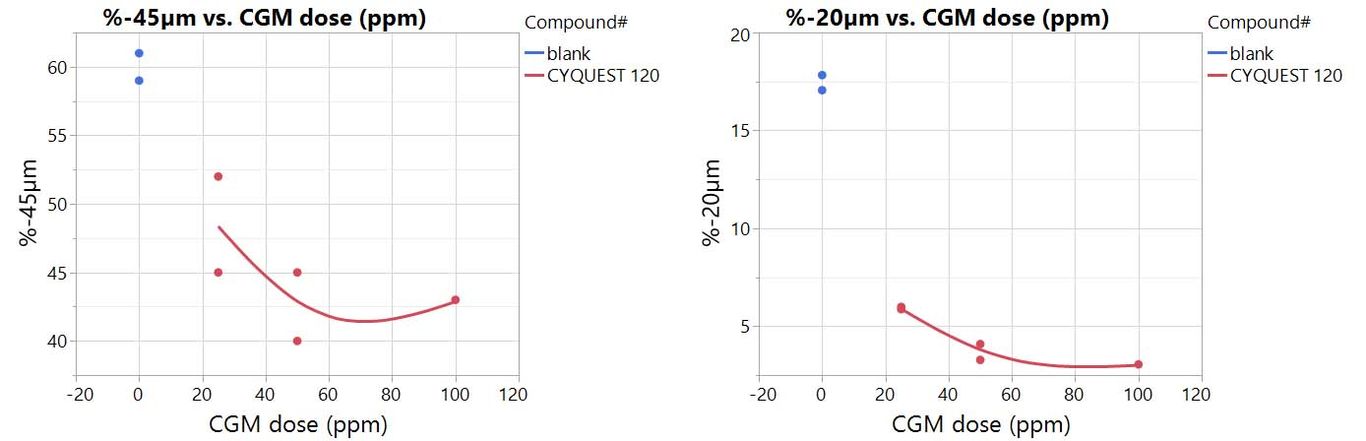
A typical lab test result of CYQUEST® 120 to coarsen the particle size of precipitate alumina trihydrate is shown in Figure 20. With the dosing of CYQUEST® 120, both the %-45µm and %-20µm of the precipitated alumina trihydrate solids reduced significantly, indicating the particle size coarsening.